kettlebell exercises for beginners
Kettlebell Exercises for Beginners: A Simple Plan That Actually Fits Your Equipment
New to kettlebells? Start with the right exercises, the right weight, and a simple plan you can actually repeat. This guide shows beginner-friendly kettlebell moves, common mistakes to avoid, and how GymPT adapts your workouts to the equipment you have.

Kettlebell exercises for beginners: start with the basics
If you are looking for kettlebell exercises for beginners, the best place to start is not with the hardest swing variation. It is with a few simple movements that teach you how to hinge, squat, carry, press, and brace your core. That approach builds strength while keeping the plan easy to repeat.
Kettlebells are useful because the offset load challenges balance, grip, and core control in a way that feels different from dumbbells or machines. That can make them a smart tool for full-body training, but beginners still need the right exercise order, the right weight, and enough practice to keep form clean.
Why kettlebells work well for beginners
A good beginner plan should do three things: teach movement patterns, build confidence, and leave room to progress. Kettlebells can do all three when you choose exercises that match your current skill level.
- They train multiple muscles at once. That makes each session efficient.
- They improve control. The handle position forces you to stabilize the weight.
- They scale easily. You can start with carries and goblet squats before moving to swings.
Harvard Health notes that kettlebells can improve strength, posture, and balance, while also carrying risks if you rush the load or use poor technique. That is why beginners should start with simple patterns and learn form before chasing intensity.
How to choose the right kettlebell weight
The best beginner kettlebell is the one you can control through the full range of motion without losing posture. There is no single perfect weight for everyone, but the load should let you keep your ribs down, spine neutral, and breathing steady.
- Too light: you may not feel enough challenge to learn tension.
- Too heavy: form breaks down and the exercise becomes a grind.
- Just right: you can complete all reps with clean technique and a little reserve.
If you are unsure, start lighter and let your plan progress over time. GymPT can adjust the plan based on your equipment, so you do not have to guess whether your kettlebell is enough for the day.
The best kettlebell exercises for beginners
These beginner-friendly movements cover the main patterns you need for a balanced plan. Start with the first four, then add the others as your confidence improves.
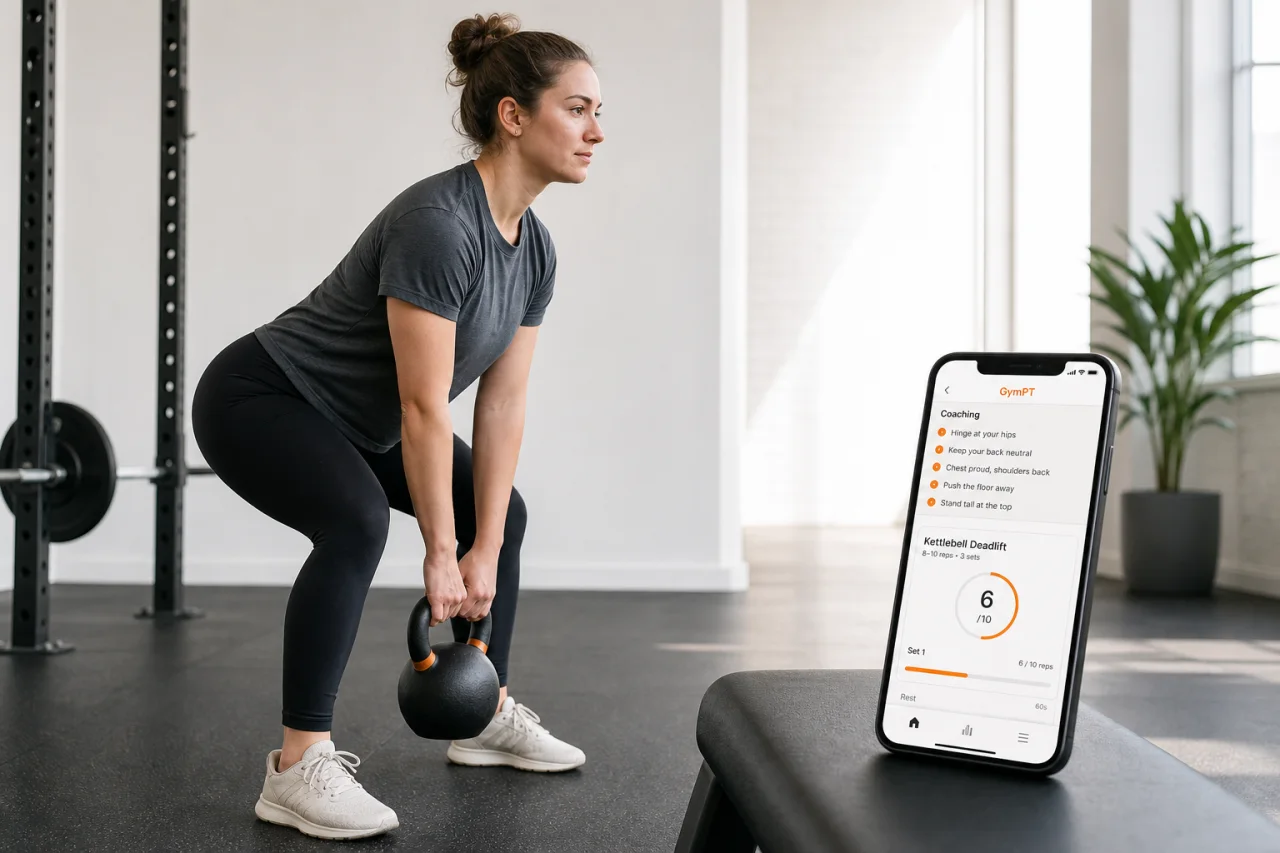
1. Kettlebell deadlift
This is the easiest way to learn the hip hinge. Place the kettlebell between your feet, push your hips back, brace your core, and stand tall by driving through the floor.
2. Goblet squat
Hold the kettlebell close to your chest and squat between your hips. The front-loaded position helps many beginners stay upright and learn better squat depth.
3. Suitcase carry
Hold one kettlebell at your side and walk with tall posture. This builds grip strength, trunk stability, and anti-side-bending control.
4. Two-hand kettlebell swing
Only add swings after you can hinge well. The swing is a powerful hip-driven movement, not a squat. Keep the bell close, snap the hips, and let the arms guide rather than lift.
5. Half-kneeling press
This is a strong beginner press variation because it reduces cheating and helps you feel core tension while pressing overhead.
6. Bent-over row
Use a stable hinge and pull the kettlebell toward your hip. Rows balance pressing work and help build upper-back strength.
NSCA technique resources and Harvard Health guidance both support starting with controlled, foundational movements before progressing to more explosive kettlebell work.
A simple beginner kettlebell workout
Use this as a starting point if you have one kettlebell and want a straightforward full-body session.
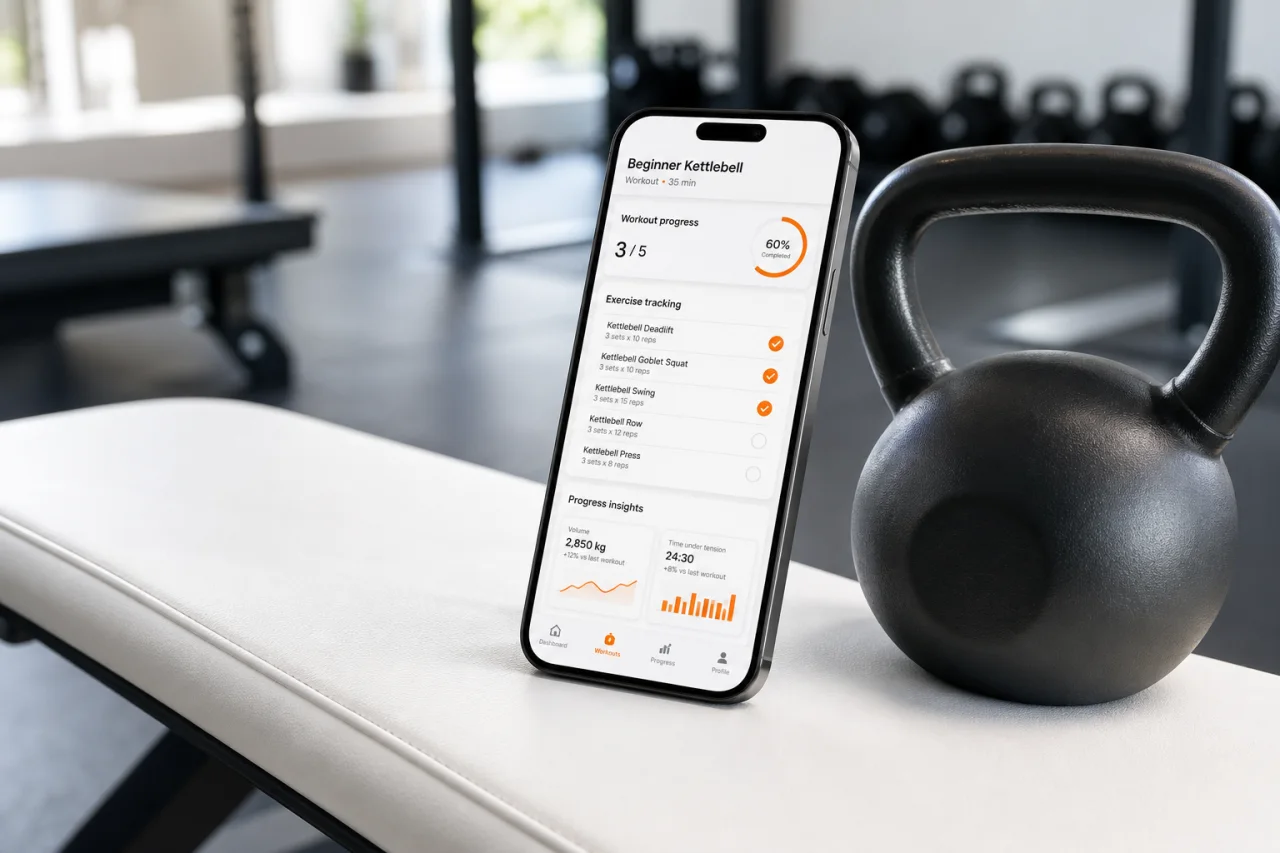
- Kettlebell deadlift — 3 sets of 8 reps
- Goblet squat — 3 sets of 6 to 8 reps
- Half-kneeling press — 3 sets of 6 reps per side
- Bent-over row — 3 sets of 8 reps per side
- Suitcase carry — 3 rounds of 20 to 30 seconds per side
Rest long enough to keep your form sharp. For most beginners, that means about 60 to 90 seconds between sets, or longer if your breathing is still elevated.
How to progress without overcomplicating the plan
Progress should feel boring in the best way. Add one small challenge at a time:
- add 1 to 2 reps per set
- slow the lowering phase
- add one extra set
- move to a slightly heavier kettlebell
- upgrade from deadlift to swing only after hinge mechanics are solid
This is where a personalized plan matters. GymPT can track what you lifted, how many reps you completed, and whether your next session should increase volume, load, or exercise difficulty.
Common beginner mistakes to avoid
- Starting with swings too early. Learn the hinge first.
- Using a weight that is too heavy. Technique should stay consistent across all sets.
- Rounding the back. Keep the torso braced and the spine neutral.
- Turning every workout into cardio. Beginners need control before speed.
- Skipping carries and rows. These build the stability that makes the bigger lifts feel better.
Harvard Health also highlights that lifting too much too soon or using kettlebells the wrong way can increase injury risk, which is another reason to keep the first phase simple and well structured.
How GymPT helps you train with the equipment you actually have
Not every beginner has the same setup. Some people have one kettlebell at home. Others train in a gym with a full rack. GymPT adapts to both.
- Equipment-based training: build a plan around one kettlebell or a full gym setup.
- AI coach chat: ask what to do if an exercise feels awkward or too hard.
- Workout tracking: log sets, reps, and load so progression is clear.
- Progress insights: see whether you are ready to add weight, reps, or a new movement.
- Body analysis: keep the plan aligned with your broader training goals.
If you want a beginner kettlebell routine that fits your schedule and your equipment, GymPT can turn the list above into a plan that is specific to you instead of generic.
Final takeaway
The best kettlebell exercises for beginners are the ones that teach strong movement patterns first and intensity second. Start with deadlifts, goblet squats, carries, rows, and controlled presses. Add swings only when your hinge is solid. Then let your plan progress one step at a time.
If you want help choosing the right exercises for the kettlebell you have, GymPT can build the plan, coach the form, and track the progress for you.
Suggested next step: open GymPT, select your equipment, and build your first beginner kettlebell session in minutes.