home workout with resistance band
Home Workout With Resistance Band: A Smarter Plan for Small Spaces and Steady Progress
A resistance band can do more than fill a gap in your routine. Learn how to build a practical home workout with resistance band exercises, progress it over time, and train effectively in limited space.

Home Workout With Resistance Band: the simplest tool for real progress
A home workout with resistance band is one of the easiest ways to train when you have limited space, limited equipment, or limited time. The band is light, portable, and versatile, but the real advantage is not convenience alone. It lets you train the major muscle groups with enough resistance to build strength, and you can make the workout harder by changing the band, your stance, your range of motion, or your tempo.
That matters because muscle-strengthening work should hit the major muscle groups at least two days per week, and resistance bands are a valid way to do that. For most people, the best home plan is not random band exercises. It is a simple structure you can repeat, track, and progress.
Why resistance bands work well at home
Resistance bands fit home training especially well because they solve three common problems: space, cost, and consistency. You do not need a rack, a bench, or a full gym setup to train your legs, back, chest, shoulders, arms, and core. You also do not need long sessions to get value from the work.
Another advantage is that bands make it easier to practice controlled reps. The tension increases as the band stretches, which encourages smooth movement and good positioning. That makes bands useful for beginners, busy lifters, and anyone who wants a low-friction way to stay on plan.
How to set up a band workout that actually progresses
The biggest mistake with band training is treating it like a random circuit. If you want steady progress, use the same basic pattern for several weeks and make one variable harder at a time.
Use this progression ladder
- Start with a band you can control for 8 to 15 good reps.
- Keep the same exercise until the last few reps feel challenging with clean form.
- Increase difficulty by using a thicker band, stepping farther from the anchor, slowing the lowering phase, or adding a pause.
- Track your reps and band level so you know when to progress.
If you can do 20 easy reps forever, the band is too light. If your form breaks down on rep 4, it is too heavy. The sweet spot is a controlled set that feels demanding near the end.
A simple full-body home workout with resistance band
This session is designed for small spaces and basic home setups. It works well as a full-body workout two to four times per week, depending on your schedule and recovery.
Workout A
- Band squat — 3 sets of 8 to 15 reps
- Band row — 3 sets of 10 to 15 reps
- Band chest press — 3 sets of 8 to 15 reps
- Band Romanian deadlift — 3 sets of 8 to 15 reps
- Band overhead press — 2 to 3 sets of 8 to 12 reps
- Band dead bug or Pallof press — 2 to 3 sets of 8 to 12 reps per side
Workout B
- Split squat with band support — 3 sets of 8 to 12 reps per leg
- Lat pulldown variation with band — 3 sets of 10 to 15 reps
- Push-up with band or band press — 3 sets of 8 to 15 reps
- Glute bridge with band — 3 sets of 12 to 20 reps
- Band curl — 2 to 3 sets of 10 to 15 reps
- Band triceps pressdown or extension — 2 to 3 sets of 10 to 15 reps
Rest 45 to 90 seconds between sets. If you want a more strength-focused session, use the lower end of the rep range and longer rest. If you want a more time-efficient session, keep the same exercises and shorten the rest slightly while preserving form.
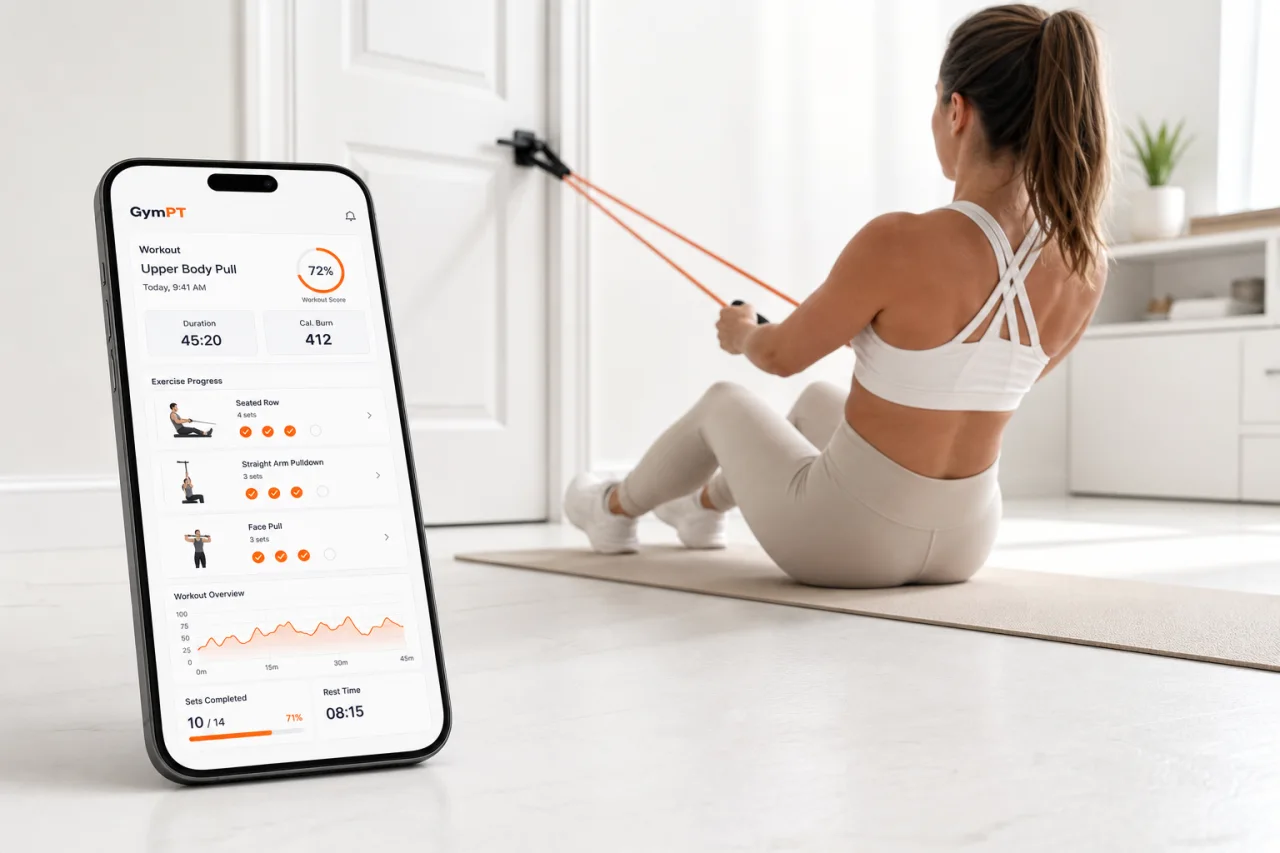
How to make band exercises harder without more equipment
You do not need a bigger home gym to keep improving. You just need better progression. Here are the most reliable ways to increase challenge with the same band:
- Change the band length by stepping farther away from the anchor.
- Slow the lowering phase to 2 to 4 seconds.
- Add a pause in the hardest part of the movement.
- Use unilateral work such as split squats, single-arm rows, and single-arm presses.
- Increase total sets when reps are already high and form is solid.
These small changes are often enough to keep a home workout with resistance band challenging for weeks or months.
Form cues that matter more than speed
Band training works best when you stay honest with the movement. Do not rush through reps just because the equipment is simple.
- Keep ribs stacked over pelvis during presses and rows.
- Brace lightly before each rep instead of leaning on momentum.
- Move through a controlled range that you can own.
- Stop a set when form changes instead of chasing sloppy reps.
If you want a useful rule: the last rep should look like the first rep, just slower and harder.
How often should you train with bands?
For general fitness, a practical target is two to four resistance sessions per week, depending on your recovery and schedule. That lines up well with public health guidance that adults should include muscle-strengthening activity at least two days per week. If you are also walking, cycling, or doing other cardio, bands can cover the strength side of the plan without taking much time.
If you are new to training, start with two full-body sessions per week. If you already train regularly, use bands for extra volume, travel weeks, or as a home-based main plan when gym access is limited.
How GymPT helps you stay consistent at home
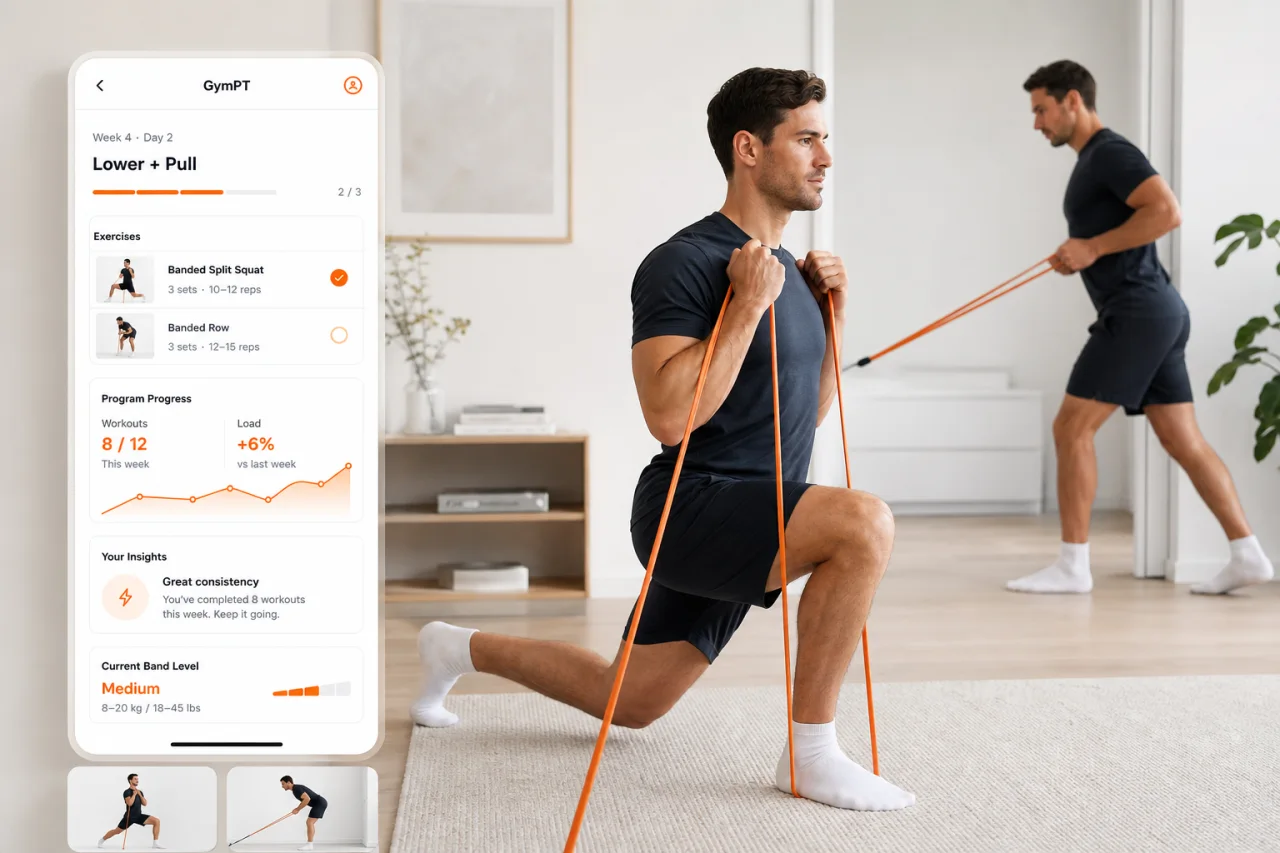
Home training gets easier when the plan is specific. GymPT can turn a resistance band into a structured program instead of a guess. You can build a personalized routine, log your sessions, and see when it is time to increase reps, change band tension, or adjust exercise selection.
That is especially useful if your space is small or your schedule changes often. Instead of wondering what to do next, you can follow a plan that fits your equipment, track progress, and keep moving forward.
Quick start plan for the next 4 weeks
If you want a simple way to begin, use this:
- Week 1: Learn the exercises and stop each set with 2 to 3 reps in reserve.
- Week 2: Add 1 to 2 reps per set where possible.
- Week 3: Add a set to one or two exercises, or slow the lowering phase.
- Week 4: Increase band tension or move to a harder variation.
That is enough to make a home workout with resistance band feel organized, repeatable, and productive.
Bottom line
Resistance bands are not a backup plan. Used well, they are a practical strength tool for home training. Keep the routine simple, train the major muscle groups, and progress one variable at a time. That is how a small setup becomes a real training plan.