smith machine exercises for beginners
Smith Machine Exercises for Beginners: A Smarter Way to Start Strong
New to the Smith machine? Learn beginner-friendly exercises, how to choose the right movements for your goal, and how to turn one machine into a simple, effective training plan with GymPT.

Smith Machine Exercises for Beginners: A Smarter Way to Start Strong
If you are looking for smith machine exercises for beginners, the goal is not to do everything at once. The goal is to learn a few stable, repeatable movements that help you train with confidence, build strength, and keep your form simple enough to improve week by week.
The Smith machine can be a useful starting point because the bar path is fixed, which can make some exercises feel easier to learn than free-weight versions. For beginners, that can reduce the number of moving parts while you practice basic patterns like squatting, pressing, hinging, and rowing. The best plan is still the one that matches your current strength, your gym setup, and your ability to recover between sessions.
Why beginners often do well with the Smith machine
Strength training guidelines recommend working the major muscle groups at least two days per week and building up gradually over time. A machine-based approach can help you do that with less setup and less guesswork, especially if you are still learning how to brace, control tempo, and choose a manageable load.
That does not mean the Smith machine is automatically better than free weights. It means it can be a practical tool when you want structure, stability, and a clear path to progression. For beginners, that often matters more than trying the most advanced version of an exercise first.
How to choose the right Smith machine exercises
Before you pick exercises, ask one simple question: what movement pattern do I need most right now? A good beginner plan usually covers these patterns:
- Knee-dominant lower body for quads and glutes, such as squats or split squats.
- Hip-dominant lower body for glutes and hamstrings, such as Romanian deadlift variations.
- Horizontal push for chest and triceps, such as bench press or incline press.
- Horizontal pull for upper back, such as bent-over rows.
- Accessory work for calves, arms, or core if you have time and energy left.
ACSM guidance on resistance training progression supports sequencing larger, multi-joint exercises before smaller isolation work, which is a smart way to organize a beginner session.
Best Smith machine exercises for beginners
Here are the most useful options to start with. Choose only a few, not all of them.
1. Smith machine squat
A strong beginner choice for legs and glutes. Set your feet so you can squat with control and keep your knees tracking comfortably over your toes. Start with a shallow range if needed, then build depth gradually as your position improves.
2. Smith machine split squat
This is a great option if bilateral squats feel awkward. It helps you train one leg at a time and can make it easier to notice side-to-side differences.
3. Smith machine Romanian deadlift
Use this to practice a hip hinge. Keep the bar close, soften the knees, and move from the hips rather than turning it into a squat. If you want a deeper hinge tutorial, our deadlift form guide is a useful next read.
4. Smith machine bench press
A beginner-friendly pressing option because the fixed path can make setup feel simpler. Keep your shoulder blades controlled, lower the bar with intent, and avoid bouncing the bar off your chest.
5. Smith machine incline press
This is a solid variation if you want a slightly different chest and shoulder emphasis. Use a lighter load than you would on flat pressing until the movement feels smooth.
6. Smith machine bent-over row
Rows help balance pressing work by training the upper back. Keep your torso stable and pull with control instead of jerking the bar.
7. Smith machine calf raise
A simple accessory move that is easy to learn and easy to progress. Use a full range of motion and pause briefly at the top and bottom.
A simple beginner Smith machine workout
If you want a practical starting point, try this full-body session 2 to 3 times per week:
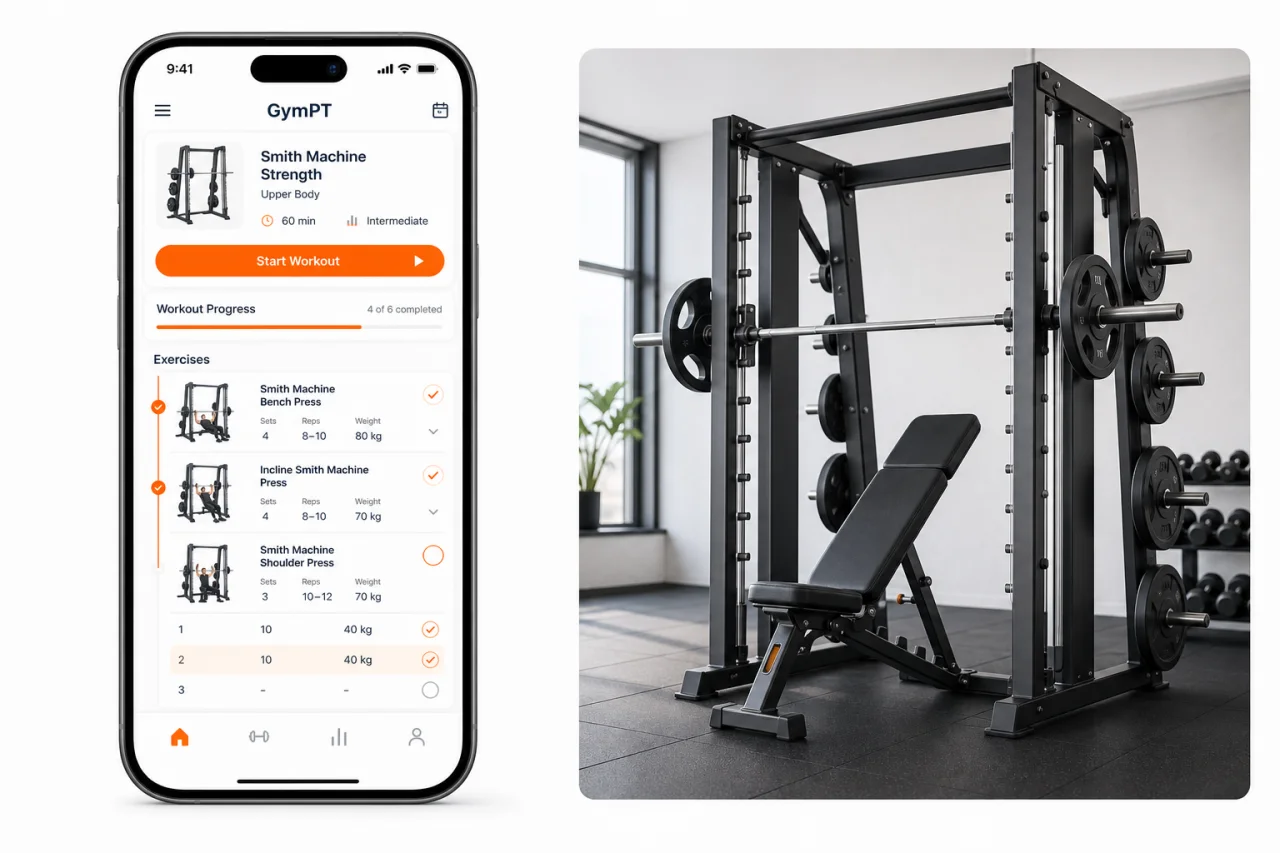
- Smith machine squat — 3 sets of 6 to 10 reps
- Smith machine bench press — 3 sets of 6 to 10 reps
- Smith machine bent-over row — 3 sets of 8 to 12 reps
- Smith machine Romanian deadlift — 2 to 3 sets of 8 to 12 reps
- Smith machine split squat — 2 sets of 8 to 10 reps per leg
- Calf raise — 2 sets of 12 to 15 reps
Rest long enough to keep your form clean. For most beginners, that means stopping each set with a little energy left rather than grinding every rep. NHS guidance also emphasizes building up slowly and increasing repetitions over time.
Form tips that matter most
- Set the bar height first. A bad setup makes every rep harder.
- Use a controlled tempo. Lower the weight with purpose instead of dropping it.
- Keep the load modest. Beginners usually progress faster when technique stays consistent.
- Do not force a range of motion. Use the depth and position you can control today.
- Stop if something feels sharp or wrong. General exercise guidance recommends stopping if you feel pain or become unwell.
One important note: the fixed bar path can be helpful, but it can also encourage awkward positions if your foot placement or bench setup is off. If an exercise feels unnatural, adjust the setup or switch to a different movement pattern instead of forcing it.
How to progress without overcomplicating things
Progress does not need to be dramatic. A beginner can improve by adding one rep, adding a small amount of weight, or making the movement slightly smoother from week to week. That is enough.
A simple progression rule:
- First, hit the top of your rep range with good form.
- Then, add a small amount of weight next session.
- If form breaks down, keep the load the same and clean up the movement.
This approach fits the broader resistance-training principle of gradual progression and exercise sequencing that prioritizes quality over ego.
How GymPT helps you build the right plan around your equipment
The smartest beginner plan is not just a list of exercises. It is a plan that fits the equipment you actually have, your current experience level, and the time you can train each week. That is where GymPT helps.
With GymPT, you can:
- build a workout plan around the Smith machine and other available equipment,
- get exercise choices matched to your goal,
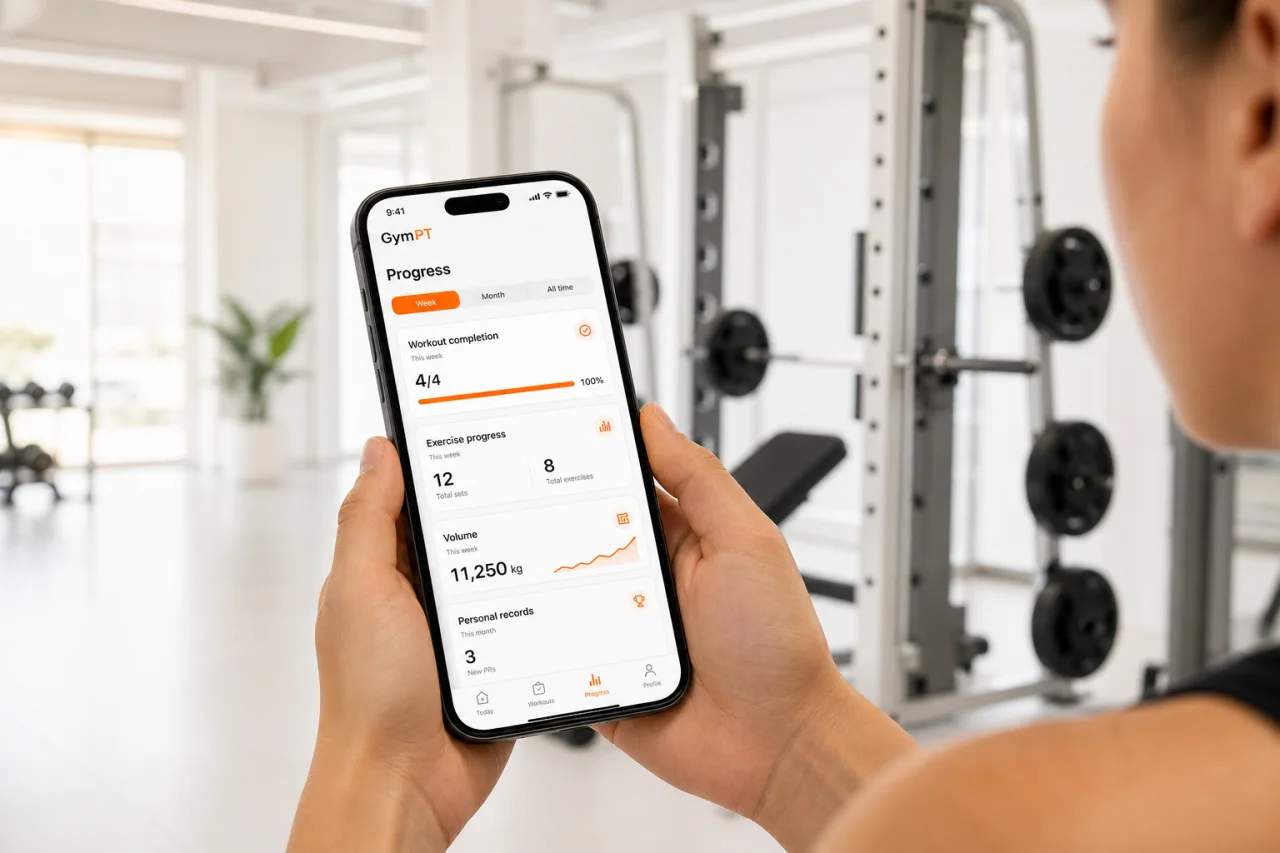
- track workouts and progress over time,
- use AI coach chat to adjust your plan when an exercise feels too hard or too easy, and
- see progress insights so you know what to change next.
If your gym has a Smith machine but not much else, GymPT can still create a balanced plan. If you also have dumbbells, cables, or a leg press, it can mix those in without making the workout more complicated than it needs to be. For a broader comparison of training tools, see our free weights vs machines guide and our dumbbell vs machine workout article.
When to move beyond beginner Smith machine work
You are ready to expand your plan when the basics feel stable: you can set up quickly, repeat your reps with control, and recover well between sessions. At that point, you can add more free-weight work, more unilateral training, or more advanced variations.
That transition should be gradual. The best beginner program is one you can repeat consistently long enough to get better at it.
Bottom line
Smith machine exercises for beginners work best when you keep the plan simple: pick a few core movement patterns, train them consistently, and progress slowly. Use the machine as a tool for learning good positions and building confidence, not as a shortcut around good training habits. If you want a plan that adapts to your equipment and your pace, GymPT can help you turn one machine into a complete routine.