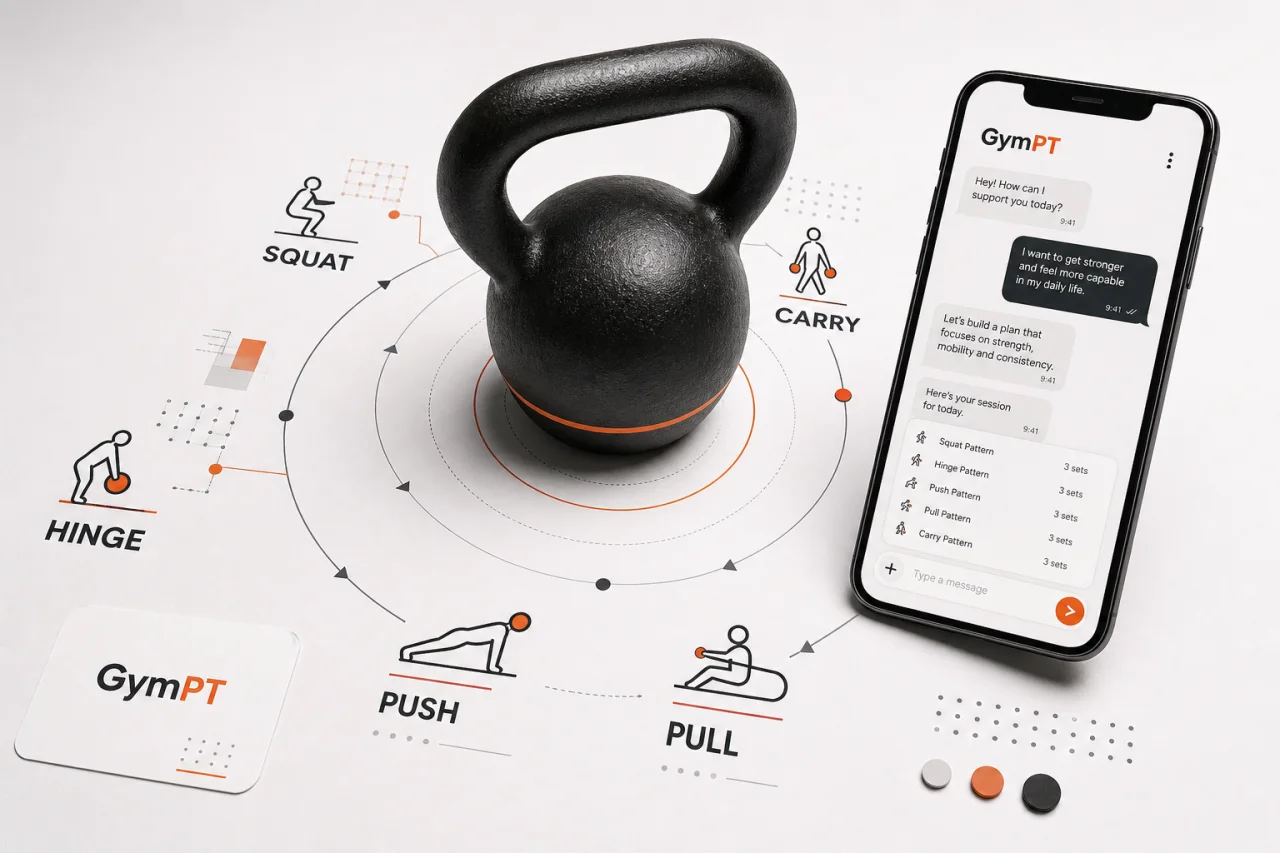
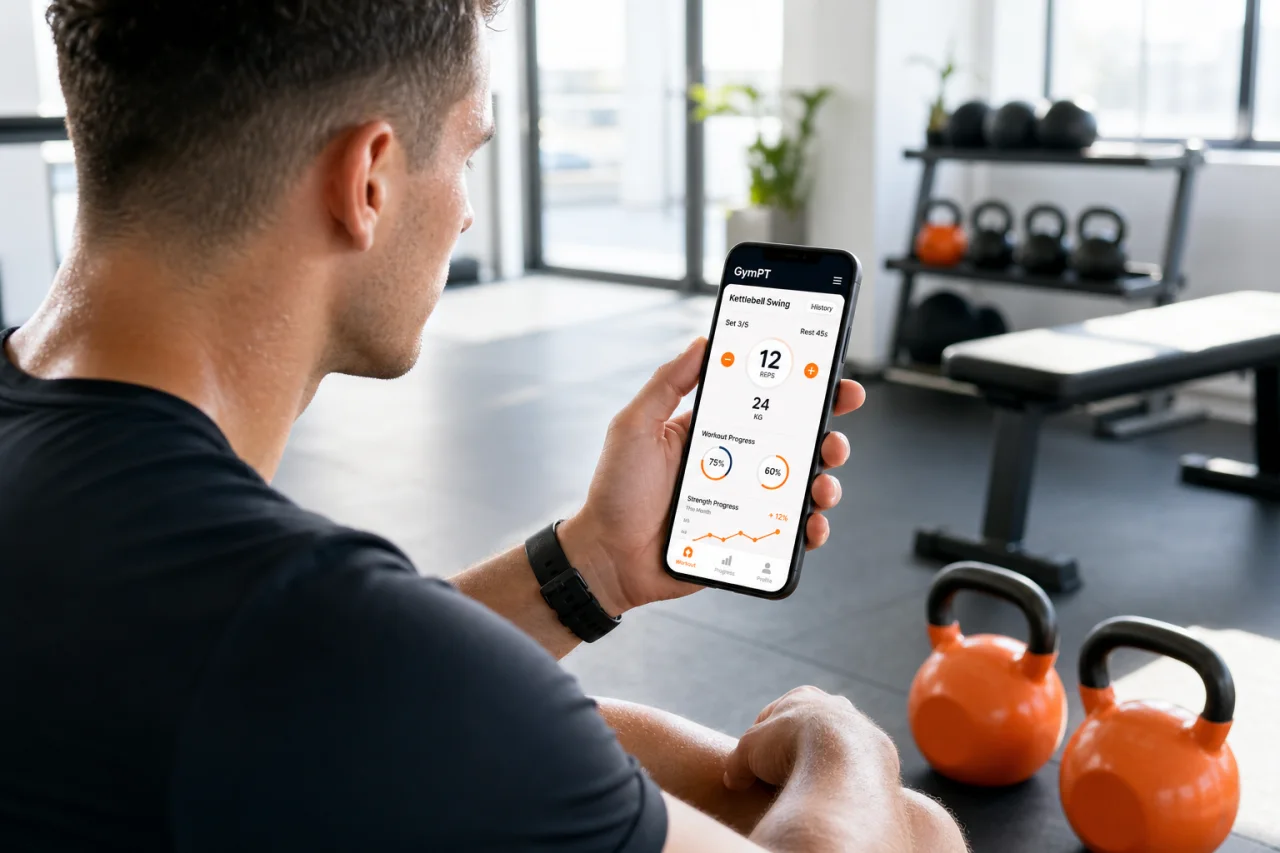
full body workout with kettlebell
Full Body Workout With Kettlebell: Build a Smarter Plan Around One Tool
A kettlebell can train your whole body if you choose the right movement pattern mix. Learn how to build a full body workout with kettlebell, adapt it to your equipment, and progress it with GymPT.
Full body workout with kettlebell: the simple way to train everything with one tool
A full body workout with kettlebell works best when you stop thinking in isolated exercises and start thinking in movement patterns. One kettlebell can cover squatting, hinging, pushing, pulling, carrying, and core control if you build the session with intention. That is why kettlebells are so useful for home training, small gyms, and busy schedules: they can create a complete session without a lot of equipment.
The goal is not to cram in as many exercises as possible. The goal is to choose a few high-value movements, perform them with good form, and progress them over time. That approach matches current strength-training guidance, which emphasizes multi-joint exercises, sensible volume, and progressive overload. Kettlebells fit that model well because they can be used for both strength and conditioning work.
Why kettlebells work so well for full-body training
Kettlebells are especially effective when you want one session to challenge multiple muscle groups at once. A swing trains the hips and posterior chain, a goblet squat trains the legs and trunk, a press trains the shoulders and arms, and a row or carry adds upper-back and grip work. In other words, one tool can cover the major patterns that matter in a balanced plan.
They are also easy to scale. You can change the load, the number of reps, the tempo, the rest time, or the exercise variation. That makes kettlebells useful whether you are a beginner learning the basics or an experienced lifter trying to make a short workout more demanding.
How to build a balanced kettlebell session
A smart full-body session usually includes five parts:
- Squat pattern for quads and glutes
- Hinge pattern for hamstrings, glutes, and lower back
- Push pattern for chest, shoulders, and triceps
- Pull pattern for upper back and biceps
- Carry or core pattern for trunk stability and grip
If you only have one kettlebell, you can still cover all five. The key is to choose exercises that do not overlap too much. For example, a goblet squat and a swing are both lower-body dominant, but they stress the body differently. Pairing them with a press and a row gives you a much more complete workout than repeating the same pattern over and over.
A practical exercise menu
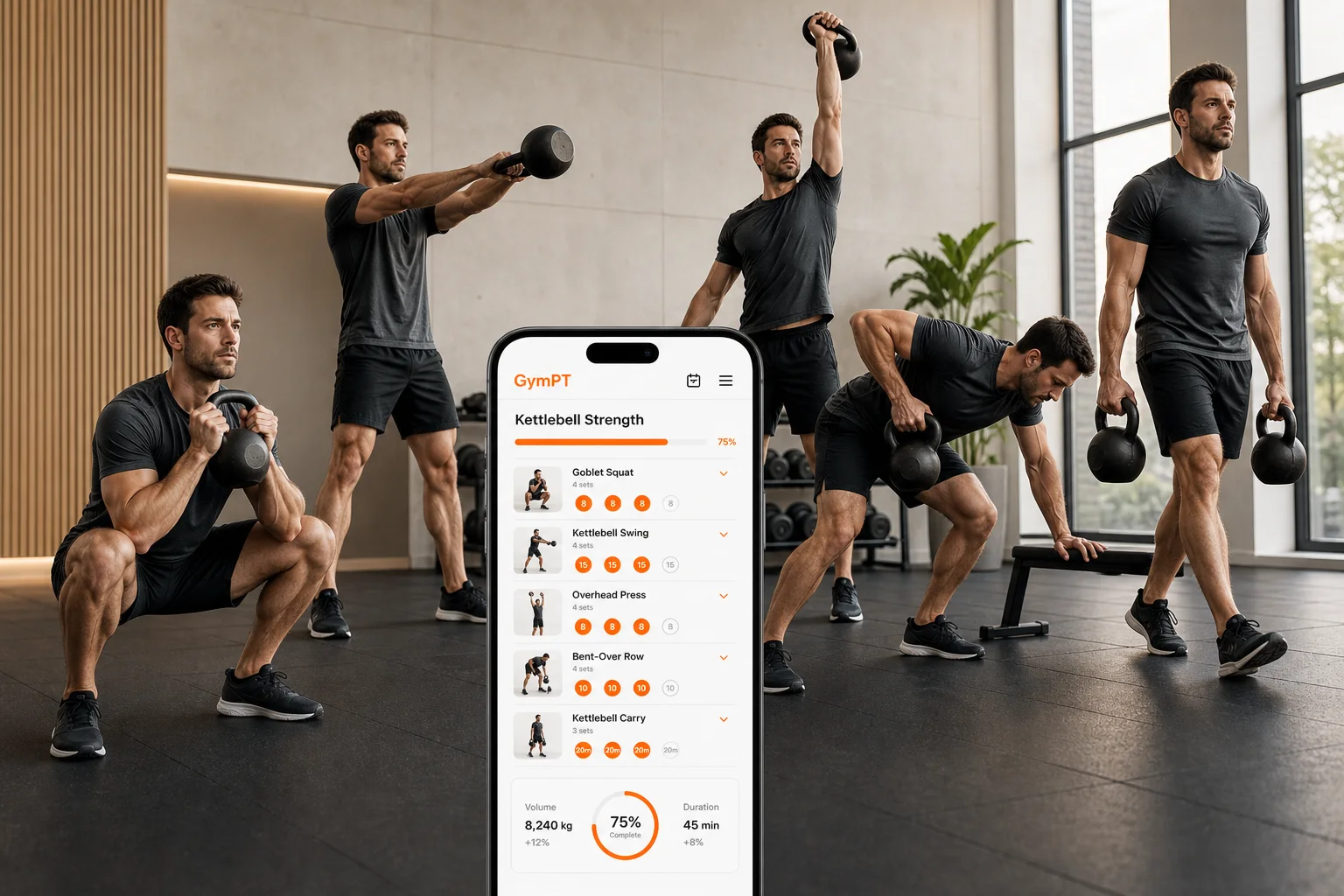
- Goblet squat for squat strength and posture
- Kettlebell swing for explosive hip drive and conditioning
- Single-arm press for shoulder and triceps strength
- Single-arm row for back balance and pulling strength
- Suitcase carry for core stability and anti-lean control
If you want a more advanced option, you can also use a clean and press, a Turkish get-up, or a half get-up. These are excellent full-body choices, but they demand more skill and control, so they are better once your basics are solid.
A beginner-friendly full body workout with kettlebell
Here is a simple session you can use as a starting point. It is designed to be effective without being overly complicated.
Workout A
- Goblet squat — 3 sets of 8 to 10 reps
- Single-arm kettlebell row — 3 sets of 8 to 12 reps per side
- Single-arm kettlebell press — 3 sets of 6 to 10 reps per side
- Kettlebell swing — 3 sets of 10 to 15 reps
- Suitcase carry — 3 rounds of 20 to 40 meters per side
Rest 60 to 90 seconds between sets if you are training for general strength and fitness. If your goal is more conditioning, keep the rest shorter, but only if your form stays clean.
For beginners, it is usually better to stop each set with a little energy left. That makes technique more repeatable and helps you build consistency. Once the movements feel stable, you can add load, reps, or another set.
How to choose the right kettlebell weight
The right kettlebell is the one that lets you complete the exercise with control. A weight that works for swings may be too heavy for presses. A weight that feels easy for carries may be too light for squats. That is normal.
Use this rule of thumb:
- For squats and carries: choose a weight that feels challenging but stable
- For presses: start lighter than you think you need
- For swings: use a weight you can accelerate with crisp hip drive
If you only own one kettlebell, build the workout around that load and adjust the exercise selection. For example, if the bell is too heavy for strict pressing, switch to floor presses, two-handed carries, or slower reps. If it is too light for swings, add reps, shorten rest, or use tempo work on squats and presses.
Form cues that matter most
Kettlebells reward good mechanics. A few simple cues can make a big difference:
- Brace before you move. Create tension through your trunk before each rep.
- Let the hips do the work. In swings and hinges, power should come from the hips, not the shoulders.
- Keep the bell close. This helps control the path and reduces wasted motion.
- Own the bottom position. In squats and get-ups, move with control instead of dropping into position.
- Match the exercise to your skill level. Advanced movements are useful, but only after the basics feel solid.
If your lower back takes over during swings, the load is probably too heavy, the hinge pattern is not clean yet, or the rep speed is too fast. In that case, reduce the weight and practice the hinge first.
How to progress your kettlebell plan without guessing
Progress does not have to mean lifting the heaviest bell in the gym. You can improve a kettlebell plan in several ways:
- Add 1 to 2 reps per set
- Add one extra set to one exercise
- Use a heavier kettlebell
- Shorten rest intervals slightly
- Slow the lowering phase on squats and presses
- Upgrade from a basic movement to a more advanced variation
The best progression is the one you can repeat week after week. If your workout is too hard to recover from, you will not stay consistent. If it is too easy, you will stall. The sweet spot is a plan that feels challenging, repeatable, and measurable.
How GymPT helps you adapt the workout to your equipment
This is where GymPT becomes especially useful. Instead of forcing a generic kettlebell plan, GymPT can build your workout around the equipment you actually have. If you only have one kettlebell, it can prioritize unilateral work, carries, and pattern balance. If you have two kettlebells, it can add double-kettlebell squats, presses, or carries. If your space is limited, it can keep the session compact and efficient.
GymPT also helps you adjust the plan when your goal changes. Want more strength? The app can shift the workout toward lower reps and longer rest. Want more conditioning? It can keep the same movement patterns but increase density. Want better balance or core control? It can add carries, anti-rotation work, and more unilateral training.
Because GymPT includes AI coach chat, workout tracking, and progress insights, you can also ask for real-time adjustments. For example, if a press feels too heavy today, GymPT can swap in a safer variation without breaking the structure of the session. That makes the plan easier to follow and easier to stick with.
Sample 3-day kettlebell structure
If you want to train with kettlebells three times per week, use a simple rotation like this:
- Day 1: squat, press, row, carry
- Day 2: hinge, push, core, conditioning
- Day 3: full-body mix with a slightly heavier or slightly faster focus
This structure keeps the workouts varied without making them random. It also gives each pattern enough exposure to improve while still allowing recovery between sessions.
Common mistakes to avoid
- Only doing swings. Swings are great, but they do not replace squats, presses, and pulls.
- Using too much load too soon. Technique should lead the way.
- Skipping unilateral work. One-arm exercises help expose and fix side-to-side differences.
- Turning every workout into cardio. A full-body plan should still include strength-focused work.
- Ignoring progression. If nothing changes, your results usually slow down.
The bottom line
A full body workout with kettlebell works best when it is built around movement patterns, not random exercises. Choose a squat, a hinge, a push, a pull, and a carry, then progress the plan in small, repeatable steps. That gives you a workout that is efficient, balanced, and easy to adapt to the equipment you have.
If you want a kettlebell plan that fits your goal, your space, and your current level, GymPT can build it for you and keep it moving forward as you improve.