home gym workout plan
Home Gym Workout Plan: Build Strength in Small Spaces
A practical home gym workout plan for limited space: learn how to train your whole body, progress safely, and stay consistent with simple tools.

Home Gym Workout Plan: Build Strength in Small Spaces
A good home gym workout plan does not need a lot of equipment or a big room. It needs a clear structure, a few repeatable exercises, and a simple way to make each week slightly harder than the last. That is how you turn a corner of your home into a real training setup instead of a place where motivation goes to die.
For most adults, the goal is not perfection. It is consistency. Public health guidance recommends at least 150 minutes of moderate-intensity activity per week and muscle-strengthening work on 2 or more days each week. A home setup can meet that standard if you plan it well.
What a home gym workout plan should do
A useful plan should cover the major movement patterns: squat, hinge, push, pull, carry, and core. That gives you a balanced routine even if you only have a mat, a pair of dumbbells, or resistance bands. It also helps you avoid the common mistake of doing random workouts that feel hard but do not build a clear progression.
Research-based strength training guidance emphasizes that the best plan is the one you can repeat consistently, and that home-based training can be effective when the program matches your goal and equipment.
How to set up your space
You do not need a dedicated gym room. You need enough space to lie down, stand up, and move your arms freely. A small area near a wall is enough for most people.
- Floor space: one yoga mat or a clear rectangle about the size of a small rug.
- Basic tools: bodyweight, resistance bands, adjustable dumbbells, or a kettlebell.
- Optional extras: a sturdy chair, a step, and a timer.
If your space is tight, choose exercises that are easy to reset between sets. Split squats, push-ups, rows, glute bridges, dead bugs, and carries are all efficient choices.
A simple weekly home gym workout plan
This plan works well for beginners and intermediate lifters who want a practical home workout plan without overcomplicating things. Train 3 days per week, alternating two full-body sessions.
Day 1: Full body A
- Squat pattern: goblet squat or bodyweight squat — 3 sets of 8 to 12 reps
- Push pattern: push-up or incline push-up — 3 sets of 6 to 12 reps
- Pull pattern: one-arm dumbbell row or band row — 3 sets of 8 to 12 reps
- Glutes: glute bridge or hip thrust — 2 to 3 sets of 10 to 15 reps
- Core: dead bug or plank — 2 to 3 sets
Day 2: Full body B
- Hinge pattern: Romanian deadlift with dumbbells or band good morning — 3 sets of 8 to 12 reps
- Shoulders: overhead press or pike push-up — 3 sets of 6 to 10 reps
- Legs: split squat or reverse lunge — 3 sets of 8 to 12 reps per side
- Upper back: band pull-apart or rear delt row — 2 to 3 sets of 12 to 15 reps
- Core: side plank — 2 to 3 sets per side
Day 3: Repeat A or B
On your third day, repeat the session you need most. If your legs are lagging, repeat B. If your upper body needs more work, repeat A.
That structure gives you enough weekly volume to progress without making home training feel like a second job. The CDC and WHO both support regular muscle-strengthening activity across the week, and ACSM’s updated guidance highlights that consistency and appropriate volume matter more than fancy equipment.
How to progress without more equipment
Progression is the real secret of any home gym workout plan. If the workout never changes, your body has no reason to adapt. You can progress in several ways even when your equipment stays the same.
- Add reps: move from 8 reps to 10, then 12.
- Add sets: go from 2 sets to 3 sets.
- Slow the lowering phase: use a 3-second descent.
- Reduce rest time: keep form sharp, but shorten rest slightly.
- Use harder variations: incline push-up to floor push-up, squat to split squat, band row to heavier band row.
- Add load: use a backpack, dumbbell, kettlebell, or heavier band.
For most healthy adults, training to total exhaustion is not required. The more important habit is to keep the work challenging enough that the last few reps feel demanding while form stays controlled.
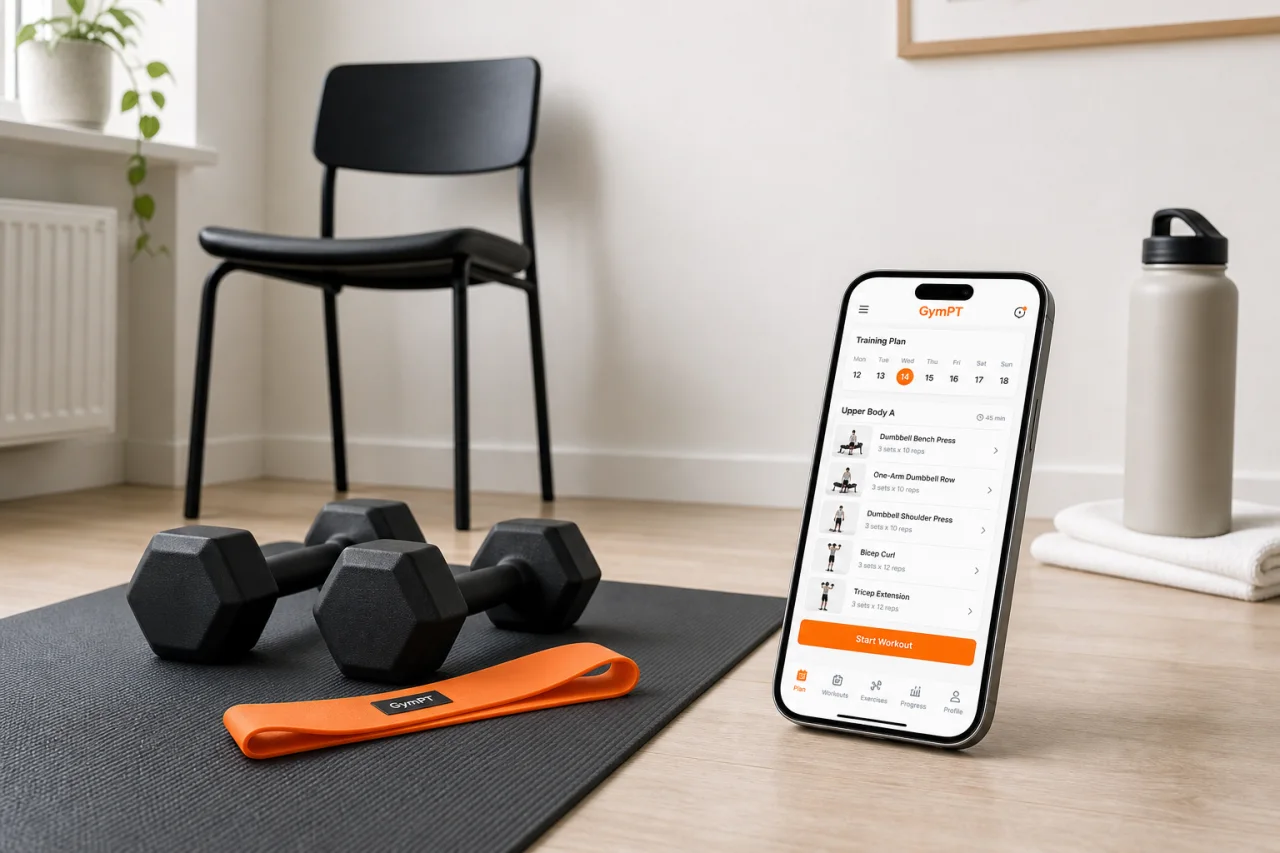
How to make home training feel easier to stick with
Home workouts fail when they are too vague. They succeed when the next step is obvious. Pick a fixed training time, keep your equipment visible, and use the same exercise order for at least 4 to 6 weeks.
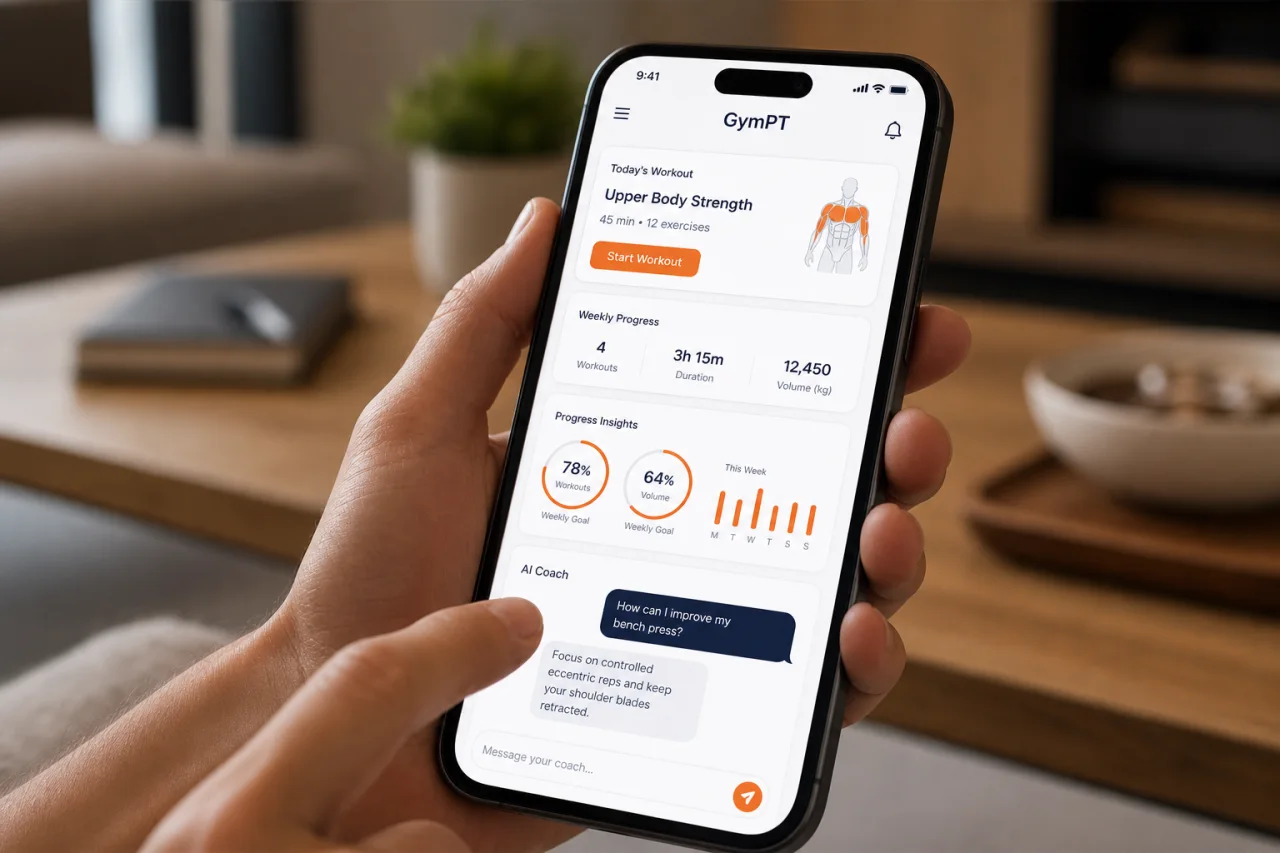
That is also where an AI coach can help. GymPT can turn your available equipment, schedule, and goals into a personalized plan, then adjust your workouts as you get stronger. It is much easier to stay consistent when the plan already knows what you can do today.
Common mistakes to avoid
- Doing only cardio: great for health, but not enough for balanced strength development.
- Changing workouts every day: fun, but hard to progress.
- Skipping pulling work: rows and band pulls matter for posture and upper-back strength.
- Using too much volume too soon: start with a manageable plan you can repeat.
- Ignoring tracking: if you do not record reps, sets, or load, progress becomes guesswork.
Tracking matters because small improvements add up. If you know last week’s numbers, you can make this week slightly better instead of just hoping it feels harder.
What to do if you only have bodyweight
You can still build a strong home workout plan with no equipment. Use unilateral exercises and slower tempos to raise the challenge.
- Squat: air squat, split squat, wall sit
- Push: incline push-up, knee push-up, floor push-up
- Pull: towel row in a safe setup, band row if available
- Hinge: single-leg hip hinge, glute bridge, hip thrust
- Core: plank, side plank, dead bug, hollow hold
If you have no weights, focus on range of motion, tempo, and clean reps. That is enough to build a solid base.
Sample 4-week progression
If you want a simple starting point, use this:
- Week 1: learn the movements and stop with 2 to 3 reps in reserve.
- Week 2: add 1 to 2 reps per set where possible.
- Week 3: add one set to your main lift on each day.
- Week 4: keep the same exercises and try a slightly harder variation or a little more load.
That kind of gradual progression is easier to recover from and easier to repeat. It also fits the public health recommendation to build activity into your week in a sustainable way.
How GymPT helps you train at home
GymPT is built for people who want a plan that fits real life. You can use it to:
- build a personalized home gym workout plan
- choose exercises based on your equipment
- get coach-style guidance through chat
- track workouts and see progress over time
- adjust training when your schedule changes
If your goal is to train effectively in a small space, the best plan is the one you can follow week after week. Start simple, track your work, and make each session a little better than the last.
Ready to start? Build your home gym workout plan, keep the setup simple, and let steady progress do the heavy lifting.