arms workout for beginners
Arms Workout for Beginners: Build Stronger Biceps and Triceps Safely
A beginner-friendly arms workout should be simple, repeatable, and easy to progress. This guide shows you how to train biceps and triceps with good form, sensible volume, and beginner alternatives you can actually stick to.

Arms workout for beginners: start simple, then progress
If you are looking for an arms workout for beginners, the best plan is not the hardest one. It is the one you can repeat with good form, recover from, and gradually improve. For most beginners, that means training the biceps and triceps with a few basic movements, using moderate effort, and keeping the weekly volume manageable.
Health organizations recommend doing muscle-strengthening work for the major muscle groups on at least 2 days per week, and beginner-friendly strength sessions often work well with 8 to 12 repetitions per set and at least 2 sets per exercise. That gives you enough practice to learn the movement without turning every workout into a grind.
What beginner arm training should actually do
Arm training is not only about bigger biceps. A good beginner plan should help you:
- learn how to control a weight through a full range of motion
- build strength in the biceps, triceps, and forearms
- support push and pull exercises like rows, presses, and push-ups
- avoid the common mistake of using too much weight too soon
That is why simple exercises with clear form cues usually beat flashy variations. You want enough challenge to stimulate progress, but not so much that your shoulders swing, elbows flare, or your lower back takes over.
A simple beginner arms workout
Use this as a starting point 1 to 2 times per week. If you already do full-body training, place this after your main lifts or on a separate upper-body day.
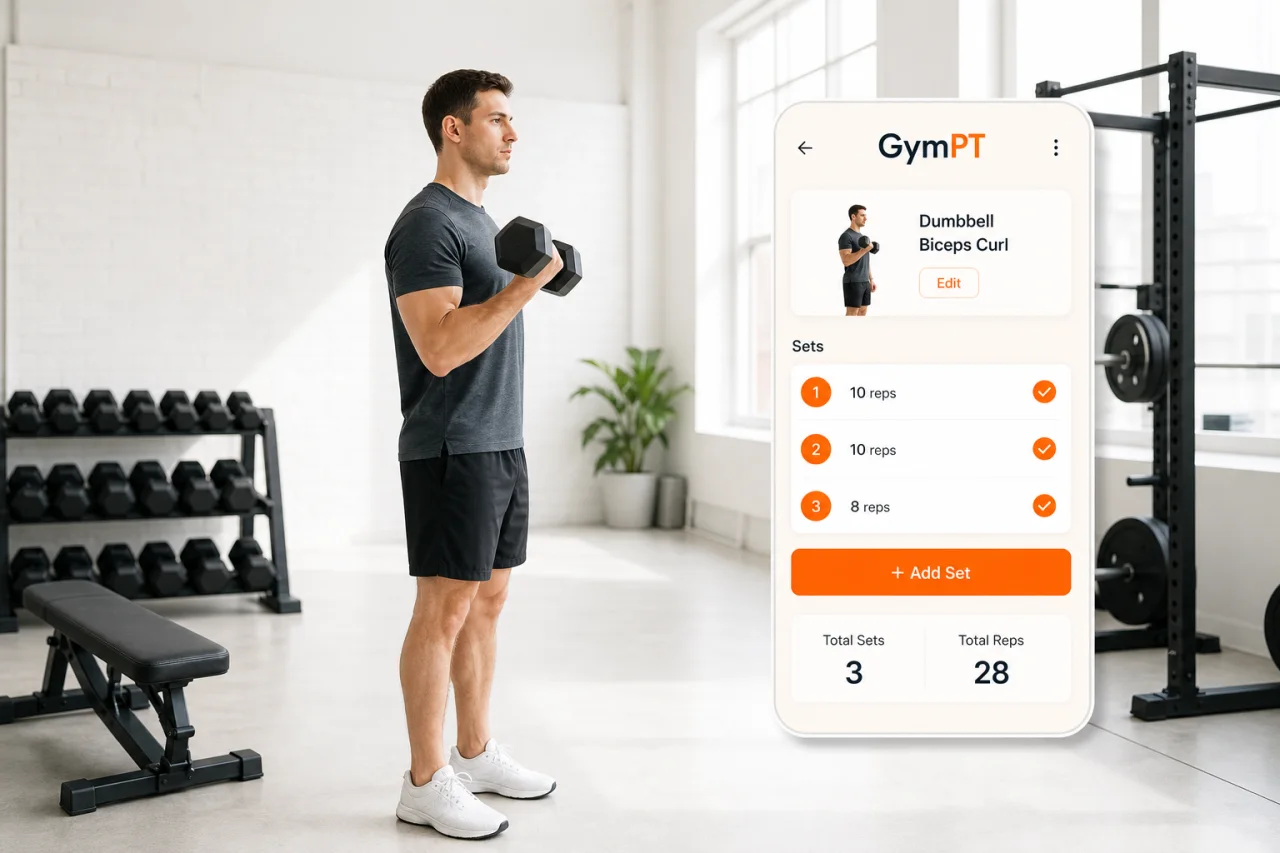
1. Dumbbell biceps curl
Sets: 2 to 3
Reps: 8 to 12
Rest: 60 to 90 seconds
How to do it: Stand tall, keep your ribs down, and let your elbows stay close to your sides. Curl the weight without swinging your torso, then lower it slowly.
Beginner cue: Think “elbows stay still, hands move.”
2. Hammer curl
Sets: 2 to 3
Reps: 8 to 12
This variation uses a neutral grip and is often easier on the wrists. It also trains the brachialis and forearms, which can help your arms look and feel more complete.
Beginner cue: Keep your palms facing in and avoid shrugging your shoulders.
3. Overhead triceps extension
Sets: 2 to 3
Reps: 8 to 12
Hold one dumbbell with both hands or use a single light dumbbell. Keep your elbows pointed forward and lower the weight behind your head with control. Then press back up without arching your lower back.
Beginner cue: Move at the elbow, not the shoulders.
4. Triceps kickback or band pressdown
Sets: 2 to 3
Reps: 10 to 15
If overhead work feels awkward, use a kickback or a resistance band pressdown. These are easier to learn and let you focus on squeezing the triceps at the end of each rep.
Beginner cue: Keep your upper arm still and finish with a straight elbow.
How hard should beginner arm sets feel?
For most beginners, a good target is to finish each set with about 2 to 3 reps left in the tank. That means the set feels challenging, but your form stays clean. If you are swinging, leaning back, or shortening the range of motion, the weight is probably too heavy.
A useful rule: if you could do 20 reps but you are only doing 8, the load is likely too light for strength progress. If you cannot reach the lower end of the rep range with control, it is too heavy. The sweet spot is a weight that lets you complete all reps with steady technique and a controlled lowering phase.
Form cues that make arm training safer and more effective
- Keep your shoulders quiet. Your upper arms should not swing forward and back.
- Use a slow lowering phase. Lowering under control helps you learn the movement and avoid momentum.
- Stop before your form breaks. A smaller, cleaner set is better than a sloppy one.
- Match the exercise to your joints. If a grip or angle feels uncomfortable, switch to a more natural variation.
- Breathe steadily. Exhale as you lift or press, inhale as you lower.
Beginner-friendly alternatives if the standard version feels too hard
Not every beginner should start with the same version of each exercise. Use the easiest variation that still challenges you.
- Too hard to curl dumbbells? Try lighter dumbbells or a resistance band curl.
- Overhead triceps extension feels awkward? Try a band pressdown or cable pressdown.
- Wrists feel uncomfortable? Use a hammer curl instead of a palm-up curl.
- One arm is much weaker? Train each arm separately and start with the weaker side.
These adjustments are not a downgrade. They are how beginners build consistency and avoid quitting because the first plan was too ambitious.
How much arm training do beginners need?
For most people, 2 to 4 total arm exercises per session is enough when you are starting out. You do not need marathon workouts to make progress. In fact, a short session you can repeat twice per week is often better than a long session you dread.
If you are also doing push-ups, rows, presses, or pulldowns, your arms are already getting indirect work. That means your direct arm work can stay modest while you build the habit and improve technique. Over time, you can add a set, add a rep, or increase the load slightly. That gradual progression is the real driver of results.
Sample 20-minute beginner arms workout
- Dumbbell biceps curl — 2 sets of 8 to 12
- Hammer curl — 2 sets of 8 to 12
- Overhead triceps extension — 2 sets of 8 to 12
- Band pressdown or triceps kickback — 2 sets of 10 to 15
Rest 60 to 90 seconds between sets. If you are new to strength training, start with 1 to 2 rounds and add volume only when recovery feels easy and your form stays consistent.
How GymPT can help you progress
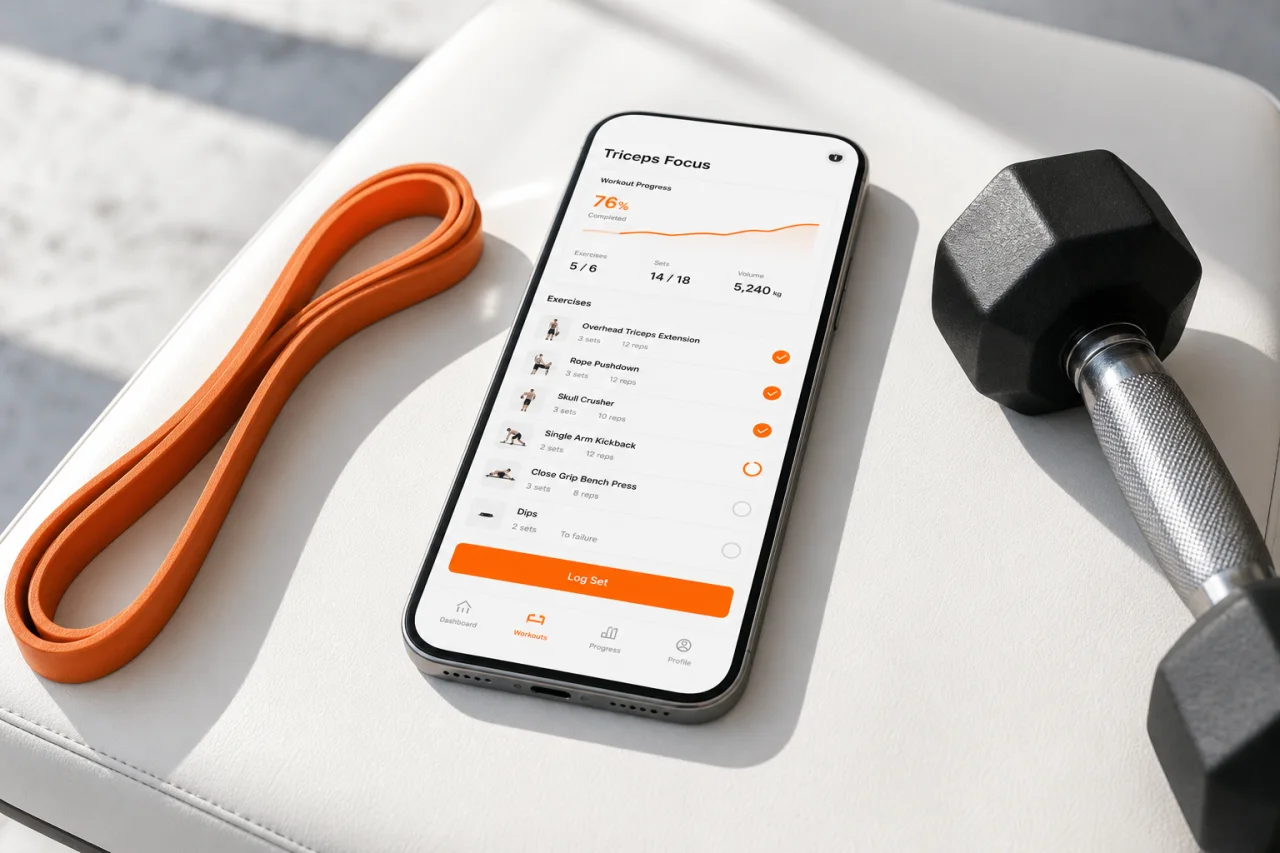
GymPT can turn this beginner plan into a personalized routine based on your equipment, schedule, and current level. If you train at home with dumbbells or bands, the app can build an arm plan around what you actually have. If you prefer the gym, it can adjust exercise selection, track your workouts, and show progress trends so you know when to increase reps or load.
That matters because beginner progress is often about consistency, not complexity. A smart plan makes it easier to show up, log your work, and improve one small step at a time.
When to move beyond beginner arm work
You are ready to progress when you can complete all sets with clean form, the top of the rep range feels manageable, and recovery is not an issue. At that point, you can:
- add a third set to one or two exercises
- increase the weight slightly
- slow the lowering phase
- swap in a harder variation
The goal is not to chase soreness. The goal is to build stronger arms with a plan you can keep doing.
Bottom line
A beginner arms workout should be simple, controlled, and repeatable. Start with curls and triceps work, use moderate reps, keep your form strict, and progress slowly. If you can do that consistently, your arms will get stronger without turning every session into a test of willpower.