upper body workout for beginners
Upper Body Workout for Beginners: A Simple Plan for Stronger Push and Pull Muscles
A beginner upper body workout should be simple, balanced, and easy to repeat. Learn the best exercises, sets, reps, and form cues for safer progress.
Upper body workout for beginners: start with the basics
If you want an upper body workout for beginners that actually builds strength, keep it simple. Your first goal is not to do the most exercises possible. It is to learn a few reliable movement patterns, use good form, and repeat them often enough to improve.
A smart beginner plan trains the main upper-body muscle groups: chest, back, shoulders, biceps, and triceps. It also includes both push and pull workout patterns so your shoulders stay balanced and your posture work is not one-sided.
For most beginners, two upper-body sessions per week is a practical starting point. Public health guidance recommends muscle-strengthening activity on at least 2 days per week, and beginner strength work is usually most effective when you can recover and repeat it consistently.
What a beginner upper body session should include
A good beginner upper body workout usually has 4 to 6 exercises. You do not need every machine or every dumbbell move. You need enough variety to cover the big patterns:
- Horizontal push: chest press or push-up variation
- Horizontal pull: row variation
- Vertical push: shoulder press variation
- Vertical pull: lat pulldown or assisted pull-down variation
- Arm isolation: biceps curl and/or triceps extension
That mix gives you a balanced upper body strength training session without making it overly complicated.
Simple beginner volume target
Start with 2 sets per exercise. A common beginner rep range is 8 to 12 reps, which is also a practical way to learn control and build a base. If you finish a set and feel like you could do many more reps with perfect form, the weight is probably too light. If your form breaks down early, it is too heavy.
As a beginner, leave about 1 to 3 reps in reserve on most sets. That means you should finish feeling challenged, but not wrecked.
The best upper body exercises for beginners
Here is a simple exercise menu you can use in the gym or adapt at home. Choose one option from each category.
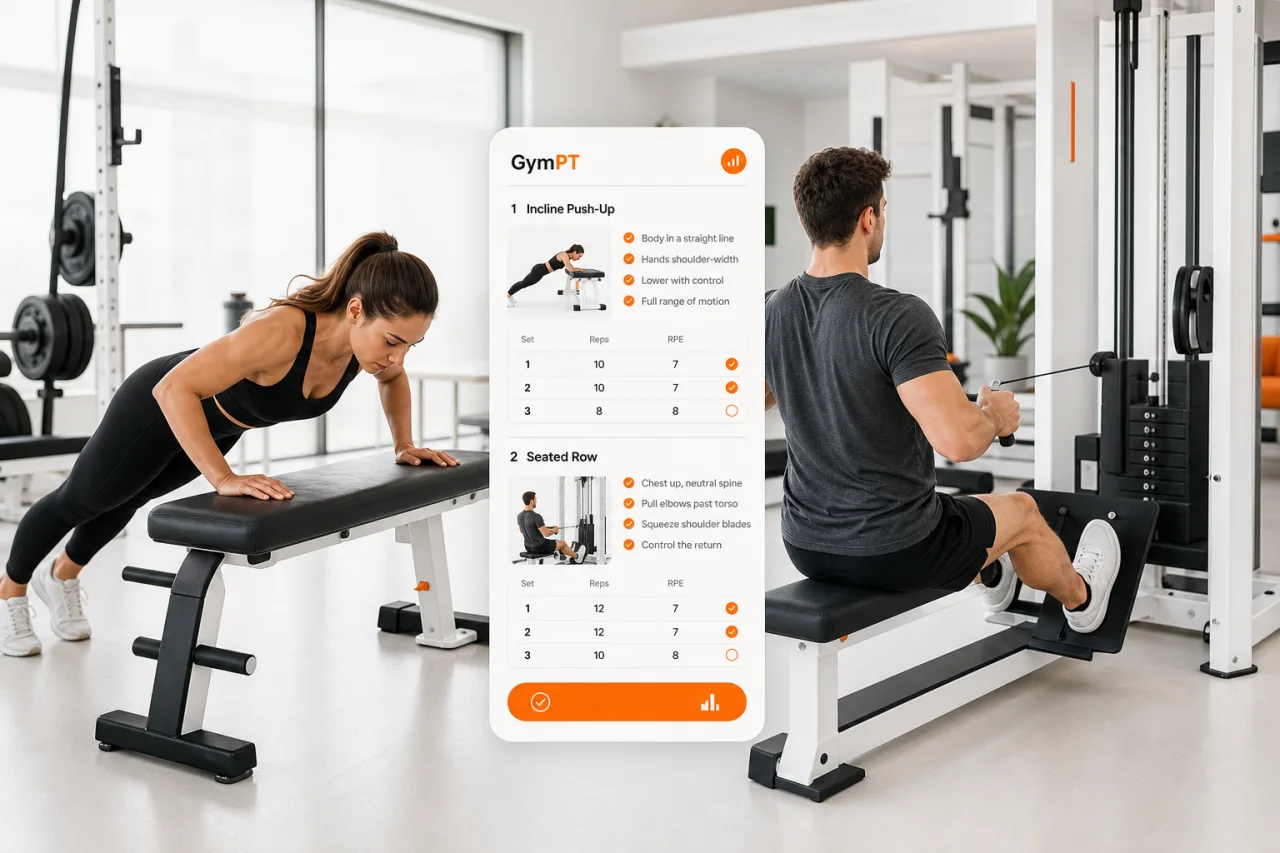
- Push-up or incline push-up
- Dumbbell chest press or machine chest press
- One-arm dumbbell row or seated cable row
- Lat pulldown or band pulldown
- Dumbbell shoulder press or machine shoulder press
- Dumbbell curl or cable curl
- Triceps pressdown or overhead triceps extension
If you only have time for four moves, choose one push, one pull, one shoulder exercise, and one arm exercise.
Form cues that matter most
- Pressing: keep your ribs down and wrists stacked over elbows.
- Rows: pull with your elbow, not your hand, and avoid shrugging.
- Shoulder presses: do not arch your lower back to move the weight.
- Curls: keep your upper arms still and avoid swinging.
- Triceps work: lock in your shoulders and move only through the elbow.
These cues help you train the target muscles instead of turning every rep into a full-body compensation pattern.
A beginner upper body workout you can follow today
Use this as a starting point for your weekly plan. It is simple, repeatable, and easy to progress.
Workout A
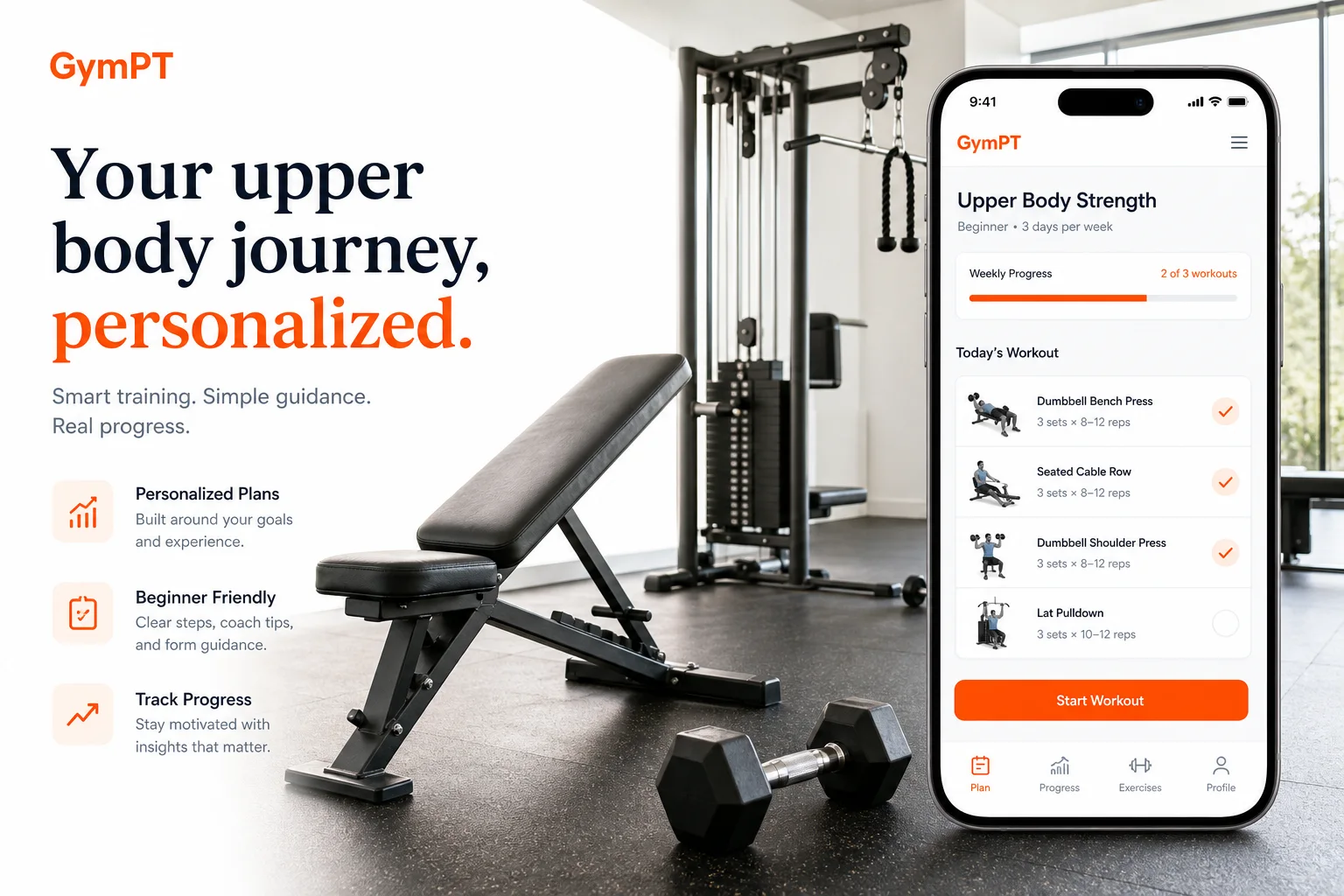
- Dumbbell or machine chest press — 2 sets of 8 to 12 reps
- Seated row or one-arm dumbbell row — 2 sets of 8 to 12 reps
- Dumbbell shoulder press — 2 sets of 8 to 12 reps
- Dumbbell curl — 2 sets of 10 to 12 reps
- Triceps pressdown or overhead extension — 2 sets of 10 to 12 reps
Workout B
- Incline push-up or machine chest press — 2 sets of 8 to 12 reps
- Lat pulldown or band pulldown — 2 sets of 8 to 12 reps
- Machine shoulder press or light dumbbell press — 2 sets of 8 to 12 reps
- Hammer curl — 2 sets of 10 to 12 reps
- Bench dip regression or triceps extension — 2 sets of 10 to 12 reps
Alternate Workout A and Workout B across the week. For example, train upper body on Monday and Thursday, or Tuesday and Friday.
How to make the workout easier or harder
Beginners often need a plan that can scale up or down fast. Use these adjustments instead of quitting when an exercise feels awkward.
- Make it easier: use a machine, reduce the range of motion slightly, or choose an incline push-up instead of a floor push-up.
- Make it harder: add a small amount of weight, slow the lowering phase, or add one extra set after a few weeks.
- Make it safer: stop each rep before your shoulders shrug, your back arches, or your elbows flare wildly.
If you are new to strength training, progress should feel gradual. You do not need to chase failure every session to get stronger.
How often should beginners train upper body?
For most people, 2 upper-body sessions per week is enough to start. That fits well with general guidance to do muscle-strengthening work on at least 2 days per week. If you are also training legs, you can split the week into upper and lower body days or use full-body sessions with a few upper-body exercises included.
A simple weekly structure looks like this:
- Monday: Upper body
- Wednesday: Lower body or cardio
- Friday: Upper body
That spacing gives your muscles time to recover while keeping the habit consistent.
Common beginner mistakes to avoid
- Doing too many exercises: more is not better if your form falls apart.
- Skipping pulling work: rows and pulldowns matter as much as pressing.
- Using weights that are too heavy: control comes first.
- Rushing reps: slow, clean reps teach better movement.
- Changing the plan every workout: repeat the same basics long enough to improve.
If your shoulders feel cranky, your first fix is usually better technique, lighter load, and a more balanced push-pull ratio, not more intensity.
How GymPT can help you stay consistent
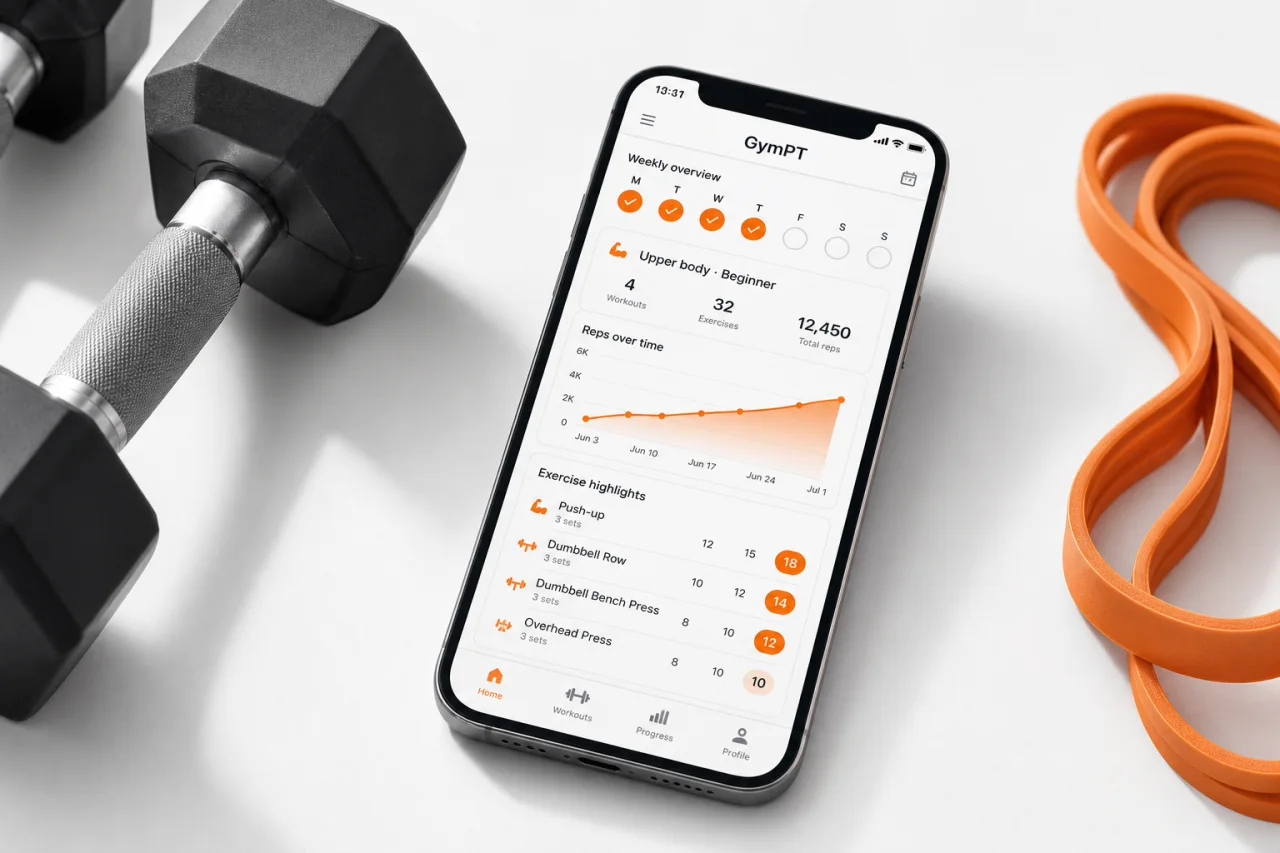
GymPT makes beginner training easier by turning a vague goal into a clear plan. You can get a personalized upper-body routine based on your equipment, track your workouts, and see progress over time. If you are unsure whether to use dumbbells, machines, or bodyweight, GymPT can help you choose the version that fits your current level and your schedule.
That matters because beginners usually do best when the plan is simple enough to repeat. A good app should reduce decision fatigue, not add to it.
Final takeaway
The best upper body workout for beginners is balanced, repeatable, and easy to progress. Focus on a few core movements, use 2 sets of 8 to 12 reps, train upper body twice per week, and keep your form clean. If you can do that consistently, you are already doing the important part.
Start simple, track your reps, and build from there.