lower body workout for beginners
Lower Body Workout for Beginners: A Simple Plan for Strong Legs and Better Form
A beginner lower body workout should be simple, balanced, and easy to progress. Learn the best exercises, form cues, and weekly volume tips.
Lower body workout for beginners: start simple, then build
If you want a lower body workout for beginners that actually helps you get stronger, the goal is not to do everything. The goal is to train the main movement patterns, keep the technique clean, and recover well enough to repeat it next week. A good beginner plan should cover squatting, hinging, single-leg work, and a little calf and core support.
That approach matches public health guidance that adults should include muscle-strengthening activity at least two days per week, and it fits the reality that beginners progress best when the plan is easy to follow and easy to repeat.
What a beginner lower body session should include
A balanced lower body session does not need a long exercise list. For most beginners, 4 to 6 exercises is enough if you choose them well. Aim to train:
- Knee-dominant work like squats or leg presses
- Hip-dominant work like Romanian deadlifts or hip hinges
- Single-leg work like split squats or step-ups
- Glute-focused work like bridges or hip thrusts
- Calf work for ankle strength and balance
That mix helps you build strength across the legs, hips, and glutes instead of overloading just one area. It also makes it easier to scale the workout up or down depending on the equipment you have.
A simple lower body workout for beginners
Use this as a starting point for 2 lower body sessions per week. Keep at least one rest day between them.
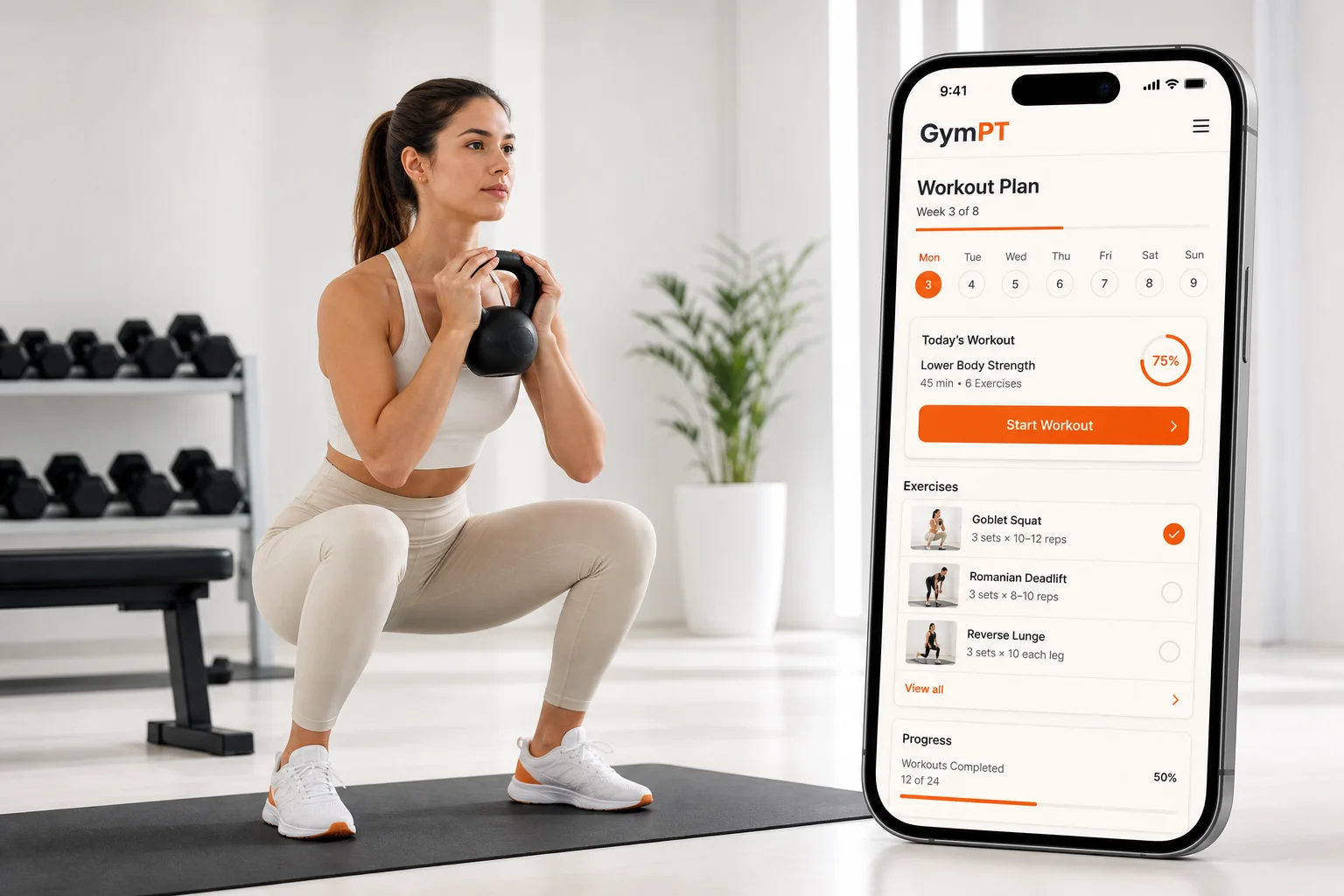
- Goblet squat — 2 to 3 sets of 8 to 10 reps
- Romanian deadlift with dumbbells — 2 to 3 sets of 8 to 10 reps
- Reverse lunge — 2 sets of 6 to 8 reps per leg
- Glute bridge — 2 to 3 sets of 10 to 12 reps
- Standing calf raise — 2 sets of 12 to 15 reps
Rest 60 to 90 seconds between sets. If your form starts to break down, use the lighter option or stop the set a rep or two earlier. For beginners, consistency matters more than chasing fatigue. General resistance-training guidance supports starting with manageable sets and progressing gradually over time.
Form cues that make the biggest difference
Good form is mostly about control, balance, and staying in positions you can repeat. Use these cues on every rep:
- Squat pattern: Keep your feet planted, brace your midsection, and let your knees track in line with your toes.
- Hinge pattern: Push your hips back, keep a soft bend in the knees, and feel the stretch in the back of the legs.
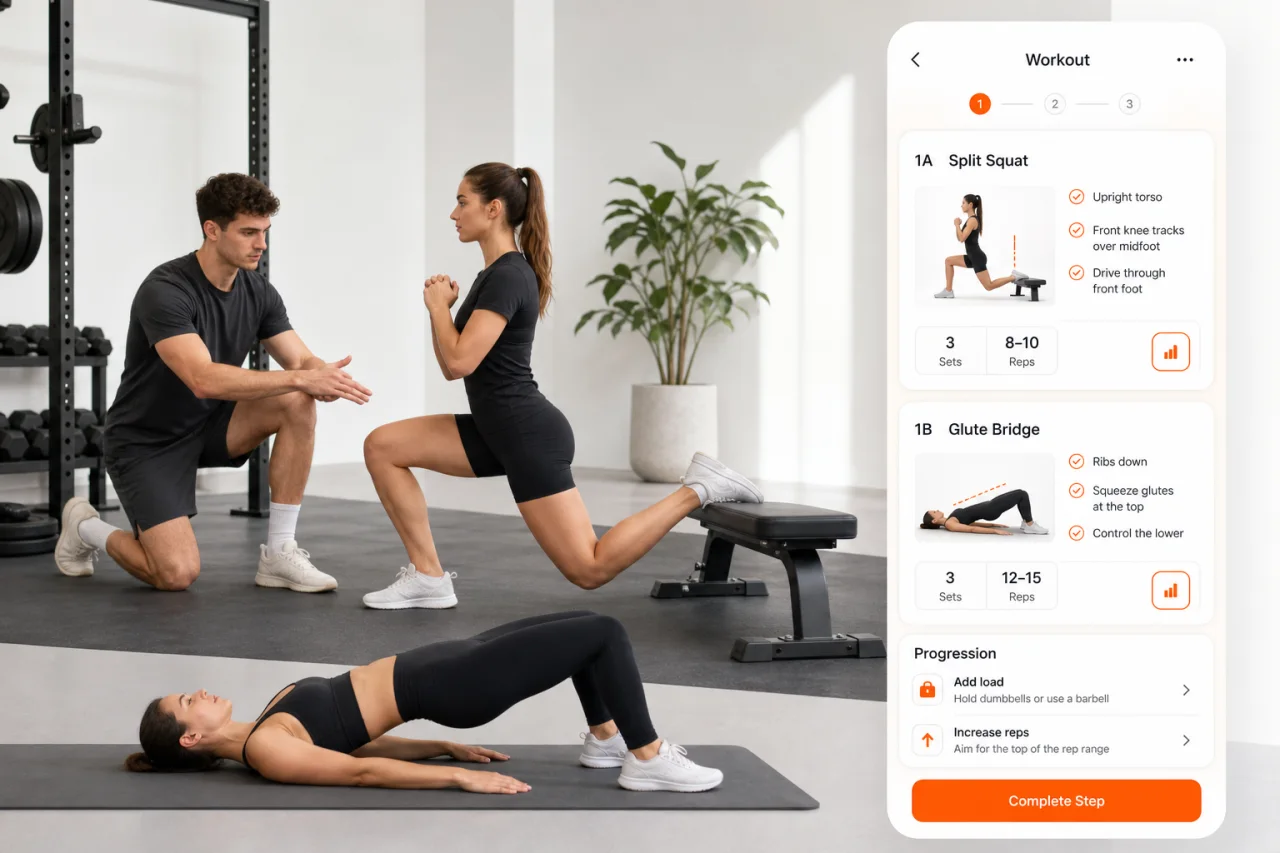
- Lunge pattern: Take a stable step, lower under control, and keep most of your weight on the front foot.
- Glute bridge: Ribs down, feet flat, and squeeze the glutes at the top without over-arching your lower back.
- Calf raise: Pause briefly at the top and lower slowly instead of bouncing.
If you are unsure whether a rep looks right, slow it down. Beginners usually improve faster when they reduce speed slightly and focus on position. That is one reason simple strength work is often easier to stick with than complicated routines.
Beginner-friendly alternatives if an exercise feels too hard
Every beginner needs easier versions sometimes. That is normal, not a setback. Swap in a simpler option when needed:
- Goblet squat → box squat or bodyweight squat to a bench
- Romanian deadlift → hip hinge with a dowel or light dumbbells
- Reverse lunge → split squat with a short range of motion
- Glute bridge → floor bridge with both feet closer to your hips
- Step-up → lower step height or hold onto a support
The best variation is the one you can perform with control while still feeling the target muscles work. If balance is a challenge, use a wall, rack, or stable bench for support and build up slowly.
How much volume should beginners do?
For a new lifter, a little volume goes a long way. Start with 2 sets for most exercises and add a third set only when the workout feels manageable and recovery is good. A practical rule is:
- Week 1 to 2: 2 sets per exercise
- Week 3 to 4: 2 to 3 sets per exercise
- After that: add reps first, then load, then sets if needed
This keeps the workout challenging without making soreness or fatigue so high that you skip the next session. The CDC recommends muscle-strengthening activity at least two days per week, and beginner plans work best when they are repeatable rather than exhausting.
How to progress without overcomplicating it
Progress should be small and measurable. Choose one of these methods at a time:
- Add reps: move from 8 to 10 reps with the same weight
- Add load: increase the dumbbell or machine weight slightly
- Add control: slow the lowering phase to improve technique
- Add a set: only after the workout feels too easy at the current volume
If you can finish every set with clean form and still feel like you had a little left in the tank, you are probably in the right zone. That is a better sign than trying to max out early.
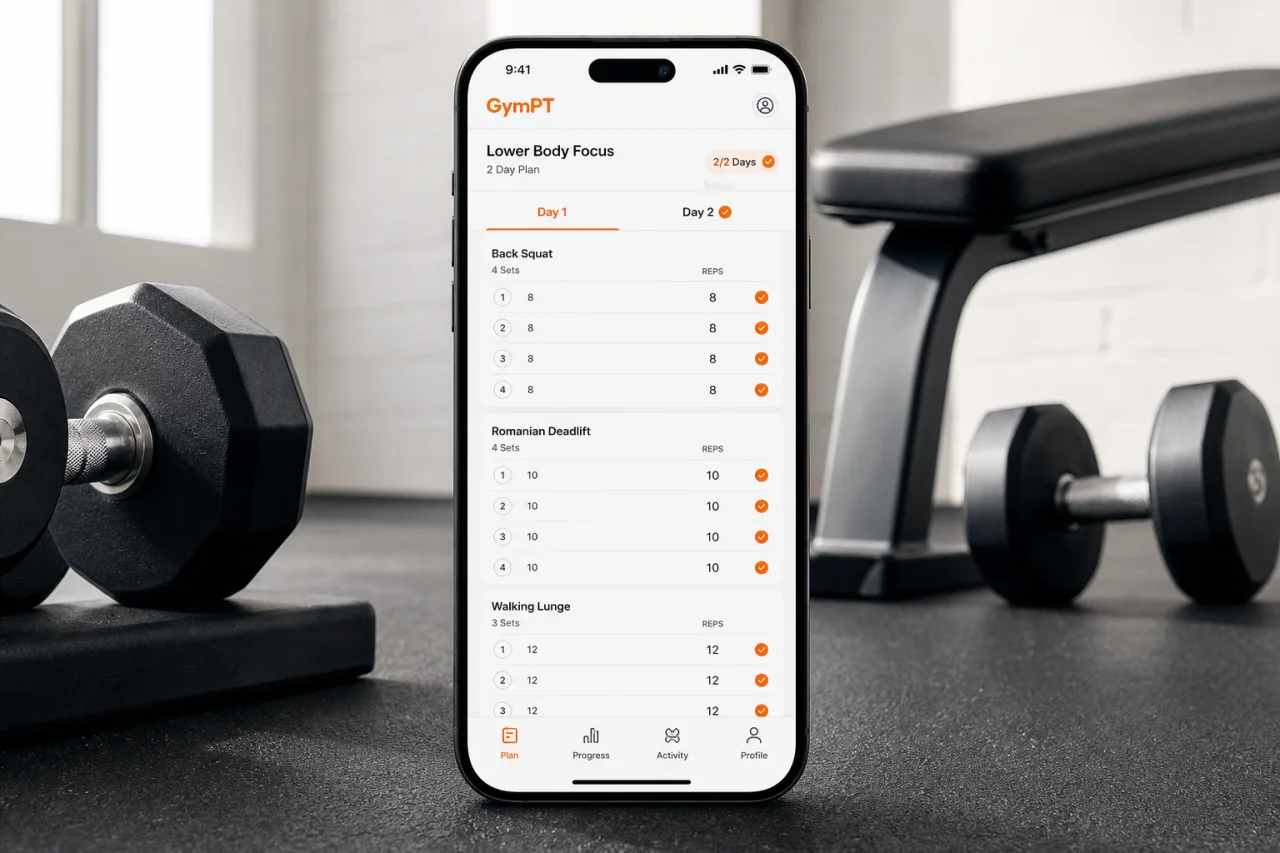
Sample 2-day lower body plan for beginners
Day A
- Goblet squat — 3 x 8
- Romanian deadlift — 2 x 10
- Glute bridge — 2 x 12
- Standing calf raise — 2 x 15
Day B
- Reverse lunge — 2 x 8 per leg
- Leg press — 3 x 10
- Step-up — 2 x 8 per leg
- Calf raise — 2 x 12 to 15
If you train at a gym, the leg press can be a very beginner-friendly way to add leg volume with a stable setup. If you want a deeper form breakdown, a leg press guide can help you make the movement safer and more effective. If you prefer dumbbells, a dumbbell-based lower body day is also easy to scale.
How GymPT can help you stay consistent
A beginner plan works best when it matches your equipment, your schedule, and your current strength level. GymPT can build a personalized lower body plan, adjust exercises based on the equipment you have, and help you track your workouts so you know when to progress. If you are not sure whether to use dumbbells, machines, or bodyweight, GymPT can also help you choose the simplest option that still moves you forward.
For most beginners, the winning formula is simple: train legs twice a week, keep the exercise list short, use good form, and progress slowly. Do that consistently, and your lower body workout will stop feeling random and start producing real strength.
Quick reminder: if a movement causes sharp pain or feels unstable in a way that does not improve with lighter load or better setup, stop and choose an easier variation.
FAQ: lower body workout for beginners
How many times a week should beginners train lower body?
Two times per week is a strong starting point for most beginners. It gives you enough practice to improve while leaving time to recover.
Should I do cardio on leg day?
You can, but keep it light if your legs are already tired. A short walk or easy bike ride is usually fine.
What if I only have dumbbells?
You can still build a great beginner leg routine with goblet squats, Romanian deadlifts, split squats, glute bridges, and calf raises.
How sore should I be after leg day?
Mild soreness is common, but extreme soreness is not the goal. If soreness keeps you from training again, reduce volume next time.