best arms exercises
Best Arms Exercises: A Smarter Guide to Bigger, Stronger Arms
A practical guide to the best arms exercises, with form cues, beginner-friendly swaps, and simple volume tips for better biceps and triceps training.
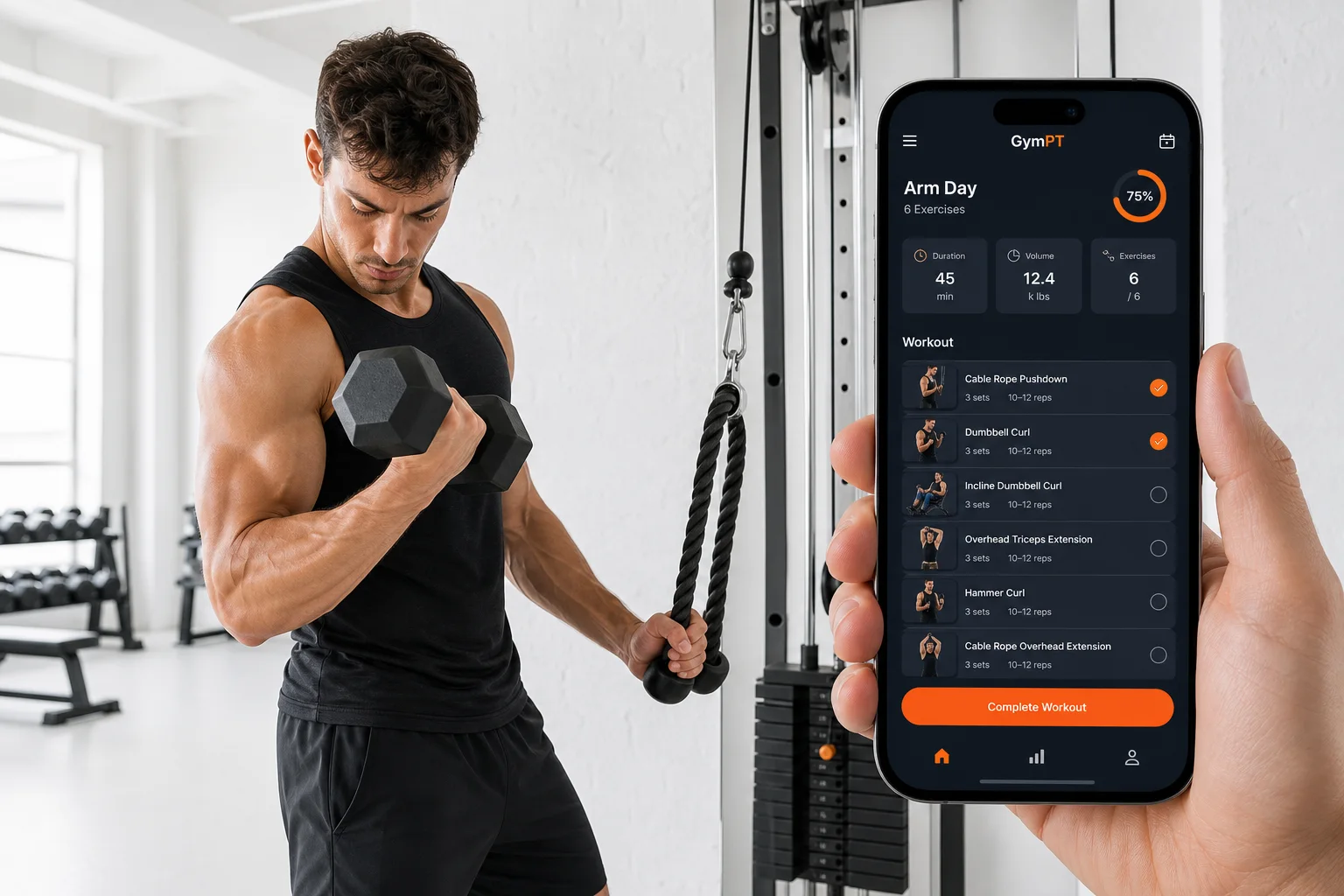
Best arms exercises: what actually deserves a place in your plan
If you want stronger, more defined arms, the best arms exercises are the ones that train both the biceps and triceps through a full range of motion, with enough effort to challenge the muscle and enough control to keep your form clean. That sounds simple, but it is where a lot of arm training goes wrong: people chase a burn, use too much momentum, or only train curls and forget that the triceps make up most of the upper arm.
A smarter arm day is built around a few reliable movement patterns: elbow flexion for the biceps, elbow extension for the triceps, and a small amount of shoulder support work so your arms can do their job without your joints feeling beat up. For most lifters, that means choosing 4 to 6 exercises, keeping the reps controlled, and progressing gradually over time.
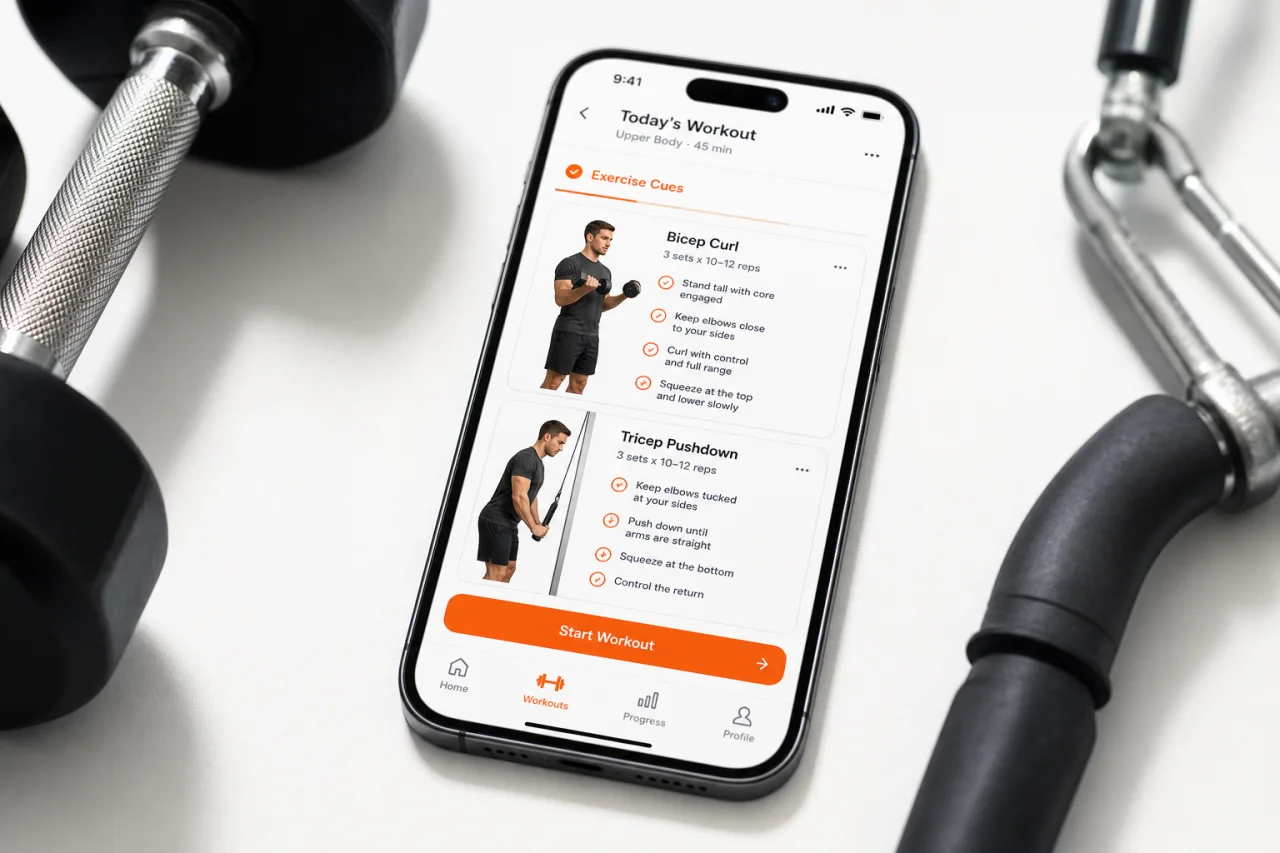
The 9 best arms exercises for most lifters
Below are the most useful arm exercises for beginners and intermediates. You do not need all of them in one workout. Pick a few that fit your equipment, then train them consistently.
1. Dumbbell biceps curl
This is the classic biceps builder for a reason. Stand tall, keep your elbows close to your sides, and curl without swinging your torso. Lower the weight slowly so the biceps stay under tension.
- Best for: direct biceps work
- Form cue: wrists stay neutral; elbows do not drift forward
- Beginner alternative: lighter dumbbells or resistance bands
2. Hammer curl
Hammer curls train the biceps and the brachialis, which can help your upper arm look thicker. Hold the dumbbells with palms facing each other and curl in a smooth arc.
- Best for: arm thickness and grip-friendly curling
- Form cue: keep the shoulders relaxed and the ribs down
3. Incline dumbbell curl
Because your arms start behind your torso, incline curls create a longer stretch on the biceps. Use a bench set at a moderate angle and avoid letting the shoulders roll forward.
- Best for: biceps lengthened-position training
- Form cue: move slowly through the lowering phase
4. Cable curl
Cables keep tension on the biceps through more of the rep than many free-weight variations. This makes them a strong option if you want smooth resistance and easy load adjustments.
- Best for: steady tension and controlled reps
- Form cue: keep your upper arm still
5. Triceps rope pushdown
One of the most useful triceps exercises for beginners, the rope pushdown is easy to learn and easy to progress. Keep your elbows pinned near your sides and finish by separating the rope slightly at the bottom.
- Best for: triceps isolation
- Form cue: do not lean your bodyweight into the stack
6. Overhead triceps extension
This movement trains the triceps in a stretched position, which many lifters find useful for balanced arm development. You can do it with a dumbbell, cable, or band.
- Best for: long-head triceps work
- Form cue: keep your elbows pointed forward, not flared wide
7. Close-grip push-up
Close-grip push-ups are a great bodyweight option when you want triceps work without extra equipment. Keep your hands slightly narrower than shoulder width and your body in a straight line.
- Best for: triceps and pressing strength
- Beginner alternative: incline close-grip push-ups on a bench
8. Bench dip
Bench dips can be effective, but they are not ideal for everyone. If your shoulders feel cranky, skip them and choose pushdowns or close-grip push-ups instead. If you do use them, keep the range controlled and avoid dropping too deep.
- Best for: bodyweight triceps training
- Form cue: stop before the front of the shoulder feels pinched
9. EZ-bar skull crusher
Skull crushers can be a strong triceps builder when performed with control. Use a moderate load, lower the bar toward the forehead or slightly behind it, and keep the elbows from drifting all over the place.
- Best for: direct triceps overload
- Beginner alternative: cable triceps extension
How many sets and reps should you do for arm growth?
For most people, arm training works best when it is simple and repeatable. A practical starting point is 2 to 4 sets per exercise and 8 to 15 reps for most arm movements. That rep range is useful because it lets you train with enough load to challenge the muscle while still keeping technique under control.
If you are new to lifting, start on the lower end: 2 exercises for biceps, 2 exercises for triceps, and 2 to 3 sets each. If you are more experienced, you can add a little more weekly volume, but only if your recovery and form stay solid.
A good rule: finish most sets with about 1 to 3 reps in reserve. In plain language, the set should feel hard, but not sloppy. If you are swinging, arching, or shortening the range of motion just to finish the rep, the weight is too heavy.
A simple arm workout that works
Here is a beginner-friendly arm session you can use in the gym or adapt with dumbbells and bands.
- Dumbbell biceps curl — 3 sets of 10 to 12 reps
- Triceps rope pushdown — 3 sets of 10 to 12 reps
- Hammer curl — 2 sets of 12 reps
- Overhead triceps extension — 2 sets of 12 reps
- Close-grip push-up — 2 sets close to technical failure
Rest 60 to 90 seconds between sets. If your goal is muscle growth, keep the workout focused and avoid turning it into a marathon. If your goal is general fitness, one solid arm session per week can be enough when combined with full-body training.
Form cues that make arm training better immediately
- Keep the elbows quiet. The upper arm should stay mostly in place during curls and pushdowns.
- Control the lowering phase. A slow eccentric helps you stay honest with the rep.
- Use a full range of motion. Short reps often feel easier but usually give you less useful work.
- Do not chase momentum. If your torso is doing the lift, your arms are getting less of the job.
- Breathe normally. Exhale as you lift or press, inhale as you lower.
Beginner-friendly alternatives if you do not have much equipment
You do not need a full gym to train your arms well. If you only have a pair of dumbbells or a resistance band, you can still build an effective plan.
- No cable machine? Use band curls and band pushdowns.
- No bench? Skip incline curls and use standing curls instead.
- Wrists get irritated? Try hammer curls or neutral-grip cable work.
- Shoulders dislike dips? Use close-grip push-ups or pushdowns instead.
The best exercise is the one you can perform safely, repeat consistently, and progress over time.
How to progress without overdoing it
Arm muscles recover well, but they still need a plan. Train arms directly one to two times per week, and leave at least a day between hard sessions for the same muscle group. When a weight becomes easy for the top of your rep range, increase the load slightly or add one extra set.
Progress does not have to mean adding weight every workout. You can also improve by using cleaner form, a fuller range of motion, slower lowering phases, or shorter rest periods while keeping technique intact.
How GymPT can help you train arms smarter
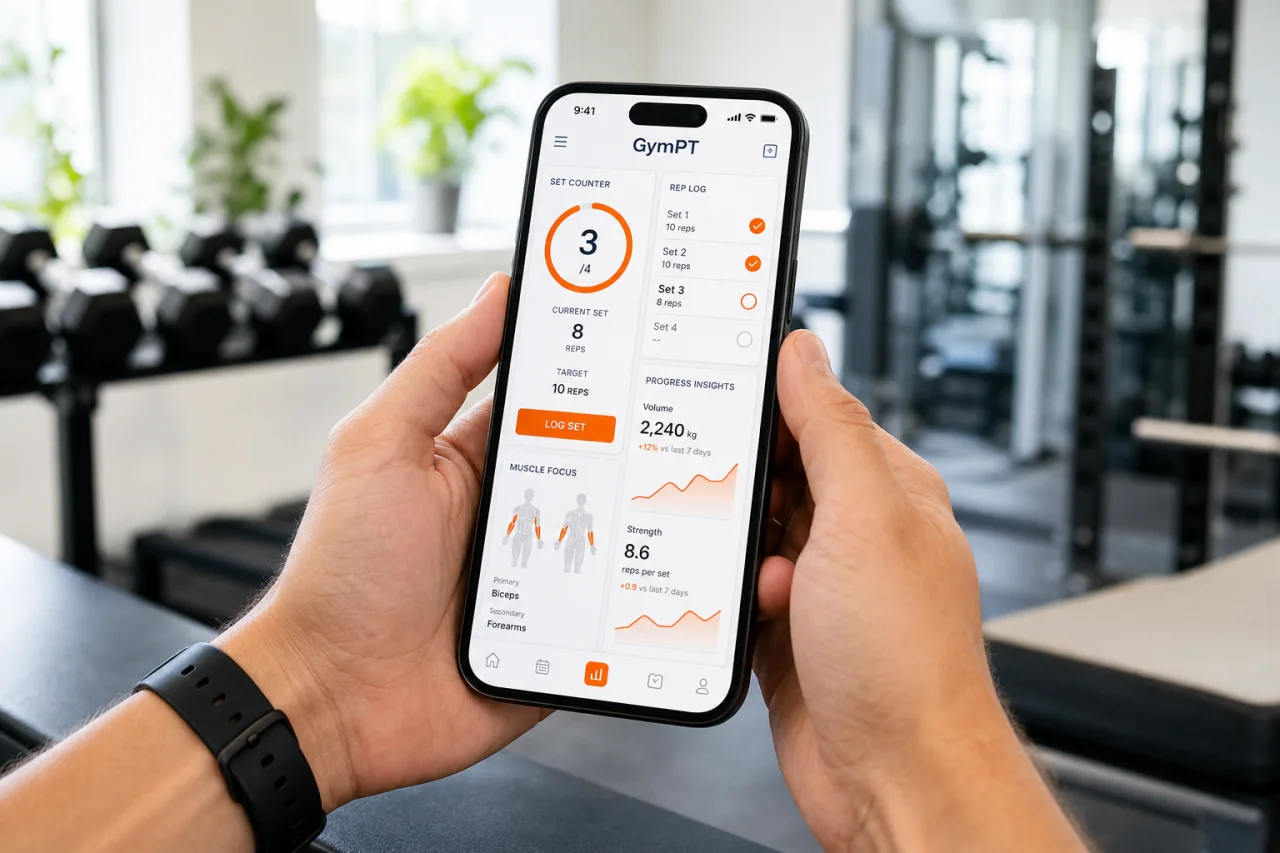
If you want a plan that fits your equipment, schedule, and recovery, GymPT can build it for you. The app can organize your arm work into a personalized routine, track your workouts, and show progress trends so you know when to add load, reps, or volume. That matters because the best arms exercises only work when they are placed into a plan you can actually follow.
Use GymPT to turn a list of exercises into a real training system: one that matches your goals, keeps your form honest, and helps you stay consistent long enough to see results.
Final takeaway
The best arms exercises are not the flashiest ones. They are the movements that train both biceps and triceps, fit your equipment, and let you progress without losing form. Start with a few reliable curls, a few strong triceps patterns, and enough weekly volume to challenge the muscles. Keep the reps controlled, the technique clean, and the plan simple enough to repeat.