best abs exercises
Best Abs Exercises: 9 Smart Moves for Stronger, Better-Form Core Training
A practical guide to the best abs exercises, with form cues, beginner-friendly alternatives, and a simple weekly plan you can actually follow.
Best abs exercises: what actually deserves a place in your routine
If you want the best abs exercises, don’t just chase the burn. The smartest core training builds strength you can use: better bracing, cleaner lifting, more stable running, and stronger posture in daily life. Your abs are part of a larger core system that includes the lower back, hips, and pelvis, so the best choices train the trunk to resist movement, flex with control, and stay stable under load.
That means a good abs routine should include more than endless crunches. A balanced plan usually mixes flexion-based work, anti-extension work, and anti-rotation work. In practice, that gives you exercises that train the front of the core, the deep stabilizers, and the obliques without overcomplicating your workout.
The 9 best abs exercises for most people
Below are the most useful options for building a stronger core. You do not need all nine in one session. Pick 3 to 5 and progress them over time.
1. Crunch
The crunch is still one of the most efficient direct ab exercises when it is done well. Keep your lower back gently anchored, lift the shoulder blades, and avoid yanking your neck. Think “ribs toward pelvis,” not “sit all the way up.”
- Best for: Direct rectus abdominis work
- Form cue: Exhale as you curl up, then lower slowly
- Beginner alternative: Smaller range of motion with hands across the chest
2. Reverse crunch
The reverse crunch shifts emphasis toward the lower portion of the abs and teaches you to control pelvic movement. Keep the motion smooth and avoid swinging your legs. The goal is to curl the pelvis upward, not to throw your knees toward your face.
- Best for: Controlled trunk flexion
- Form cue: Roll the hips up, then lower with control
- Beginner alternative: Bent-knee knee tuck on the floor
3. Plank
The plank is a classic anti-extension exercise. It trains your core to resist sagging, which matters for lifting, sprinting, and everyday bracing. Keep your body in a straight line, squeeze your glutes, and breathe behind the brace instead of holding your breath the entire time.
- Best for: Core stability and bracing
- Form cue: Elbows under shoulders, ribs down, glutes tight
- Beginner alternative: Kneeling plank
4. Dead bug
The dead bug is one of the best beginner abs exercises because it teaches coordination without loading the spine heavily. Move one arm and the opposite leg while keeping your lower back from arching. If your back pops off the floor, shorten the range.
- Best for: Deep core control
- Form cue: Exhale as the arm and leg extend
- Beginner alternative: Heel taps only
5. Side plank
The side plank trains the obliques and the muscles that help keep your pelvis level. It is especially useful if you want a stronger, more balanced core without relying on spinal flexion. Keep your shoulder stacked and your hips lifted in one line.
- Best for: Obliques and lateral stability
- Form cue: Push the floor away and keep the neck long
- Beginner alternative: Side plank from the knees
6. Bicycle crunch
The bicycle crunch can be effective when it is controlled. The mistake is rushing through it. Rotate through the torso, not just the elbows, and keep the movement deliberate so the abs do the work instead of momentum.
- Best for: Dynamic core work and obliques
- Form cue: Slow twist, controlled reach
- Beginner alternative: Slow alternating knee-to-elbow taps
7. Hollow hold
The hollow hold is a demanding anti-extension drill that teaches full-body tension. It is excellent for gymnasts, lifters, and anyone who wants a stronger midline. If it feels too hard, bend the knees or keep the arms by your sides.
- Best for: Bracing and trunk stiffness
- Form cue: Keep the low back pressed down
- Beginner alternative: Tucked hollow hold
8. Mountain climber
Mountain climbers are not just cardio. Done with control, they challenge the core to stay steady while the legs move. Keep your shoulders over your wrists and avoid bouncing the hips side to side.
- Best for: Core endurance under movement
- Form cue: Slow knees, quiet hips
- Beginner alternative: Incline mountain climbers on a bench
9. Pallof press
The Pallof press is one of the best anti-rotation exercises for core training. It teaches your torso to resist twisting, which carries over well to lifting and sports. Use a cable or band, press straight out, and keep your ribs stacked over your pelvis.
- Best for: Anti-rotation strength
- Form cue: Do not let the band pull you into rotation
- Beginner alternative: Lighter band and shorter hold
How to choose the right abs exercises for your goal
The best abs workout depends on what you want the core to do. If your goal is visible ab development, you still need direct ab work, but you also need overall training and nutrition habits that support body composition. If your goal is performance, stability drills may matter more than high-rep burnouts. If your goal is simply to train safely as a beginner, start with movements that let you keep perfect control.
- For muscle-building: Crunches, reverse crunches, bicycle crunches
- For stability: Planks, dead bugs, hollow holds
- For anti-rotation: Pallof presses, side planks
- For beginners: Dead bugs, kneeling planks, heel taps
How much ab training you actually need
You do not need to train abs every day. For most people, 2 to 4 core sessions per week is enough, especially if you already squat, hinge, press, and carry in your main workouts. A simple target is 2 to 4 exercises per session, for 2 to 4 sets each, using controlled reps or timed holds.
Good starting ranges:
- Crunches or reverse crunches: 8 to 15 reps
- Planks or side planks: 20 to 45 seconds
- Dead bugs or Pallof presses: 6 to 10 reps per side
Stop a set when your form breaks. For core work, quality matters more than chasing fatigue. If your lower back starts arching, your neck tenses up, or your hips twist, the set is over.
Common abs training mistakes to avoid
Many people make abs training harder than it needs to be. The biggest mistake is using momentum instead of control. Another common issue is doing only flexion exercises and ignoring stability work. That can leave your core strong in one pattern but underprepared in others.
- Pulling on the neck: Keep the hands light and the chin neutral
- Arching the lower back: Brace the ribs down and shorten the range
- Rushing reps: Slow down and own the lowering phase
- Training only one pattern: Mix crunches, planks, and anti-rotation work
- Doing too much too soon: Start with fewer exercises and build gradually
A simple beginner abs workout you can use today
If you want a straightforward routine, try this 10-minute core session:
- Dead bug — 2 sets of 6 to 8 reps per side
- Kneeling plank — 2 sets of 20 to 30 seconds
- Crunch — 2 sets of 10 to 15 reps
- Side plank from knees — 2 sets of 15 to 25 seconds per side
Rest 30 to 60 seconds between sets. If you finish and feel like you could do much more, increase the hold time, add a set, or slow the tempo next time. That is how you progress without turning core training into random burnout.
How GymPT helps you train abs smarter
GymPT can turn these exercises into a plan that fits your level, your equipment, and your schedule. Instead of guessing which abs exercises to do, you can build a personalized core workout, track your reps and holds, and use progress insights to see when it is time to make the routine harder.
If you want a stronger core, the best approach is simple: choose a few high-quality movements, use clean form, and progress them consistently. That is how abs training becomes useful, not just exhausting.
Quick takeaway: The best abs exercises are the ones you can perform with control, repeat consistently, and progress over time.
Featured image
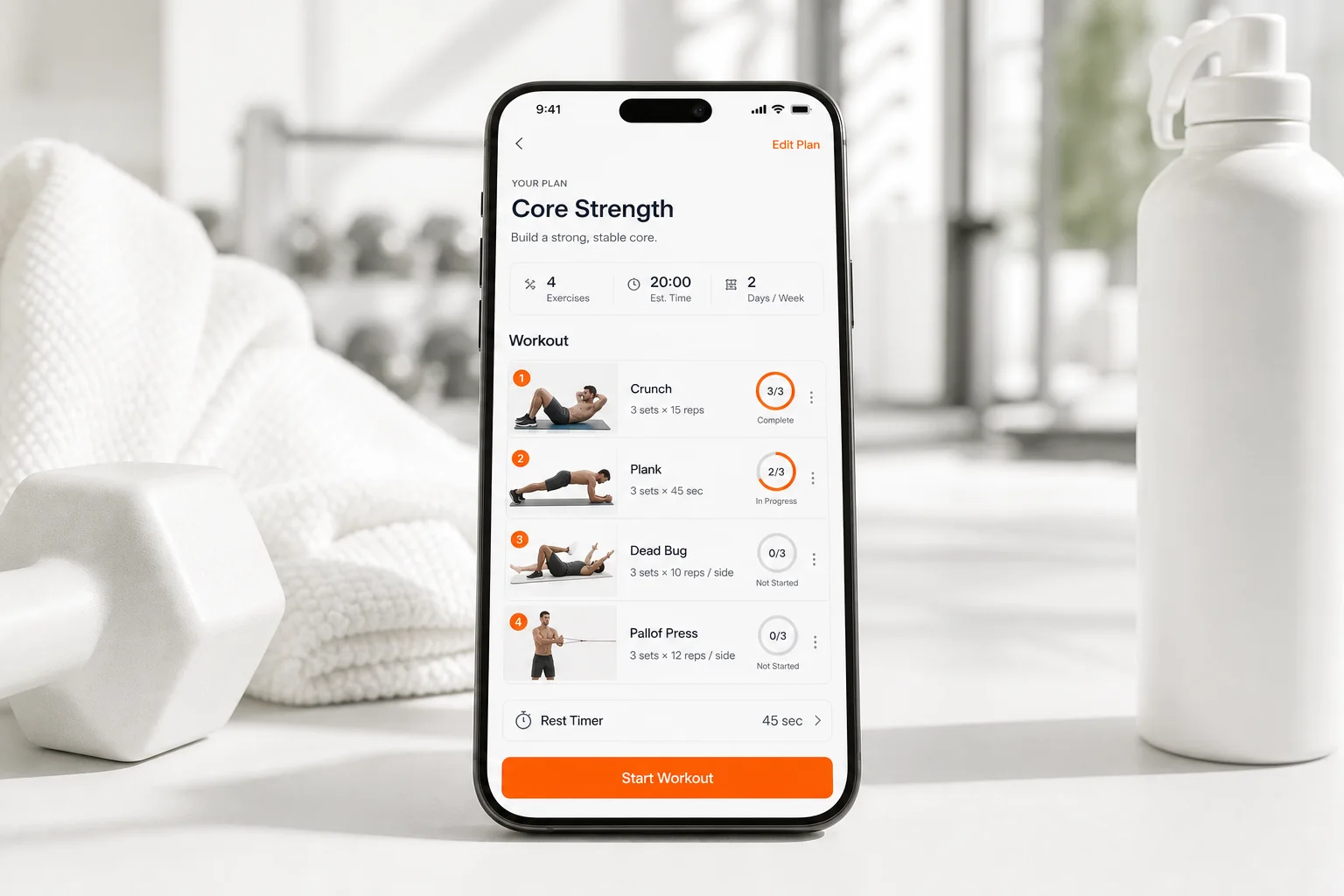
A premium GymPT app editorial scene showing a user reviewing a core workout plan on a phone in a bright paper-white gym space, with orange GymPT accents, dark ink UI text, and realistic exercise cards for crunch, plank, dead bug, and Pallof press. Include subtle workout tracking details and a clean, modern fitness aesthetic. No third-party branding, no fake logos, no watermarks.
Inline image 1
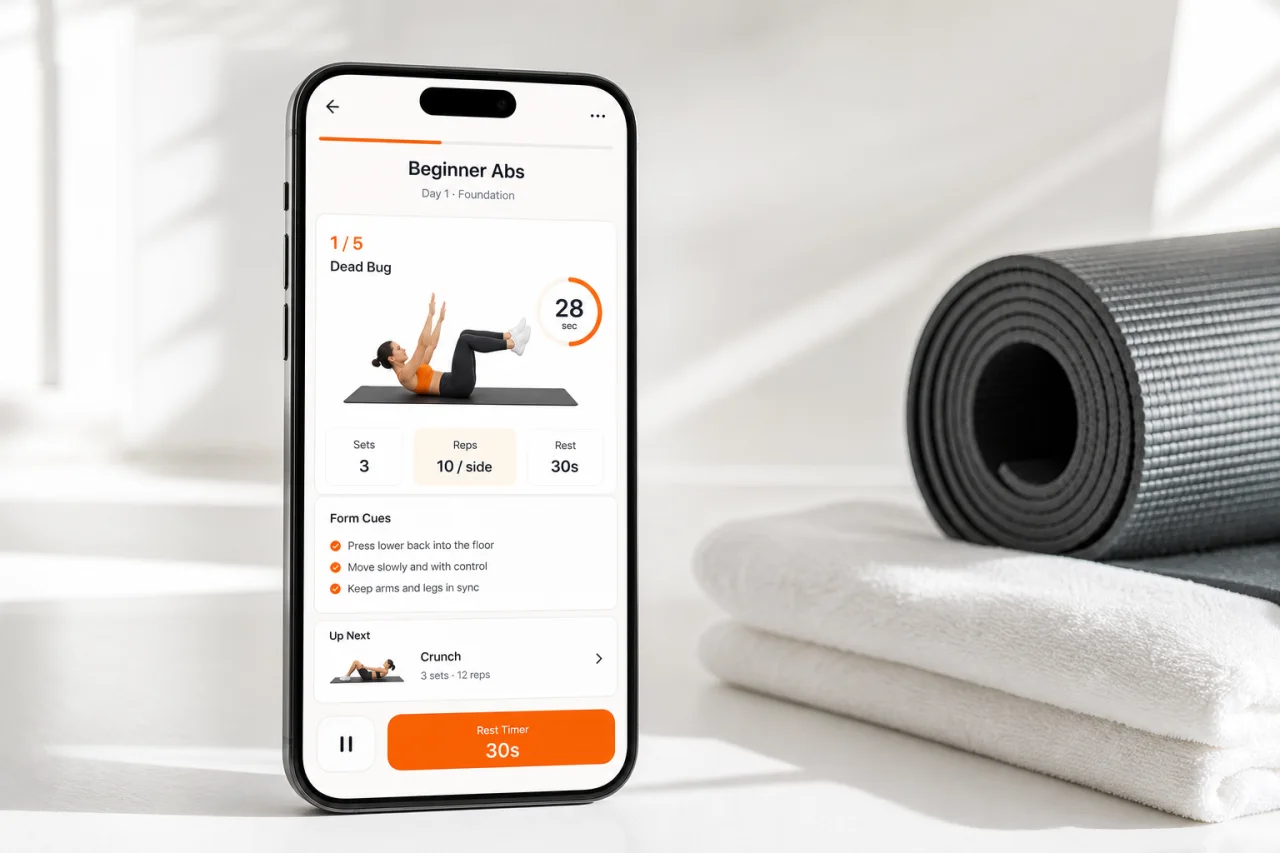
A realistic GymPT coaching screen on a smartphone beside a yoga mat, showing a beginner-friendly abs workout with set counts, rest timers, and form cues in a clean orange, ink, and paper palette. The scene should feel editorial and premium, with no non-GymPT brand marks.
Inline image 2
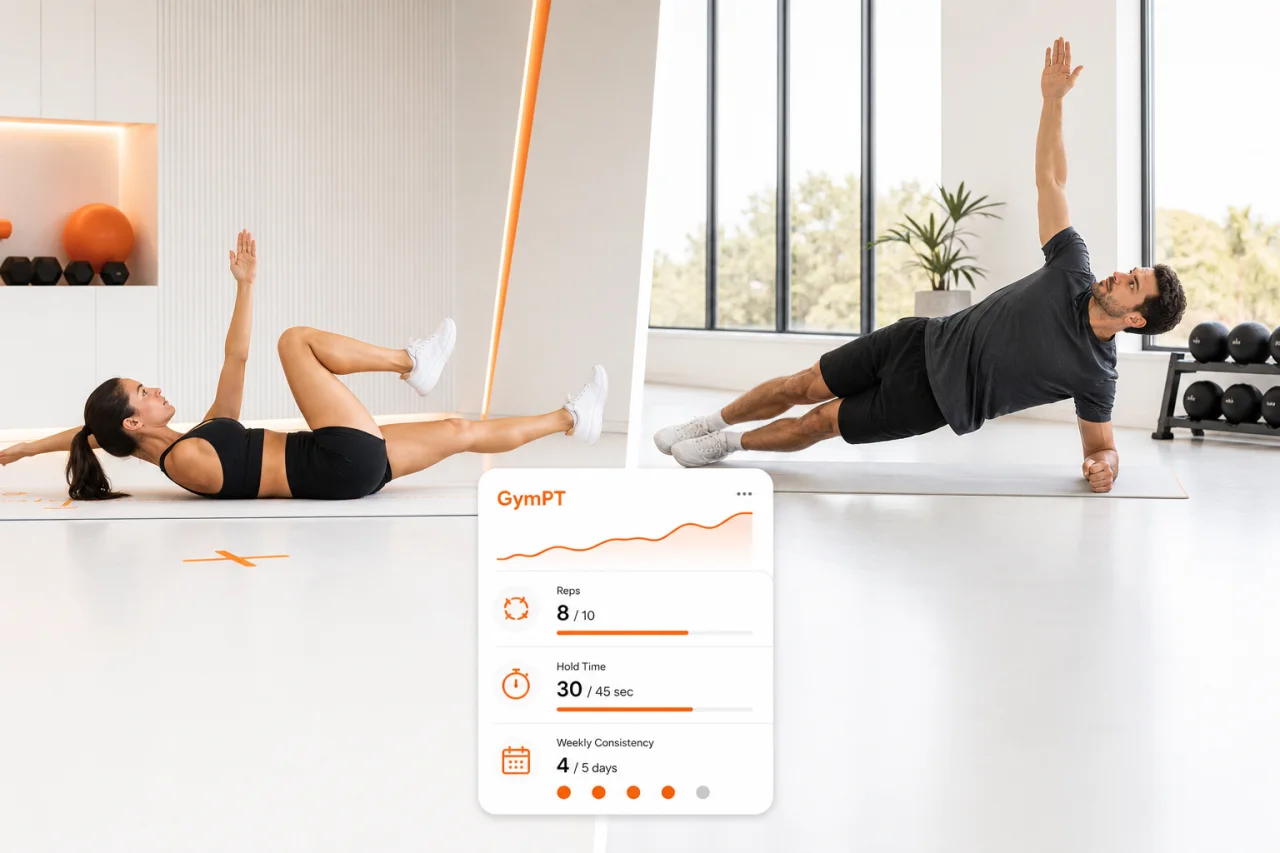
A split editorial visual of two core-training moments: a controlled dead bug and a side plank, with a small GymPT progress card overlay showing reps, hold time, and weekly consistency. Bright, minimal, app-first composition, GymPT-only branding.
Internal links to explore next
- Push Up Form Guide — useful if you want better full-body bracing and upper-body control.
- Squat Form Guide — helpful for learning how core stability supports lower-body lifts.
- Progressive Overload Workout Plan — a good next step if you want to keep improving your core work.
- Bodyweight Only Workout — a simple option if you want to train abs without equipment.