progressive overload workout plan
Progressive Overload Workout Plan: How to Track Real Progress Without Guesswork
A progressive overload workout plan works best when you track the right metrics, review them on a schedule, and adjust training before progress stalls.
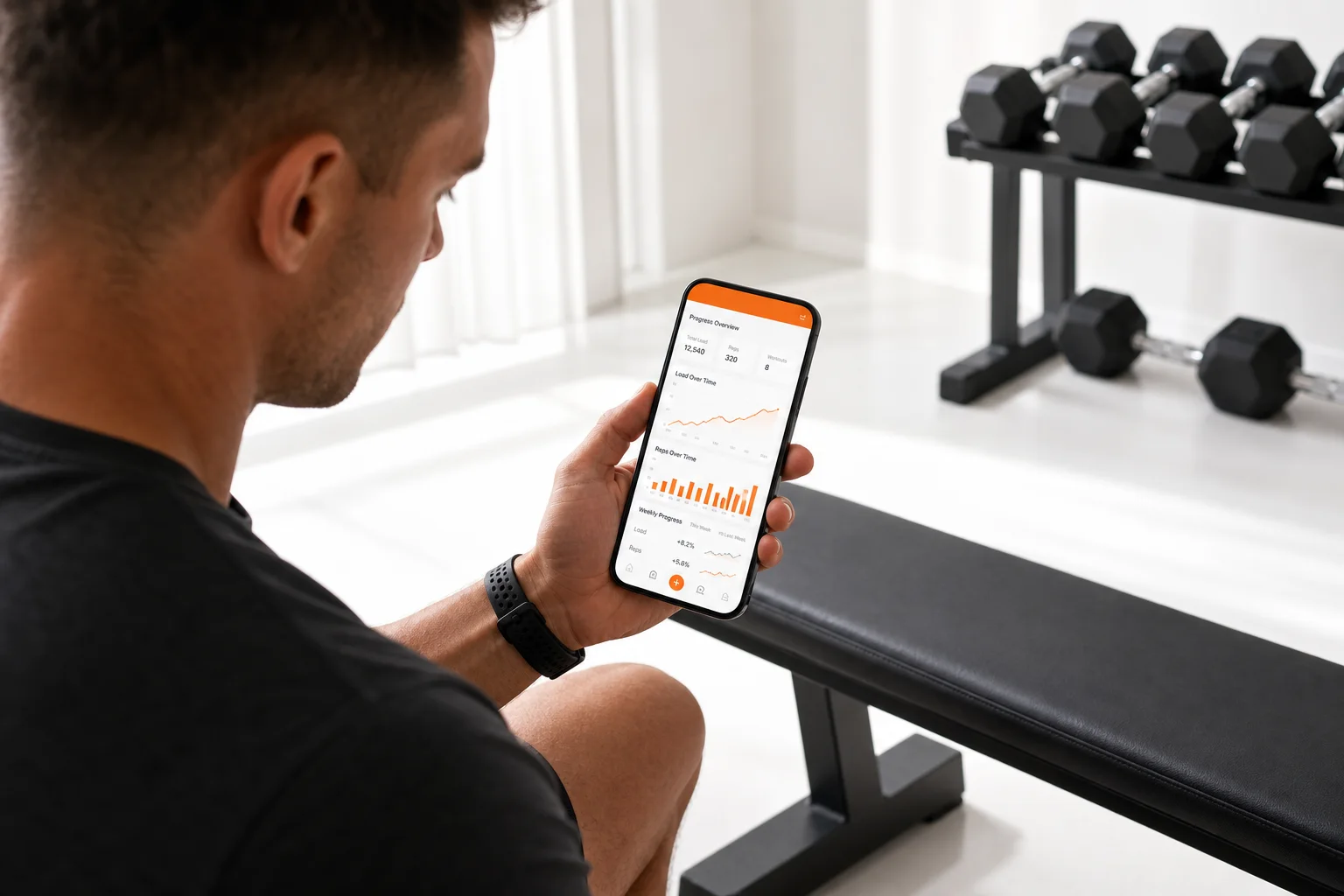
Progressive overload workout plan: the simplest way to keep getting stronger
A progressive overload workout plan is not just about adding weight every session. It is about giving your body a reason to adapt, then tracking that adaptation with enough structure to know what is actually working. That matters because adults are generally advised to include muscle-strengthening activity at least two days per week, and resistance training is most effective when the challenge increases over time in a planned way.
The problem is that many lifters rely on memory. They think they are improving, but they cannot tell whether the change came from more reps, better technique, shorter rest, or simply a good day. A better plan uses clear metrics, simple logs, and realistic review intervals so progress is visible before motivation fades.
What progressive overload really means
Progressive overload means gradually increasing the training demand so your body has to adapt. In practice, that can happen by adding load, adding reps, adding sets, improving range of motion, reducing rest, or making the movement more difficult. The best choice depends on the exercise, your experience level, and how well you recover.
For most people, the goal is not to force a bigger number every workout. The goal is to make the next training block slightly more demanding than the last one while keeping form, recovery, and consistency under control.
The metrics that matter most
If you want a progressive overload workout plan that actually works, track the numbers that reflect real training stress and performance. The most useful metrics are simple:
- Load: the weight used for each exercise.
- Reps: how many clean repetitions you completed.
- Sets: how much total work you performed.
- RPE or effort level: how hard the set felt.
- Rest time: how long you recovered between sets.
- Technique quality: whether the movement stayed controlled and consistent.
These numbers tell a better story than bodyweight alone. A stronger squat, a cleaner press, or an extra rep at the same load is progress even if the scale has not changed.
Use one primary metric per lift
Not every exercise needs every metric to improve at once. For a main compound lift, you might focus on load and reps. For accessory work, reps and technique may matter more than heavy loading. This keeps your plan focused and prevents you from chasing too many variables at the same time.
How to log workouts so the data is useful
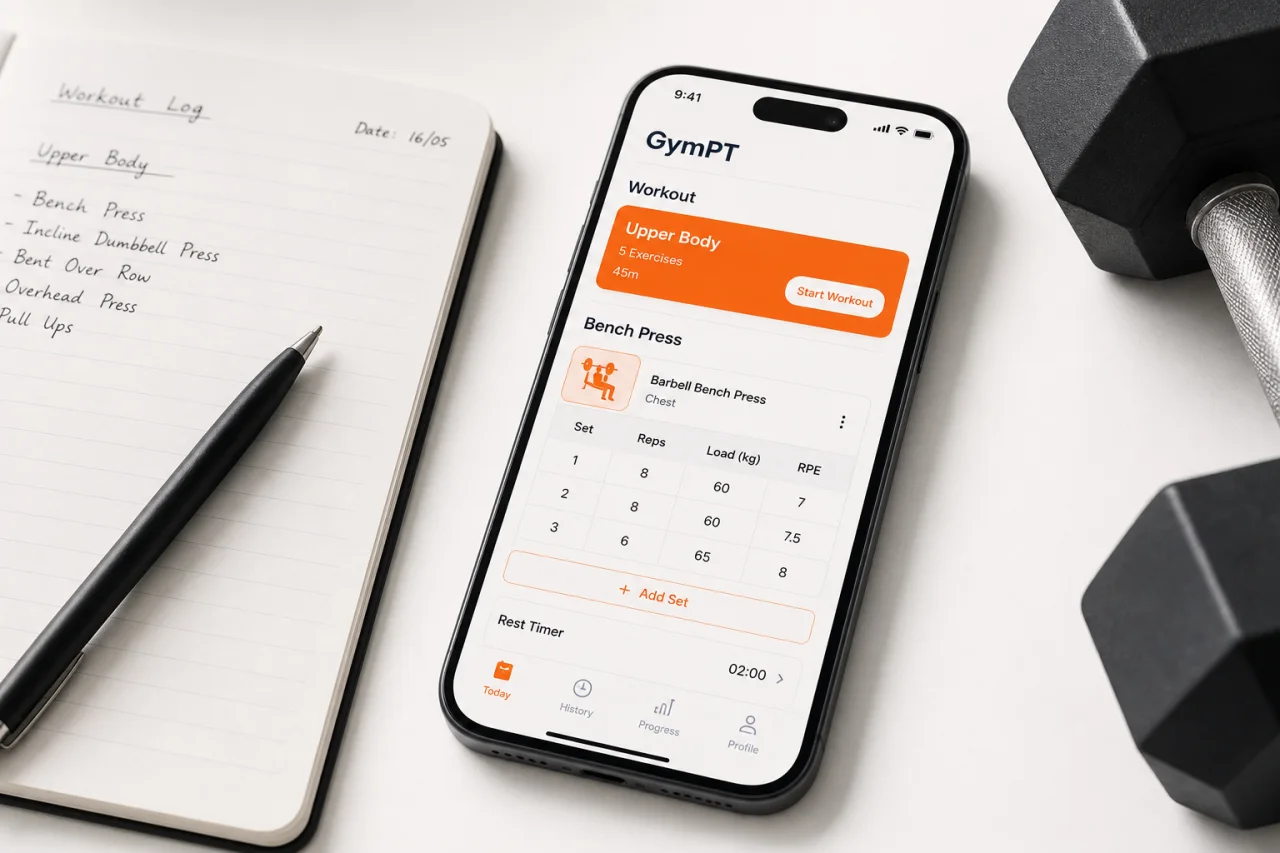
Good workout logs are short, specific, and consistent. Each entry should tell you what you did, how hard it felt, and what to change next time. A useful log might include the exercise, sets, reps, load, rest, and one brief note about performance.
For example:
- Bench press — 4 sets of 6 reps at 80 kg, last set RPE 8, add 1 rep next week if form stays clean.
- Lat pulldown — 3 sets of 10 reps at 55 kg, controlled tempo, keep load and add a set in the next block.
- Split squat — 3 sets of 8 reps per leg, stable balance, increase range of motion before load.
This kind of logging makes your next decision obvious. You are not guessing whether to push harder; you are reading the evidence from the previous session.
How often should you review progress?
Reviewing too often can make normal day-to-day variation look like failure. Reviewing too rarely can let a stalled plan continue for weeks. A realistic rhythm is to check training trends every 2 to 4 weeks and make bigger programming decisions every 4 to 8 weeks.
That interval gives you enough data to see patterns in performance, recovery, and consistency. It also matches how resistance training adaptations usually show up: gradually, not overnight.
Use shorter check-ins for exercise performance and longer check-ins for body composition or physique changes. Strength can improve within a few sessions, while visible body changes usually need more time and more consistent training.
What to look for in a review
- Are your main lifts moving up in load, reps, or control?
- Are you recovering well enough to repeat quality sessions?
- Are you missing reps because the plan is too aggressive?
- Are you progressing in one area while another stays flat?
If the answer is yes to the first two and no to the last two, your plan is probably on track.
How to progress without burning out
A smart progressive overload workout plan does not force every session to be harder than the last. That approach usually breaks down recovery. Instead, progress in small steps and use a few reliable rules.
- Start with a repeatable baseline. Choose loads and rep ranges you can perform with good form.
- Progress one variable at a time. Add reps before load, or load before sets, depending on the exercise.
- Keep most sets submaximal. Leave a little room in reserve so you can train again soon.
- Deload when needed. If performance drops for more than one week and fatigue is high, reduce volume or intensity briefly.
- Judge the block, not one workout. One bad session is noise; a flat trend is information.
This is where many plans fail. People try to force linear progress forever. In reality, progress is usually a staircase: a few steps up, a short plateau, then another step up.
How GymPT can help you track overload more accurately
GymPT makes progression easier because it turns training into a visible system. You can build a personalized plan, log each workout, and see whether your numbers are moving in the right direction. That matters when you want to compare sessions across weeks instead of relying on memory.
With AI coach chat, you can also ask whether to add load, keep the same weight, or change the rep target. If you train with specific equipment, GymPT can adapt the plan to what you actually have available. And if you want a broader view, progress insights help you spot trends in consistency, volume, and performance before they become obvious problems.
A simple weekly structure for progressive overload
If you want a practical starting point, use a weekly structure that repeats the same key lifts often enough to measure progress. For example, train each major movement pattern 2 times per week and keep the exercise selection stable for a full block.
- Day 1: squat pattern, horizontal press, row, accessory core work.
- Day 2: hinge pattern, vertical press, vertical pull, single-leg accessory.
- Day 3: repeat the main patterns with slightly different rep targets or load.
That setup gives you enough repetition to compare performance while still allowing recovery. It also makes your logs easier to read because the same lifts appear often enough to show a trend.
Common mistakes that hide progress
Sometimes progress is happening, but the plan makes it hard to see. Watch out for these mistakes:
- Changing exercises too often: you never get a clean comparison.
- Tracking only bodyweight: strength and skill improvements get ignored.
- Adding load too fast: form breaks down before adaptation catches up.
- Reviewing after every workout: normal variation looks like failure.
- Ignoring recovery: fatigue masks real gains.
A better approach is to keep the plan stable long enough to measure it, then adjust only when the data says you should.
How to know when to change the plan
Change the plan when the trend changes, not when one workout feels off. If your reps, load, or technique have stalled for several sessions and recovery is still poor, it may be time to reduce volume, change the rep range, or swap the exercise variation.
On the other hand, if performance is rising and effort feels manageable, keep the plan steady. The best progressive overload workout plan is not the one that changes most often. It is the one that changes only when the evidence supports it.
Build progress you can actually measure
Progressive overload works best when it is visible. Track the lift, the reps, the effort, and the trend over time. Review your training every few weeks, not every few minutes. Then use those numbers to decide whether to push, hold, or adjust.
That is the difference between hoping for progress and managing it. With GymPT, you can turn that process into a simple routine: plan, log, review, and improve.
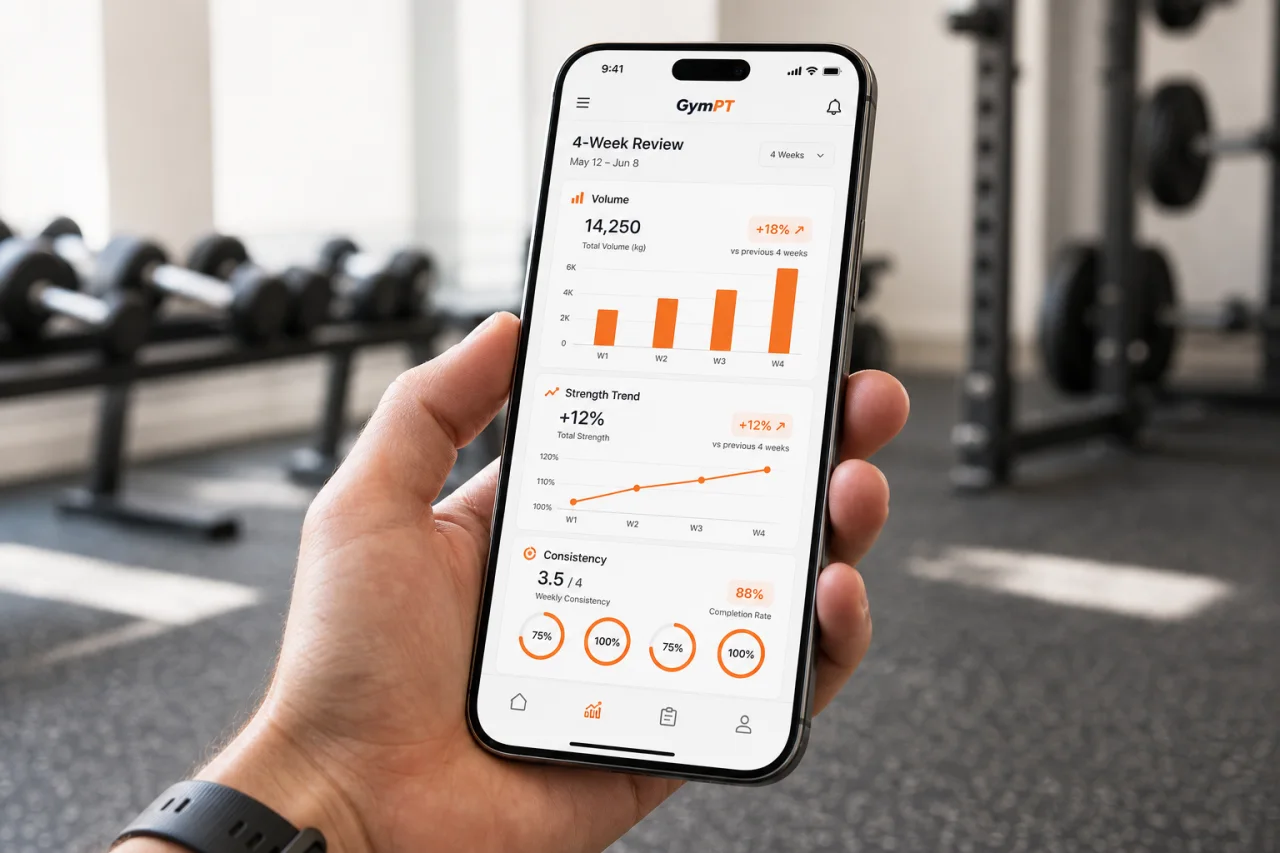
Ready to make your next block more measurable? Use GymPT to build your plan, track your workouts, and see progress with less guesswork.
Frequently asked questions
How do I apply progressive overload if I train at home?
You can still progress by adding reps, slowing tempo, increasing range of motion, shortening rest, or using harder variations. Load is only one way to overload a movement.
How long should I follow one workout plan?
Most people should keep a plan long enough to collect meaningful data, often 4 to 8 weeks, before making major changes. Small adjustments can happen sooner if performance clearly stalls.
What if my strength goes up but my body does not look different yet?
That is common. Strength can improve before visible physique changes. Keep logging performance and review body composition or measurements over a longer interval.