muscle building workout plan
Muscle Building Workout Plan: How to Train for Growth Without Guesswork
A muscle building workout plan works best when it matches your recovery, equipment, and schedule. Learn how to structure weekly volume, progress safely, and stay consistent.
Muscle Building Workout Plan: What Actually Drives Growth
A good muscle building workout plan is not just a list of exercises. It is a system for applying enough training stimulus, recovering from it, and repeating that cycle consistently. For most people, the biggest drivers of muscle gain are weekly training volume, progressive overload, exercise selection, and recovery management.
If your plan is random, too easy, or impossible to recover from, progress slows down. If it is structured well, you can build muscle with fewer wasted sessions and better long-term adherence.
The 4 rules of a muscle-building plan
1) Use enough weekly volume
Muscle growth responds well to sufficient hard sets per muscle group each week. In practice, that usually means starting with a moderate amount of volume and building up only if you are recovering well and still progressing. A useful target for many lifters is around 10 or more challenging sets per muscle group per week, adjusted for experience and recovery.
2) Train close enough to failure
You do not need to max out every set, but your working sets should be hard enough to create a growth stimulus. Most sets should finish with a few reps left in reserve, especially on compound lifts. That balance helps you train productively without burning out too fast.
3) Progress over time
Progressive overload is the engine of long-term muscle gain. That can mean adding weight, adding reps, adding sets, improving technique, or reducing rest only when it makes sense. The key is that your body has a reason to adapt from week to week.
4) Recover like growth depends on it
Because it does. Muscles grow between sessions, not during them. Sleep, nutrition, rest days, and smart exercise spacing all matter. If performance is dropping, soreness is lingering, or motivation is crashing, your plan may need less volume or more recovery.
How to structure a weekly muscle gain routine
A simple weekly structure is often better than an overly complicated split. For many people, training each muscle group two times per week is a practical way to balance stimulus and recovery. Beginners can grow well with full-body training three days per week, while more experienced lifters may prefer upper/lower or push-pull-legs structures.
- Beginners: 3 full-body sessions per week
- Intermediate lifters: 4 sessions per week with upper/lower focus
- Advanced lifters: 5 to 6 sessions per week if recovery is strong
The best split is the one you can repeat consistently while still adding quality work over time.
A sample muscle building workout plan
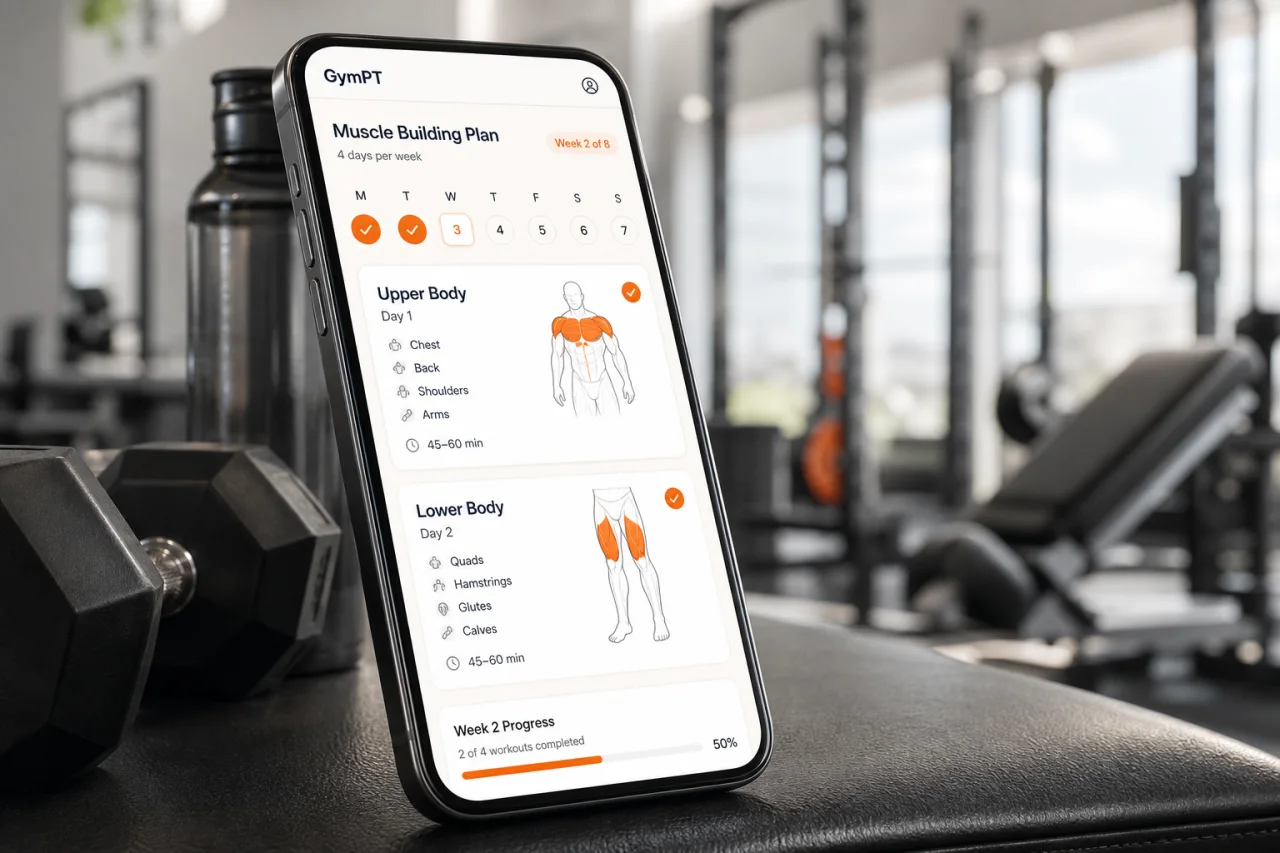
Here is a simple four-day structure that works well for many lifters using dumbbells, machines, or a full gym.
Day 1: Upper body
- Bench press or dumbbell press
- Row variation
- Overhead press
- Lat pulldown or pull-up
- Arm accessory work
Day 2: Lower body
- Squat or leg press
- Romanian deadlift
- Lunge or split squat
- Leg curl
- Calf raises
Day 3: Rest or light activity
Day 4: Upper body
- Incline press
- Chest-supported row
- Lateral raise
- Pull-down or pull-up variation
- Arm accessory work
Day 5: Lower body
- Deadlift variation or hip hinge
- Front squat or hack squat
- Leg press or step-up
- Hamstring curl
- Core work
This is not the only way to train for muscle gain, but it is a strong starting point because it gives each muscle enough weekly exposure without making sessions too long.
How to choose exercises that actually build muscle
The best exercises are the ones that let you apply tension safely and repeatably. Prioritize movements you can load progressively and perform with good control.
- Compound lifts: squats, presses, rows, hinges, pull-downs
- Isolation work: curls, triceps extensions, lateral raises, leg curls
- Machine work: useful for adding volume with less fatigue
A smart plan usually combines all three. Compound lifts build the base, isolation work fills in weak links, and machines help you add quality volume without overtaxing recovery.
How to progress without stalling
Progress does not have to mean adding weight every session. A better approach is to use a progression rule you can follow consistently.
- Pick a rep range, such as 6 to 10 or 8 to 12.
- Use the same exercise for several weeks.
- When you hit the top of the rep range with good form, increase the load slightly.
- If performance drops for multiple sessions, reduce volume or take a lighter week.
This keeps your training organized and helps you avoid the common mistake of changing everything too often.
Recovery: the part most plans ignore
Recovery is not a bonus feature. It is part of the plan. If you want muscle growth, you need enough rest between hard sessions, especially when training the same muscle groups.
- Sleep: aim for consistent, high-quality sleep
- Nutrition: eat enough protein and total calories to support growth
- Rest days: place them where they improve performance, not just where they look neat on paper
- Fatigue control: reduce volume if your lifts are flat for too long
When recovery improves, training quality usually improves with it.
How GymPT helps you stay on track
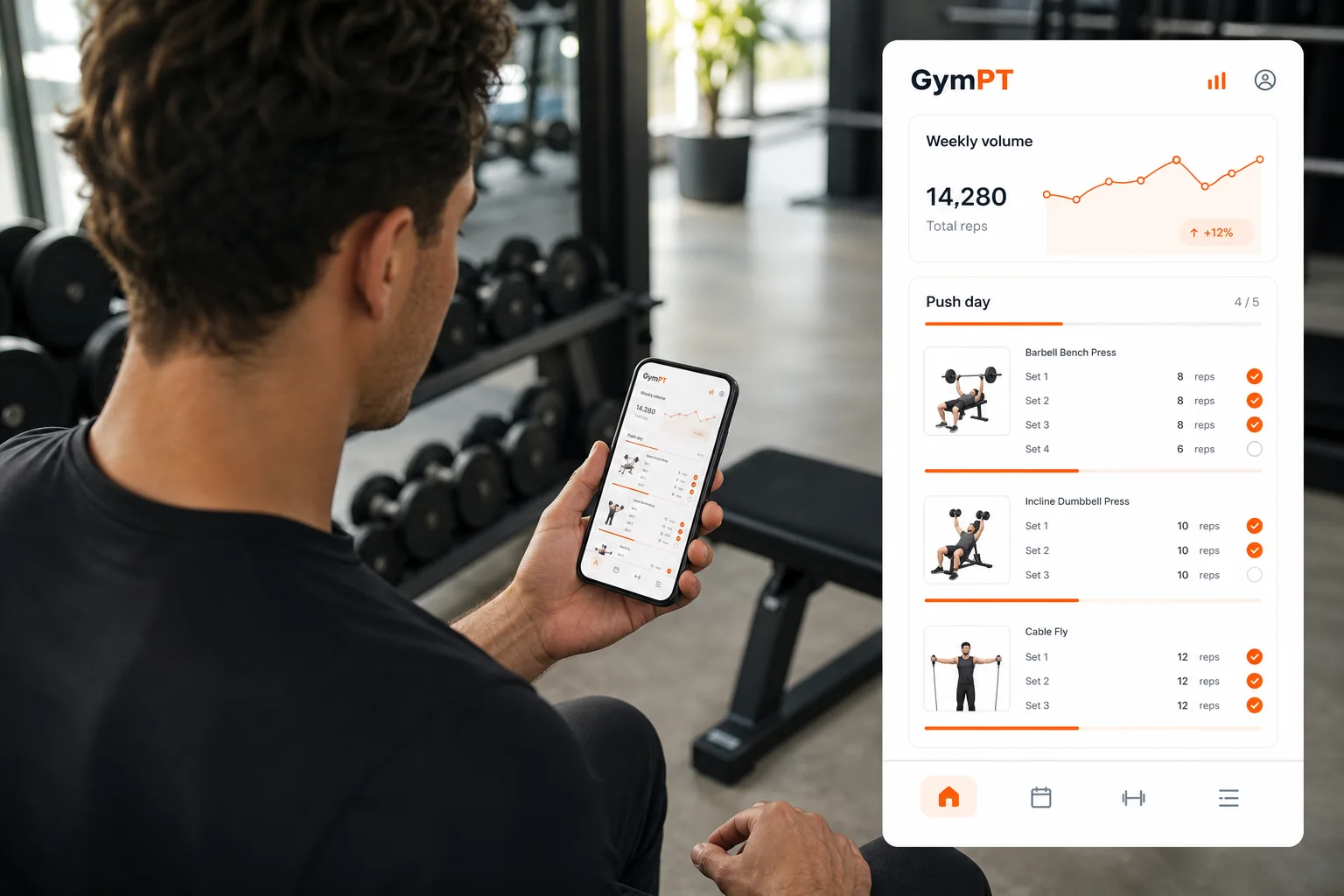
GymPT makes it easier to turn a good idea into a plan you can actually follow. You can build a personalized workout plan based on your equipment, track your sessions, and use progress insights to see whether your volume and effort are moving in the right direction. If your schedule changes, the plan can adapt instead of forcing you to start over.
That matters because the best muscle building workout plan is the one you can sustain long enough to see results.

When to adjust your plan
Change your plan only when the data says you should. Good reasons to adjust include:
- you are no longer adding reps or load
- your recovery is consistently poor
- certain muscles are not getting enough weekly work
- your sessions are too long to repeat consistently
If progress is steady, keep the plan. If progress stalls, change one variable at a time so you know what helped.
Final takeaway
A strong muscle building workout plan is built on enough weekly volume, progressive overload, recovery, and consistency. You do not need a perfect split or a complicated routine. You need a plan that gives your muscles a reason to grow and gives your body enough time to adapt.
If you want a more personalized approach, GymPT can help you build, track, and refine your training as you go.