upper body workout plan
Upper Body Workout Plan: Build Stronger Push and Pull Days With Better Weekly Progression
A practical upper body workout plan should train push and pull patterns, manage weekly volume, and progress without beating up your shoulders. Here’s how to build one.
Upper Body Workout Plan: what it should actually do
An effective upper body workout plan is not just a list of chest exercises. It should train the main movement patterns of the upper body, balance pushing and pulling, and give you a clear way to progress week to week. For most adults, strength training should cover the major muscle groups at least two days per week, and muscle-strengthening work belongs in a well-rounded weekly routine.
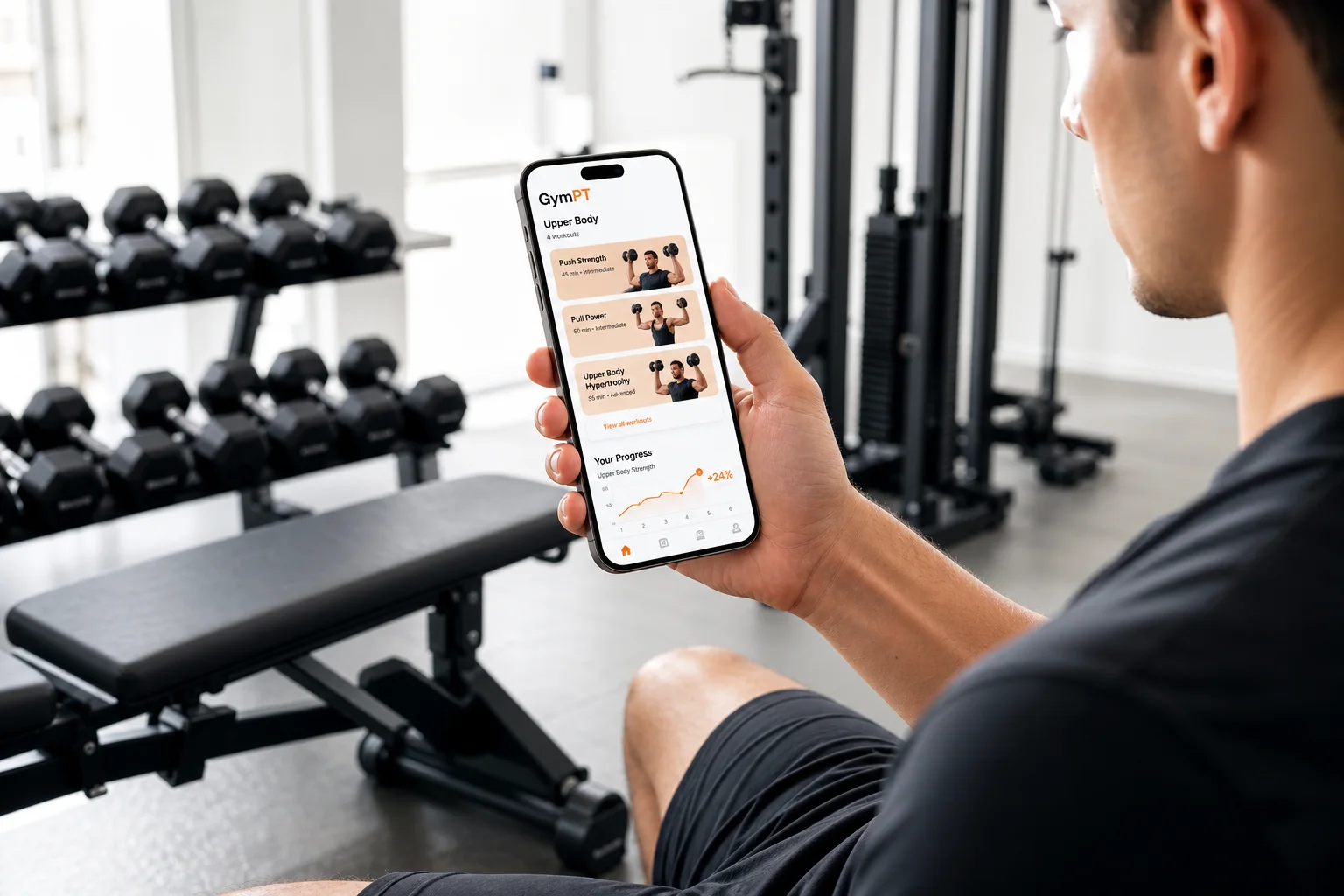
If your goal is to look stronger, lift more, or simply feel more capable in the gym, the best plan is usually simple: choose a few reliable compound lifts, add a small amount of isolation work, and repeat the structure long enough to improve it. That is the kind of plan GymPT is built to organize for you.
The best upper body training structure
A smart upper body session usually includes four parts:
- One horizontal push such as a bench press or dumbbell press.
- One horizontal pull such as a row variation.
- One vertical push such as an overhead press.
- One vertical pull such as a pulldown or pull-up pattern.
This structure helps you cover the big patterns without overloading one area. It also makes it easier to keep your shoulders happy, because pressing volume is balanced with enough pulling work.
Sample weekly split
If you train upper body twice per week, use one heavier day and one moderate-volume day:
- Day 1: heavier presses and rows, lower reps, longer rest.
- Day 2: moderate loads, more total sets, accessory work for shoulders and arms.
If you train upper body once per week, keep the session full-body in its own category: include at least one push, one pull, one overhead movement, and one arm finisher. If you train upper body more often, reduce per-session volume so recovery stays manageable.
A practical upper body workout plan for most lifters
Use this as a starting template, then adjust it to your equipment, experience, and recovery.
Workout A
- Bench press or dumbbell press — 3 sets of 5-8 reps
- Chest-supported row or cable row — 3 sets of 6-10 reps
- Overhead press — 2 to 3 sets of 6-10 reps
- Lat pulldown or assisted pull-up — 3 sets of 8-12 reps
- Lateral raise — 2 sets of 12-15 reps
- Triceps pressdown — 2 sets of 10-15 reps
Workout B
- Incline dumbbell press — 3 sets of 8-12 reps
- One-arm dumbbell row or machine row — 3 sets of 8-12 reps
- Seated dumbbell shoulder press — 2 to 3 sets of 8-12 reps
- Neutral-grip pulldown — 3 sets of 10-12 reps
- Rear delt fly — 2 sets of 12-15 reps
- Dumbbell curl — 2 sets of 10-15 reps
That gives you a balanced push and pull workout without making the plan complicated. It also works well whether you train in a full gym or with limited equipment.
How to choose the right exercises
The best exercise selection is the one you can repeat consistently with good form and steady progression. If you have access to machines, dumbbells, and cables, use the tools that let you train hard without unnecessary joint stress. If you only have basic equipment, keep the movement patterns the same and swap the implement.
- For chest: barbell press, dumbbell press, machine press, push-up.
- For back: row variations, pulldowns, pull-ups, cable rows.
- For shoulders: overhead press, lateral raise, rear delt fly.
- For arms: curls, pressdowns, overhead triceps extensions.
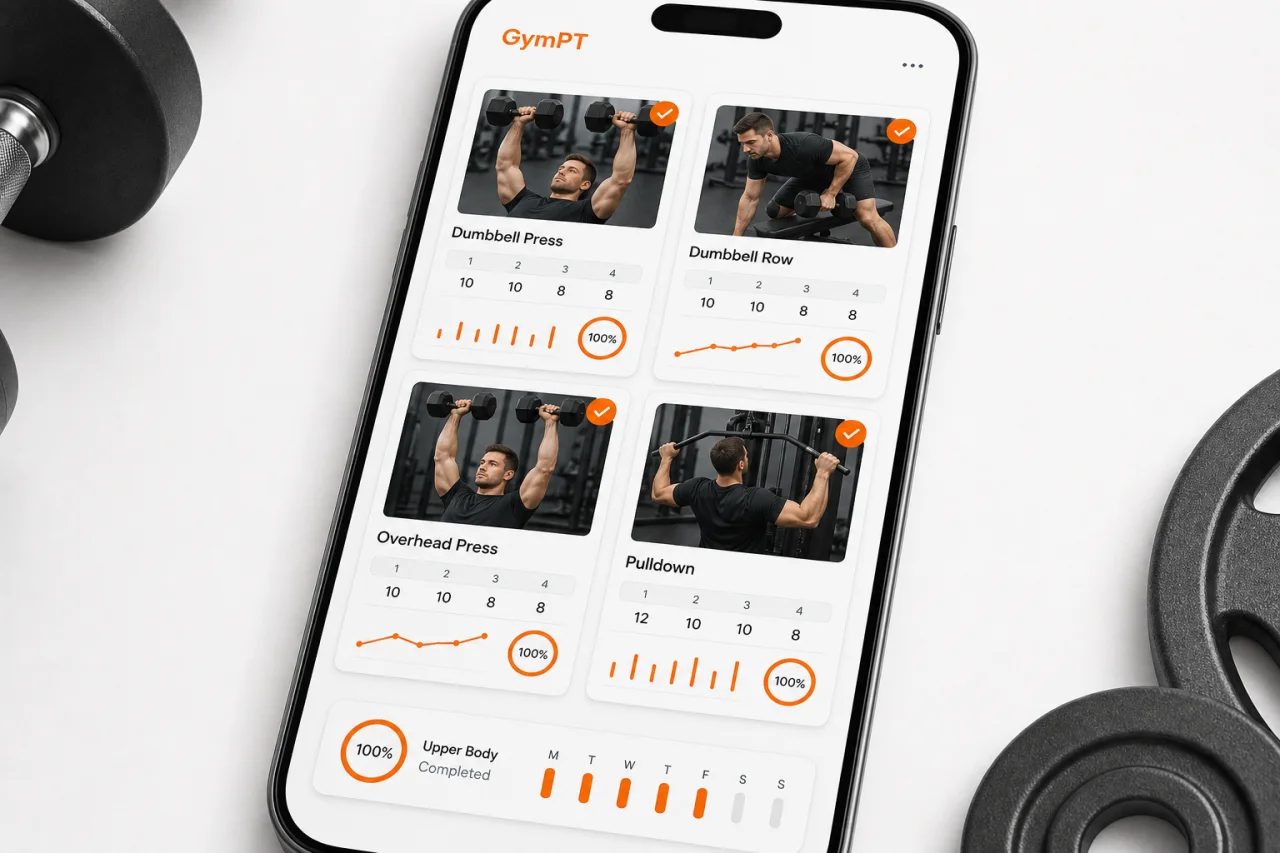
GymPT can match your upper body workout plan to the equipment you actually have, so you are not stuck guessing between dozens of similar exercises.
How much volume do you need?
For most people, progress comes from enough weekly work, not from doing everything in one session. A useful rule is to start with a moderate number of hard sets per muscle group and increase only when recovery and performance stay solid. If your reps are dropping, your joints feel beat up, or your motivation is fading, you may be doing too much too soon.
A good starting point for an upper body workout plan is:
- Chest: 6-10 sets per week
- Back: 8-12 sets per week
- Shoulders: 6-10 sets per week
- Biceps and triceps: 4-8 sets per week each
These are starting ranges, not fixed rules. Bigger or more advanced lifters may need more, while beginners often grow well on less.
How to progress without stalling
Progression should be simple enough that you can follow it for months. The easiest method is double progression:
- Pick a rep range, such as 6-10.
- Use the same weight until you can hit the top of the range on all sets.
- Increase the load slightly and repeat.
For example, if you do dumbbell press for 3 sets of 6-10 reps, you might build from 8, 8, 7 to 10, 10, 10 before moving up in weight. That keeps the plan measurable and avoids random changes every workout.
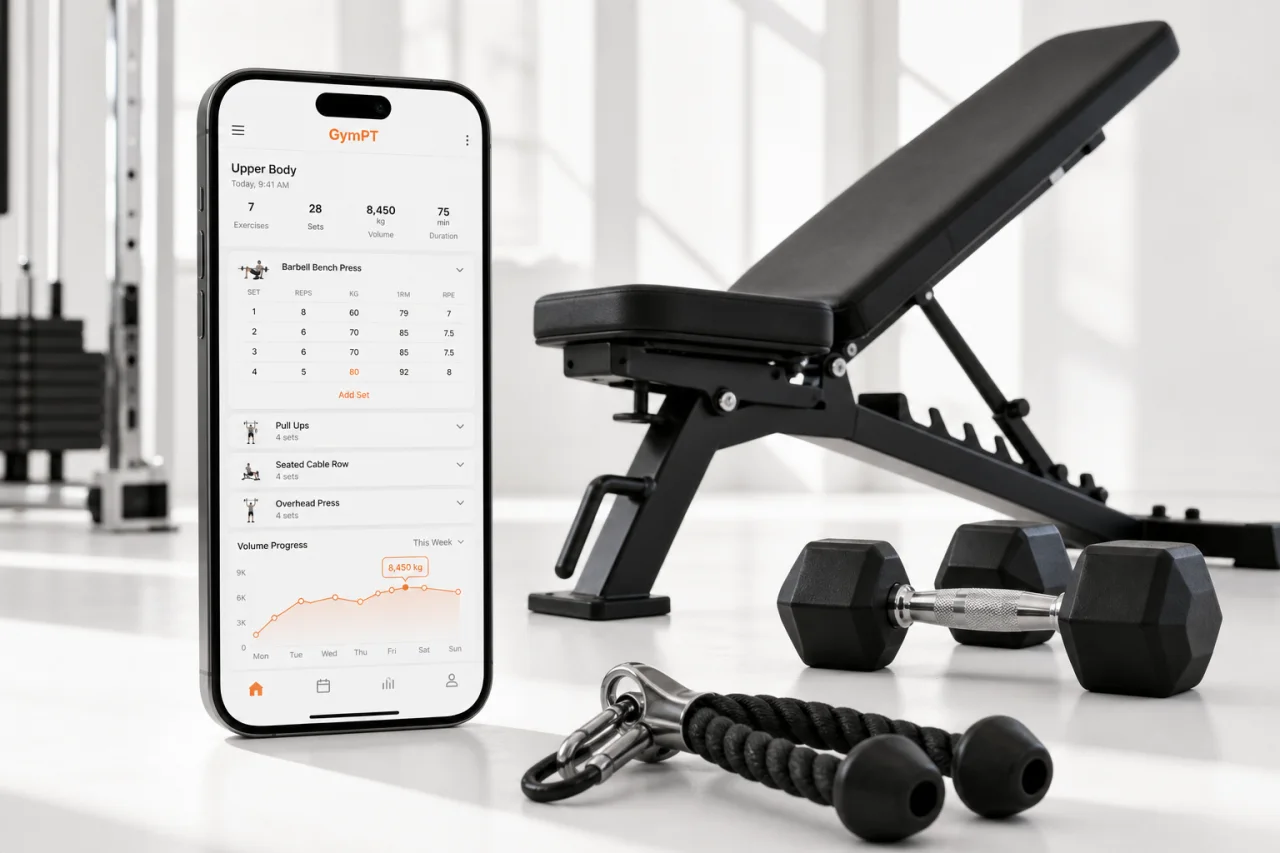
GymPT’s workout tracking and progress insights make this easier because you can see whether your upper body training is actually moving forward or just feeling busy.
Common mistakes to avoid
- Too much pressing, not enough pulling. This is one of the fastest ways to create an unbalanced upper body routine.
- Changing exercises every week. You cannot progress what you never repeat.
- Going to failure on every set. Save true all-out effort for selected sets, not the entire workout.
- Skipping warm-ups. A few ramp-up sets improve performance and make heavy work feel smoother.
- Ignoring recovery. Sleep, food, and rest days matter as much as the workout itself.
How to warm up for upper body day
Keep the warm-up short and specific. Start with a few minutes of easy movement, then do ramp-up sets for your first compound lift. If your shoulders feel stiff, add light band pull-aparts, scapular push-ups, or cable face pulls before pressing.
A simple warm-up might look like this:
- 3-5 minutes of light cardio
- 1-2 mobility drills for shoulders or thoracic spine
- 2-4 ramp-up sets for your first press
The goal is not to get tired. The goal is to be ready.
How GymPT helps you build a better upper body plan
GymPT can turn a vague goal like “train upper body” into a real plan with structure. You can ask the AI coach for exercise swaps, build a routine around your available equipment, track your sessions, and review progress over time. If your chest is improving but your pulling work is lagging, the app helps you spot that imbalance early and adjust before it becomes a problem.
That matters because the best upper body workout plan is not the one with the most exercises. It is the one you can recover from, repeat, and improve.
Bottom line
If you want a stronger upper body, keep the plan balanced, repeatable, and progressive. Train push and pull patterns, use enough weekly volume, and make small improvements over time. With that structure in place, your upper body workouts become much easier to manage and much more effective.
Ready to build yours? Use GymPT to create a personalized upper body workout plan, track your lifts, and keep your progression moving in the right direction.