no equipment workout plan
No Equipment Workout Plan: A Practical Way to Train Anywhere
A no equipment workout plan can still build strength, improve conditioning, and keep you consistent. Here’s how to structure it for limited space and real progress.
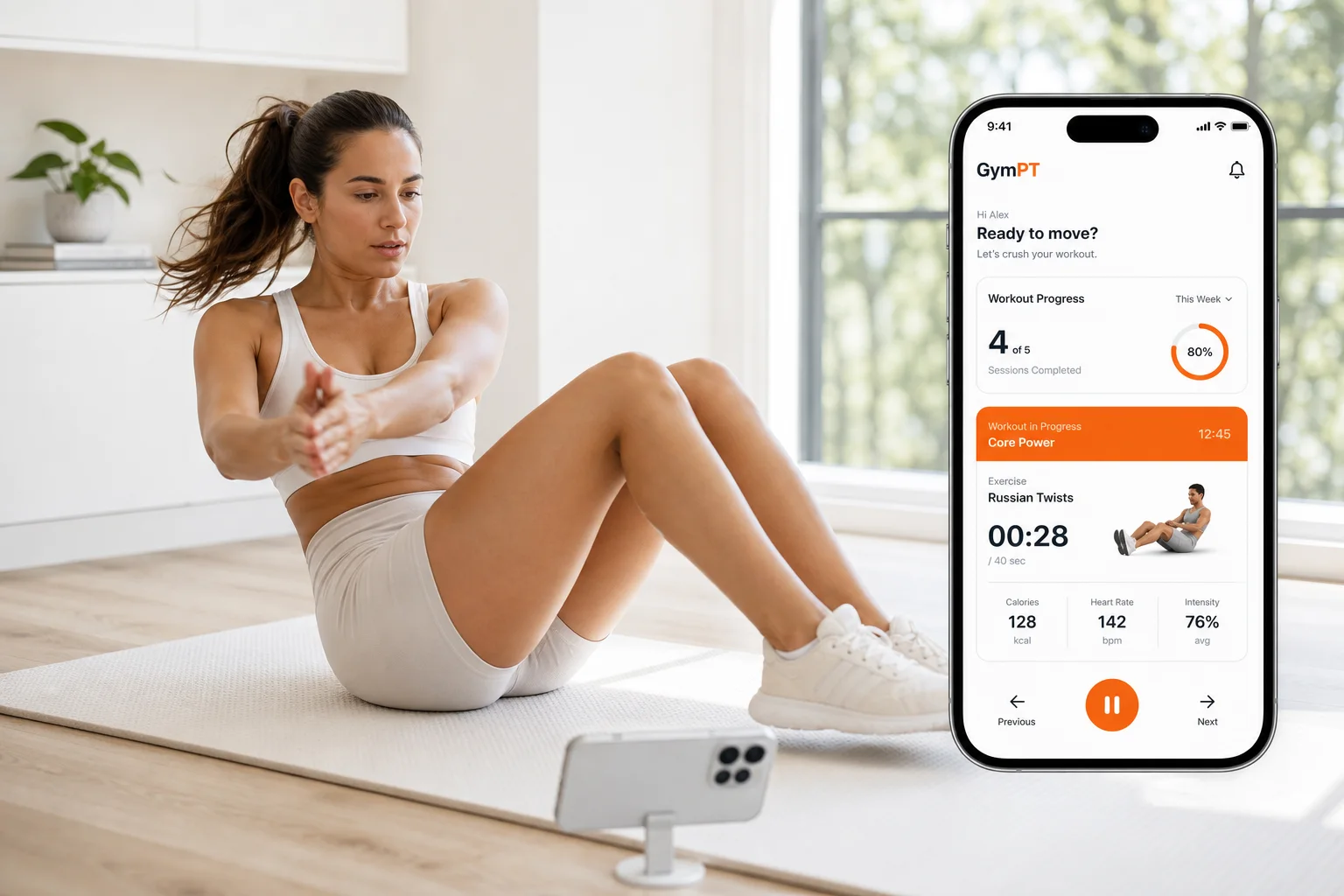
Why a no equipment workout plan works
A no equipment workout plan is not a backup plan. It is a simple way to train when you have limited space, limited gear, or limited time. The goal is to use your body, your environment, and smart programming to create enough challenge for strength, conditioning, and consistency.
Public health guidance recommends regular aerobic activity plus muscle-strengthening work on at least 2 days per week. That makes bodyweight training a legitimate foundation, not a compromise. The key is to make the plan structured enough that it is repeatable and progressive.
If you want the plan to work long term, think in terms of three things: movement quality, effort, and progression. That is where most home routines succeed or fail.
What a good no equipment workout plan should include
A useful plan should train the major movement patterns, not just random exercises. That means you want:
- Squat patterns for legs and glutes
- Hinge patterns for hamstrings and posterior chain
- Push patterns for chest, shoulders, and triceps
- Pull patterns for upper back and posture
- Core work for trunk stability
- Conditioning to support heart health and work capacity
Without equipment, pulling is the hardest pattern to train. You can still include it with towel rows, table rows if safe, isometric holds, prone back work, and scapular control drills. If you later add equipment, this is where a smart upgrade helps most.
The best way to structure the week
For most people, a simple weekly structure is easier to follow than a complicated split. A practical approach is 3 full-body sessions per week, with optional walking or light cardio on the other days.
Example weekly template
- Monday: Full-body strength
- Wednesday: Full-body strength
- Friday: Full-body strength
- Other days: Walking, mobility, or short conditioning
This setup works well because it gives each muscle group repeated practice without requiring a lot of time. It also fits the reality of busy schedules better than a plan that depends on perfect motivation.
If you prefer shorter sessions, you can also rotate two workouts and repeat them across the week. The important part is not the exact split. It is whether the plan is realistic enough to keep doing.
A simple no equipment workout plan you can start today
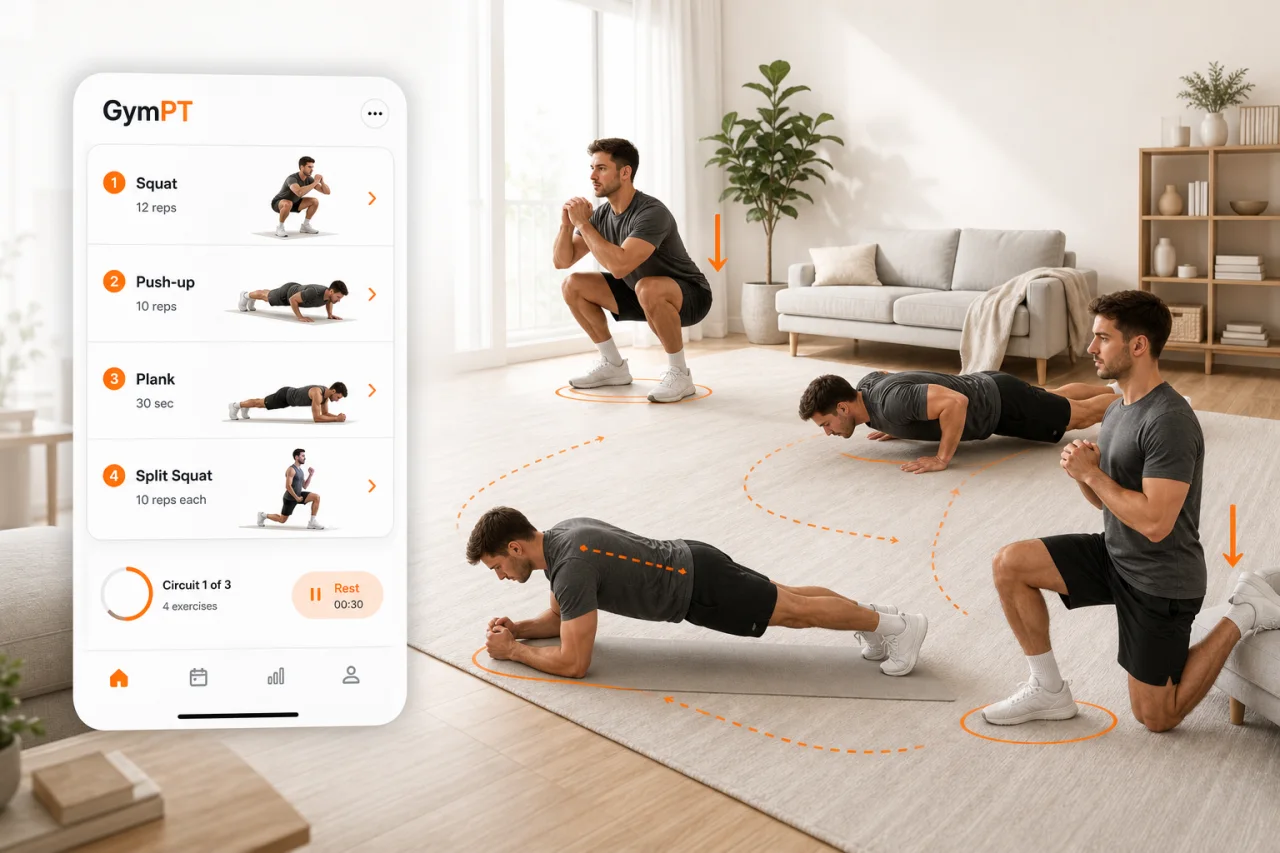
Here is a practical bodyweight workout plan you can use as a starting point. Aim to leave 1 to 3 reps in reserve on most sets, especially if you are new or returning after a break.
Workout A
- Squat - 3 sets of 8 to 15 reps
- Push-up - 3 sets of 6 to 12 reps
- Glute bridge - 3 sets of 10 to 20 reps
- Plank - 3 sets of 20 to 45 seconds
- Mountain climber - 2 sets of 20 to 40 total reps
Workout B
- Split squat - 3 sets of 8 to 12 reps per leg
- Pike push-up or incline push-up - 3 sets of 6 to 10 reps
- Hip hinge good morning - 3 sets of 10 to 15 reps
- Dead bug - 3 sets of 8 to 12 reps per side
- High knees - 4 rounds of 20 to 30 seconds
Alternate Workout A and Workout B across the week. If you train three days, do A/B/A one week and B/A/B the next week.
How to make bodyweight training harder without equipment
The biggest mistake in a home workout routine is repeating the same easy version forever. Progress comes from making the exercise harder over time. You can do that in several ways:
- Add reps until you reach the top of your target range
- Add a set when the current volume feels too easy
- Slow the tempo with a 3-second lowering phase
- Pause at the hardest point of the movement
- Use unilateral work like split squats and single-leg bridges
- Reduce rest time for conditioning-focused sessions
These progressions matter because bodyweight exercises can become too easy if you never change the stimulus. A good no equipment workout plan should tell you exactly how to progress, not just what to do on day one.
How to train in limited space
Limited space does not have to limit results. You can build an effective routine in a bedroom, living room, or small apartment if you choose exercises that need little room to move.
- Use floor-based exercises like push-ups, planks, dead bugs, and glute bridges
- Choose split squats instead of large lunges if space is tight
- Use marching, step jacks, or shadow boxing for conditioning
- Keep the workout area clear so transitions are fast and safe
If your space is especially tight, shorter circuits are often better than long straight sets. For example, rotate one lower-body move, one push, one core move, and one conditioning move with minimal rest.
How to stay consistent when motivation drops
Consistency is usually the real problem, not exercise selection. A no equipment plan helps because it removes setup friction. To make it stick, use these rules:
- Keep the minimum session small so you can still train on bad days
- Train at the same time when possible
- Track your workouts so progress is visible
- Use a simple plan instead of constantly changing exercises
- Focus on completion first, perfection second
Even a 15- to 20-minute session can keep momentum alive. That matters because the best plan is the one you can repeat.
When to add equipment later
You do not need equipment to start, but you may eventually outgrow a pure bodyweight plan. That usually happens when:
- Push-ups become easy at high reps
- Leg work no longer feels challenging enough
- You want more pulling volume for your back
- You want faster strength progression
At that point, adding a pair of dumbbells, a resistance band, or a pull-up bar can expand your options. Until then, a well-designed no equipment workout plan can still deliver a strong base.
How GymPT can help you stay on track
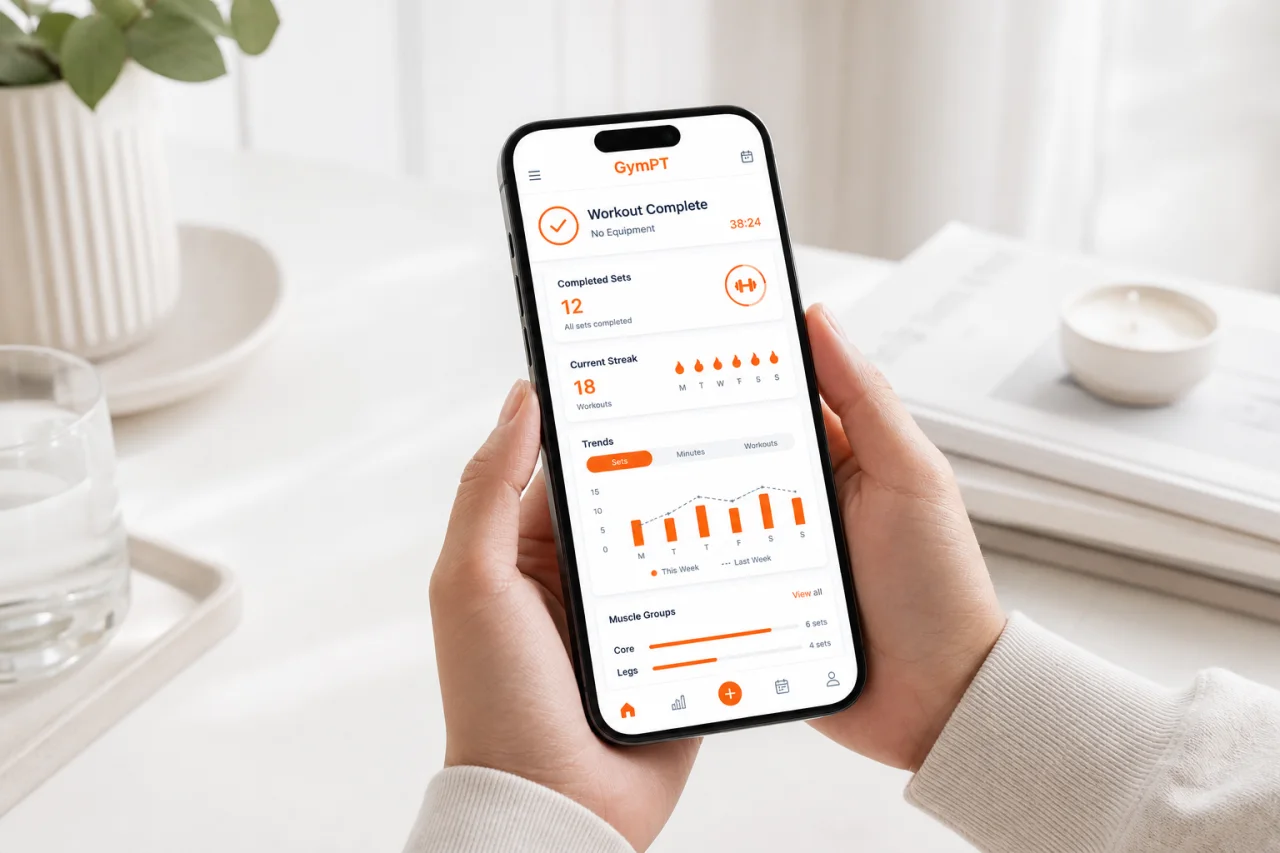
GymPT can turn a basic bodyweight workout plan into something more personal. You can build a routine around your schedule, track completed sessions, and use progress insights to see whether your plan is actually working. If you train at home, that kind of feedback helps you adjust before you stall.
Instead of guessing what to do next, you can use GymPT to keep the plan aligned with your current level, available space, and consistency goals.
Final thoughts
A no equipment workout plan is one of the easiest ways to start training and one of the most practical ways to stay consistent. Keep it simple, cover the major movement patterns, progress it on purpose, and make it realistic for your space and schedule.
If you can repeat the plan week after week, it is doing its job.