home workout with cable machine
Home Workout With Cable Machine: Build a Smarter Plan Around One Tool
A cable machine can do far more than one exercise at a time. Learn how to build a balanced home workout with a cable machine, choose the right movements for your space and goal, and adapt the plan with GymPT.

Home workout with cable machine: the smartest way to build around one tool
A home workout with cable machine works best when you stop thinking in random exercises and start thinking in movement patterns. A cable station can cover pushing, pulling, squatting, hinging, core work, and single-arm work in one compact setup. That makes it one of the most flexible pieces of home gym equipment for strength, muscle, and consistency.
The goal is not to use every attachment. The goal is to choose a few cable exercises that cover your whole body, fit your available space, and match your training level. Public health guidance recommends muscle-strengthening work at least two days per week, and beginner resistance training often works well with full-body sessions on nonconsecutive days.
Why cable training works so well at home
Cables give you constant tension through much of the range of motion, which makes them useful for controlled reps and smooth resistance. They are also easy to scale: you can change the load, stance, angle, and attachment without needing a full rack of equipment. That flexibility is ideal when your home setup is limited.
For most people, the biggest advantage is simplicity. One machine can support a complete weekly plan if you organize it around a few key patterns:
- Horizontal push like a cable chest press
- Horizontal pull like a seated or standing cable row
- Vertical pull like a lat pulldown variation
- Lower-body squat pattern like a cable squat or belt squat setup
- Hip hinge like a cable pull-through
- Core anti-rotation like a Pallof press
How to choose exercises around your cable machine
Before you build the workout, look at what your machine actually allows. A single-stack tower, dual adjustable pulley, or compact home cable unit may each support different angles and attachments. Choose exercises based on what you can do safely and repeatably, not on what looks advanced.
Use this decision rule
- Pick the movement pattern first. For example, if you need a back exercise, choose a row or pulldown variation.
- Match the setup to your space. If you cannot step far away from the stack, use seated or half-kneeling variations.
- Choose the version you can control. Smooth reps matter more than complicated angles.
- Keep the exercise stable enough to progress. If balance becomes the main challenge, reduce the load or simplify the stance.
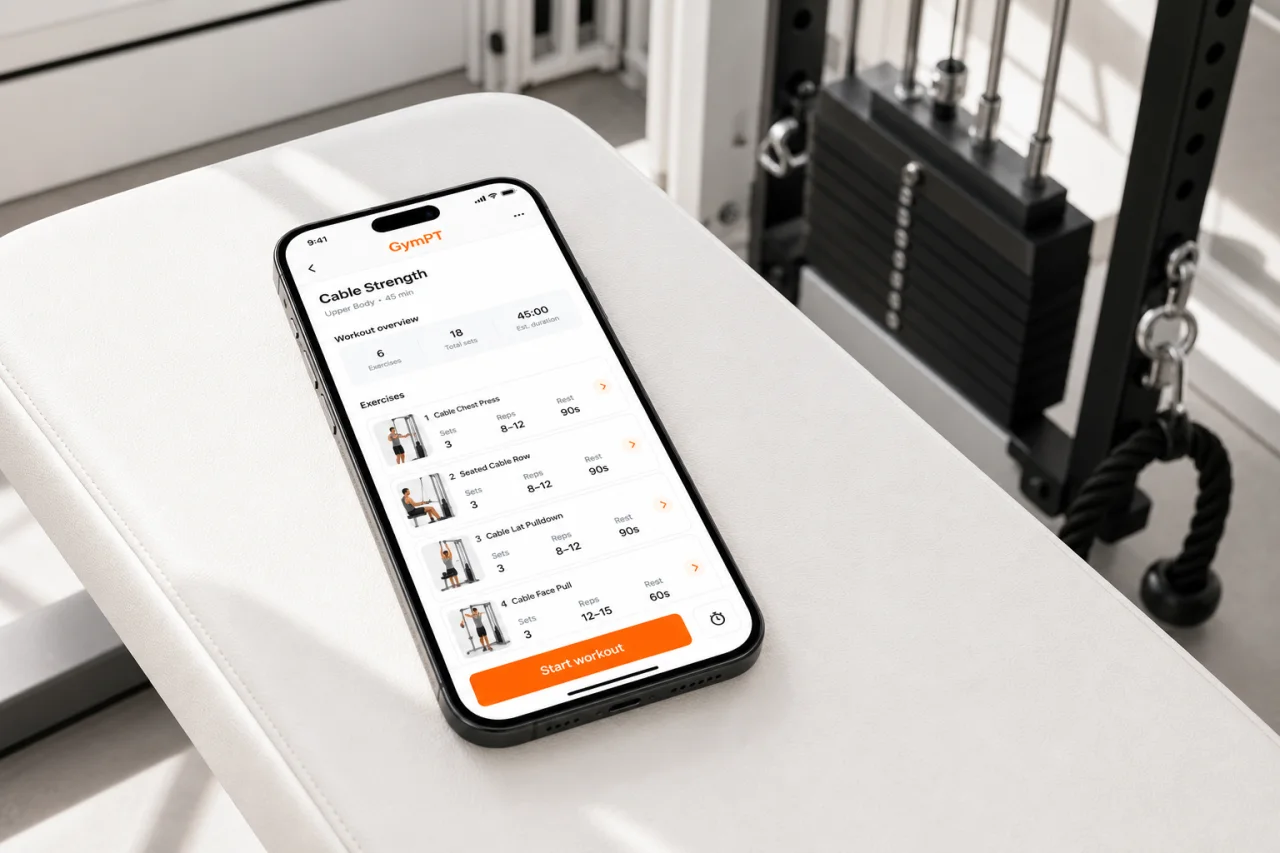
This is where GymPT helps. If you tell GymPT what cable station you have, it can build a plan around your exact equipment instead of forcing a generic routine.
A simple home cable workout structure
If you train two to three days per week, a full-body cable plan is usually the easiest way to stay consistent. That matches common beginner-friendly frequency guidance and helps you practice the main lifts often enough to improve.
Workout A
- Cable squat — 3 sets of 8-12 reps
- Cable chest press — 3 sets of 8-12 reps
- Seated cable row — 3 sets of 8-12 reps
- Cable pull-through — 2-3 sets of 10-15 reps
- Pallof press — 2-3 sets of 10-12 reps per side
Workout B
- Split squat with cable support — 3 sets of 8-10 reps per leg
- Lat pulldown — 3 sets of 8-12 reps
- Single-arm cable press — 3 sets of 8-12 reps per side
- Cable Romanian deadlift — 2-3 sets of 8-12 reps
- Woodchop — 2-3 sets of 10-12 reps per side
Alternate Workout A and Workout B across the week. If you train three days, repeat the first workout at the end of the week and keep the next week balanced by starting with the second workout.
How hard should you train?
For most home lifters, the best effort level is challenging but controlled. You should finish most sets with a few good reps left in the tank. That makes it easier to keep form clean and recover well between sessions.
General resistance training guidance supports working all major muscle groups, and ACSM’s recent resistance-training guidance continues to emphasize structured sets and reps for healthy adults.
- Beginners: 2-3 sets per exercise, 8-12 reps
- Intermediate lifters: 3-4 sets for key lifts, 6-12 reps
- Rest periods: about 60-120 seconds for most accessory work, longer if the next set needs it
If your form breaks down, the set is too heavy or too long. Reduce the load before you reduce the quality.
Common mistakes with cable machine home workouts
- Training only arms and shoulders. A cable machine can do much more than curls and triceps pressdowns.
- Using too many exercises. Four to six well-chosen movements are usually enough.
- Ignoring the lower body. Your plan should still include squatting and hinging patterns.
- Changing the plan every session. Progress comes from repeating the same core lifts long enough to improve them.
- Letting the stack do the work. Control the eccentric phase and keep your torso stable.
How GymPT adapts the plan to your equipment
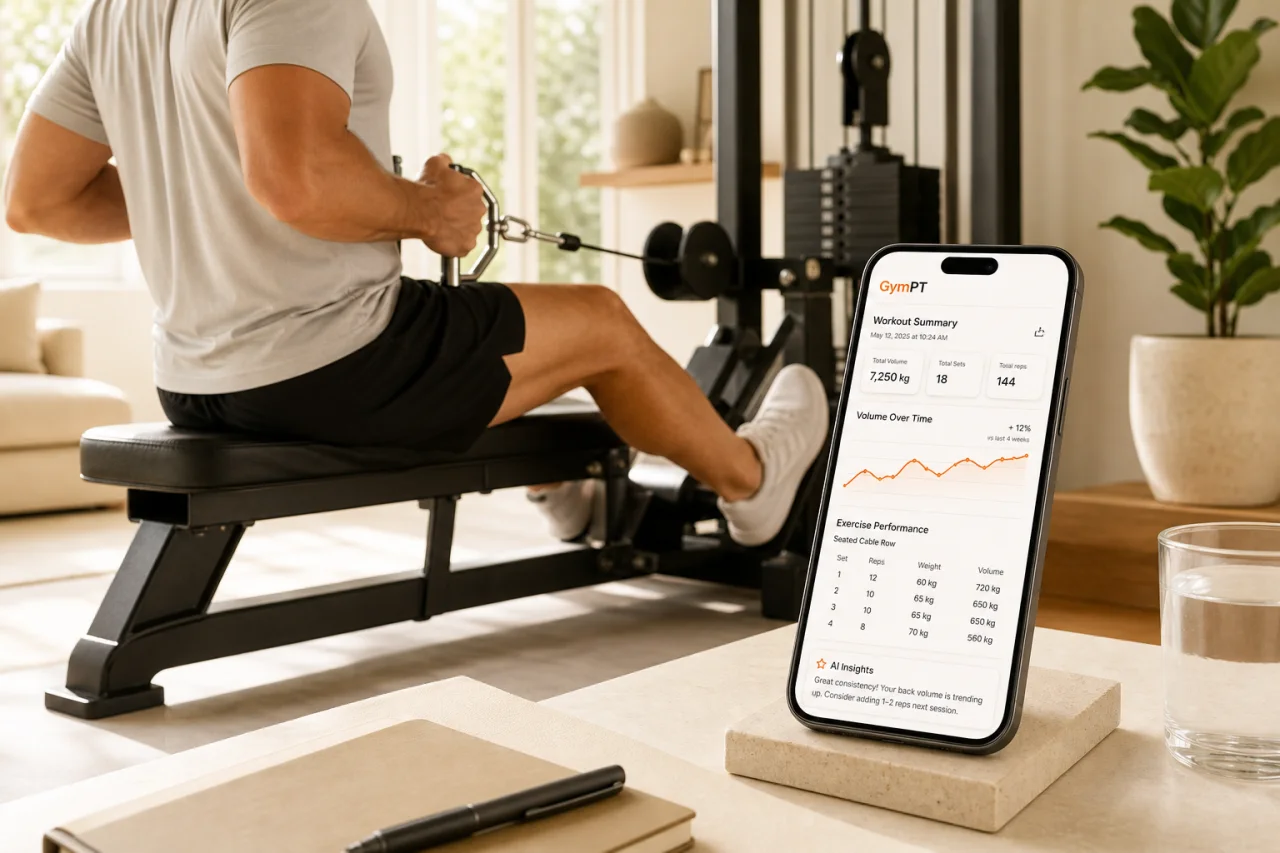
GymPT is useful when your home setup is not perfect. You can tell it what cable machine you have, how much space you have, and what your goal is. Then it can build a workout that fits your reality instead of a generic template.
For example, GymPT can help you:
- turn one cable station into a full-body weekly plan
- swap exercises when an attachment or angle is not available
- adjust sets, reps, and progression as you get stronger
- track workouts so you know when to increase load
- use progress insights to keep the plan realistic and consistent
If you want a cable machine workout plan that actually matches your home setup, this is the easiest way to stay on track.
Sample weekly plan for a home cable setup
Day 1
- Cable squat
- Cable chest press
- Seated cable row
- Pallof press
Day 2
- Cable pull-through
- Lat pulldown
- Single-arm cable press
- Woodchop
Day 3
- Split squat
- Row variation
- Press variation
- Core finisher
This structure gives you enough variety to train the whole body while still repeating the main patterns often enough to improve. That is the real advantage of a home cable machine training setup: it is simple, scalable, and easy to keep doing.
Final takeaway
A cable machine can be the center of an effective home program if you build around movement patterns, not random exercises. Start with a few stable lifts, train them consistently, and progress them over time. If you want help turning your exact equipment into a plan, GymPT can do that for you.