calisthenics workout plan
Calisthenics Workout Plan: How to Build a Routine Around the Equipment You Have
A good calisthenics workout plan is not about doing random bodyweight exercises. It is about matching movements to the equipment you have, then progressing them in a way you can repeat week after week.
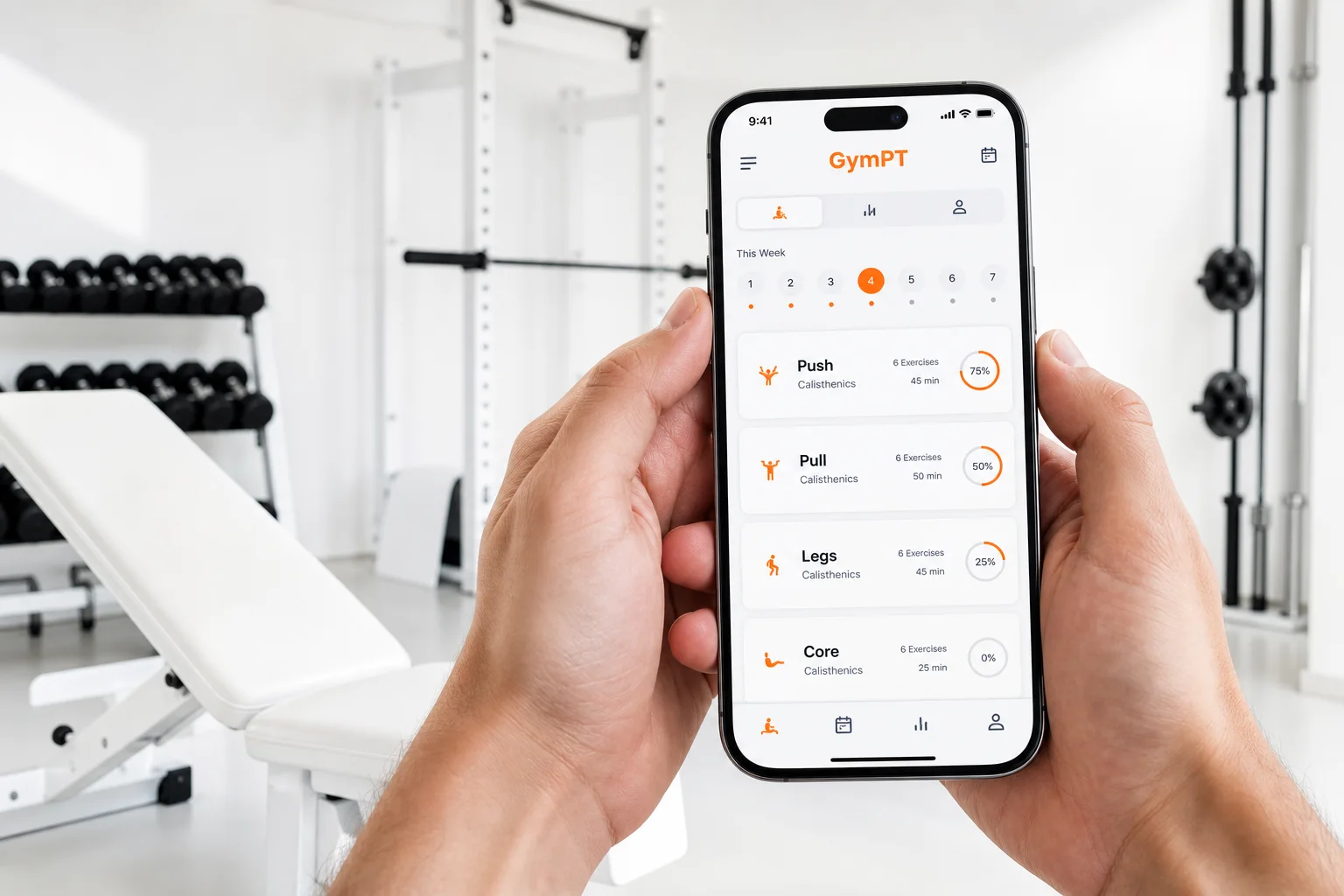
Calisthenics workout plan: the simplest way to make bodyweight training easier to follow
A calisthenics workout plan works best when it matches your real setup, not an ideal gym fantasy. If you know whether you have a pull-up bar, parallel bars, rings, a bench, or nothing at all, it becomes much easier to choose exercises, keep your sessions consistent, and progress without guessing.
That matters because effective training is not just about effort. It is about doing enough work for the major muscle groups, repeating it consistently, and gradually making the exercises harder over time. Public health guidance recommends regular muscle-strengthening activity on at least 2 days per week for adults, alongside weekly aerobic activity.
GymPT helps with that by turning your available equipment into a plan you can actually use. Instead of asking you to adapt a generic routine, it can build a bodyweight workout plan around what is available today, then adjust as your strength improves.
Why equipment-based calisthenics works better than a generic list
Many people start with calisthenics by copying a list of exercises they saw online. The problem is simple: the list may not match the equipment they have. A plan that includes pull-ups, dips, and ring rows is great if you have the tools. It is frustrating if you do not.
When exercises are matched to equipment, the plan becomes easier to follow in three ways:
- Less friction: you spend less time swapping exercises or searching for alternatives.
- Better consistency: the same movement pattern can stay in your program long enough to measure progress.
- Cleaner progression: you can move from easier to harder versions without rebuilding the whole routine.
That is the real advantage of equipment-based training: it removes decision fatigue. You are not trying to invent a workout every session. You are following a structure that already fits your environment.
What a balanced calisthenics workout plan should include
A strong calisthenics plan does not need dozens of exercises. It needs the right movement patterns. A practical weekly plan usually covers:
- Push: push-ups, incline push-ups, dips, pike push-ups
- Pull: pull-ups, chin-ups, inverted rows, ring rows
- Legs: squats, split squats, step-ups, lunges, single-leg variations
- Core: planks, hollow holds, dead bugs, hanging knee raises
- Locomotion or conditioning: brisk walking, stair work, short circuits, or jump rope if available
If you only have floor space, you can still train every major pattern with push-up variations, split squats, glute bridges, planks, and tempo work. If you have a pull-up bar, your plan becomes more complete because you can train vertical pulling directly. If you have rings or bars, you can add more progression options without changing the whole structure.
Example: no equipment
A no-equipment calisthenics workout plan can still be effective if you use harder variations and controlled tempo. For example, you might use incline or standard push-ups, split squats, single-leg glute bridges, plank variations, and slow eccentrics to increase difficulty.
Example: pull-up bar only
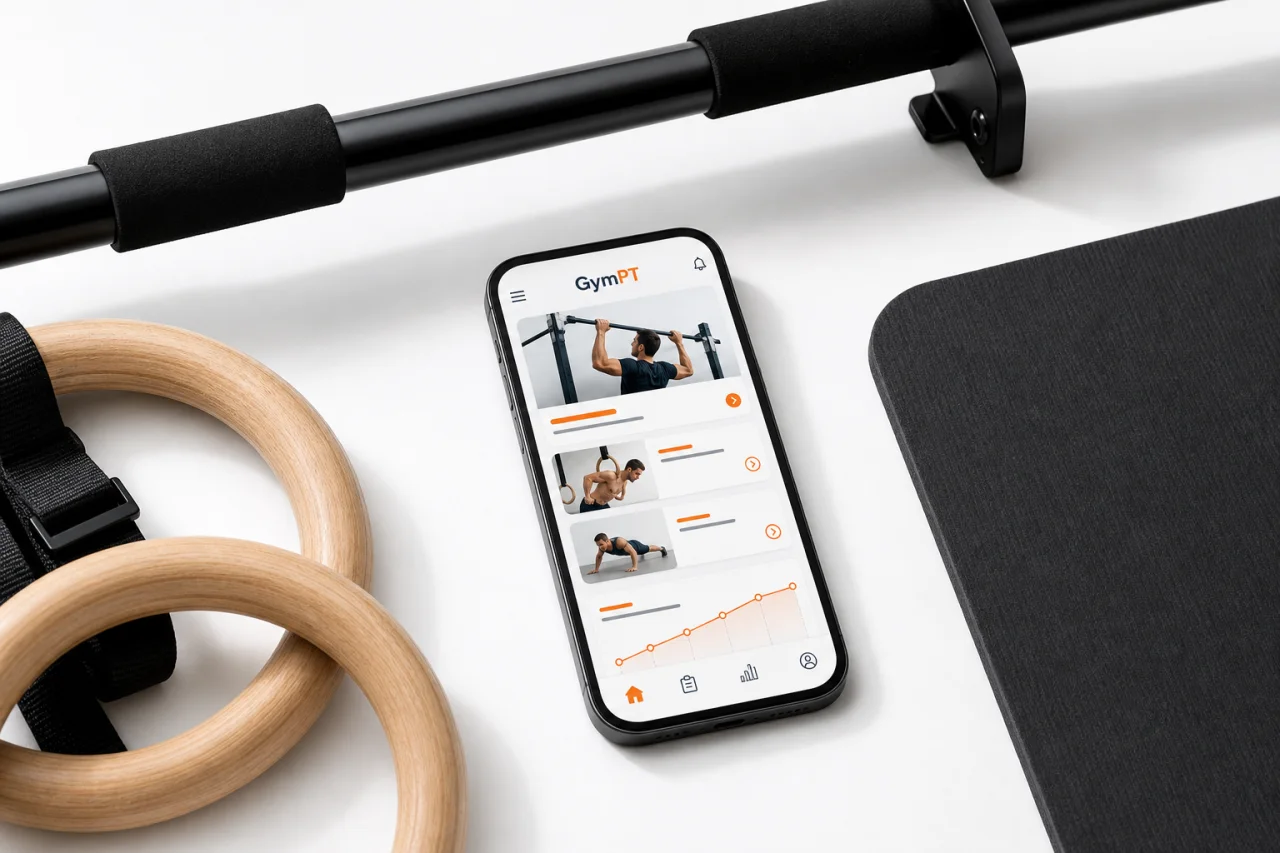
With a pull-up bar, you can build a much stronger upper-body plan by pairing push-ups with pull-ups or chin-ups, then adding hanging knee raises and split squats for balance.
Example: rings or bars
Rings and parallel bars open up rows, dips, support holds, and deeper range-of-motion work. That makes it easier to scale exercises up or down without losing the movement pattern.
How to progress without overcomplicating the plan
Progression is where many bodyweight plans fall apart. People either repeat the same easy workout forever or jump to a harder version too soon. A better approach is to change one variable at a time.
Use this order:
- First, add reps until you reach the top of your target range.
- Then, add a set if the exercise still feels manageable.
- Then, make the movement harder by changing leverage, range of motion, tempo, or body position.
- Only then, add more advanced variations such as assisted pull-ups, dips, or one-leg progressions.
This approach keeps your plan simple and measurable. It also fits what modern resistance-training guidance emphasizes: bodyweight and elastic-band work can produce meaningful strength and muscle benefits when the exercise selection and progression are appropriate.
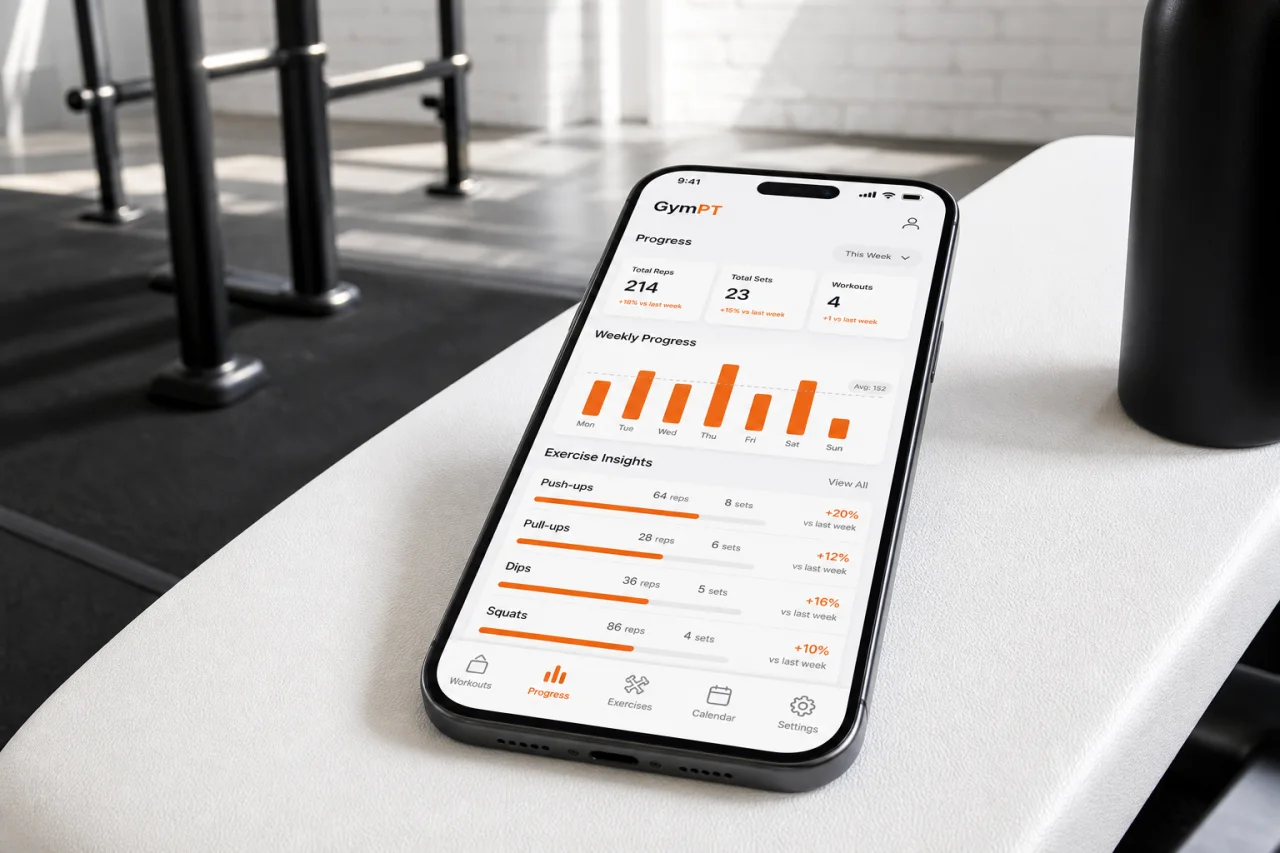
In GymPT, that progression can be tracked automatically so you are not relying on memory. If your push-ups are getting easier, the app can suggest a harder variation or adjust your reps and sets based on your recent performance.
How to structure a weekly calisthenics workout plan
The best weekly structure is the one you can repeat. For most people, 3 to 4 training days works well because it leaves room for recovery while still giving enough practice to improve.
A simple 3-day structure might look like this:
- Day 1: push, legs, core
- Day 2: pull, legs, core
- Day 3: full body with easier variations or extra volume
A 4-day structure can split upper and lower body or alternate harder and lighter sessions. The exact split matters less than the fact that you can keep showing up and recover well enough to progress.
WHO guidance also reminds us that adults should combine muscle-strengthening work with regular aerobic activity across the week, so your calisthenics plan can be even better when you add walking, cycling, or short conditioning finishers.
How GymPT makes calisthenics easier to stick with
GymPT is useful here because it does the part most people dislike: translating goals and equipment into a plan. You can tell it what you have, how many days you can train, and what level you are starting from. Then it can build a calisthenics workout plan that fits your setup instead of forcing you into a generic template.
That means you can use the app to:
- generate workouts based on available equipment
- chat with the AI coach when an exercise feels too hard or too easy
- track reps, sets, and workout completion
- see progress insights over time
- adjust the plan as your strength and confidence improve
For bodyweight training, that flexibility matters. A plan is only useful if it survives contact with real life.
A practical way to build your own plan today
If you want a calisthenics workout plan that actually works, start with these three questions:
- What equipment do I have? Floor only, pull-up bar, rings, bars, bench, or a full gym?
- How many days can I train? Two, three, four, or more?
- What movement patterns am I missing? Push, pull, legs, core, or conditioning?
Once you answer those, the plan becomes much easier to build. You can choose the right exercise variations, set a realistic weekly schedule, and progress without constantly changing direction.
If you want a bodyweight routine that feels clear from day one, GymPT can help you turn your available equipment into a structured plan you can follow, track, and improve.
Bottom line: the best calisthenics workout plan is not the hardest one. It is the one that matches your equipment, covers the major movement patterns, and gives you a simple way to progress week after week.
Frequently asked questions
Can I build muscle with a calisthenics workout plan?
Yes. Bodyweight training can build muscle when exercises are challenging enough, volume is sufficient, and you keep progressing over time.
Do I need a pull-up bar for calisthenics?
No, but a pull-up bar adds valuable pulling work. Without one, you can still train effectively with rows, towel variations, or other pulling substitutes if available.
How many days per week should I do calisthenics?
Most people do well with 3 to 4 days per week. That gives enough training frequency while still leaving time to recover.
What if I only have a little equipment?
That is fine. A good plan should adapt to what you have, not assume a perfect gym setup. Start with the equipment you own and use progression to make the exercises harder over time.