cable back exercises
Cable Back Exercises: A Coach’s Guide to Better Rows, Better Control, Better Growth
Cable back exercises are one of the best ways to train your back with constant tension and cleaner technique. This guide shows you how to row, pull, and program cable work for better control, better muscle engagement, and steady progress.

Cable Back Exercises: Why They Work So Well
Cable back exercises are a smart choice when you want a back workout that feels controlled, repeatable, and easy to progress. Cables keep tension on the muscle through much of the range of motion, which makes them especially useful for learning good pulling mechanics and building a stronger upper back, lats, and rear delts.
If you want better back training without guessing, cable work gives you three big advantages: stable resistance, easy load adjustments, and simple technique feedback. That makes it a strong option for beginners and experienced lifters alike.
For most people, the goal is not to chase the heaviest stack possible. The goal is to pull with clean form, feel the target muscles working, and repeat that effort week after week.
What Cable Back Exercises Train
Most cable back exercises train one or more of these areas:
- Lats for width and strong pulling power
- Mid-back muscles for posture and scapular control
- Rear delts for shoulder balance
- Lower traps and rhomboids for better shoulder blade movement
- Biceps and forearms as secondary movers
That matters because a good back program should not be just “pull until tired.” It should cover both horizontal pulls, like rows, and vertical pulls, like pulldowns.
The Best Cable Back Exercises to Start With
Below are the most useful cable back exercises for building a balanced back routine.
1. Seated Cable Row
The seated cable row is a foundation movement for mid-back thickness and scapular control. Sit tall, brace your core, and pull the handle toward your torso without leaning back to finish the rep. Keep your wrists neutral and let your shoulder blades move naturally.
Coach cue: pull elbows back, not shoulders up.
2. Single-Arm Cable Row
This version helps you train each side independently and often makes it easier to feel the lat working. Set your torso stable, reach forward under control, then drive the elbow back while keeping the shoulder down.
Best for: fixing side-to-side strength gaps and improving mind-muscle connection.
3. Cable Lat Pulldown
A cable lat pulldown is one of the best ways to train the lats through a vertical pulling pattern. Keep your chest tall, avoid excessive swinging, and pull the bar or handle toward the upper chest with control.
Coach cue: think “elbows to ribs,” not “hands to chest.”
4. Straight-Arm Cable Pulldown
This is a great isolation move for the lats. Keep a slight bend in the elbows, hinge lightly at the hips, and sweep the handle down in an arc without turning it into a triceps press.
Best for: learning to feel the lats without heavy loading.
5. Cable Face Pull
Face pulls are a valuable upper-back and rear-delt drill. Pull the rope toward your face with elbows high enough to keep tension on the upper back, then finish with control instead of jerking the weight.
Coach cue: separate the rope and finish with your hands near eye level.
6. Cable Rear Delt Fly
This movement targets the rear delts and upper back with a smaller range of motion. Use light to moderate resistance and keep the movement smooth. If you have to swing, the load is too heavy.
How to Perform Cable Back Exercises With Better Form
Good cable training is about position, not ego. Use these form rules on most cable back exercises:
- Set your ribs and pelvis first. A stable torso gives your back muscles a better base to work from.
- Start each rep with control. Let the weight stretch the target muscles without losing posture.
- Pull with the elbows. This usually helps you keep the shoulders from taking over.
- Pause briefly in the contracted position. A short pause improves control and makes the rep more honest.
- Return slowly. The lowering phase matters for muscle tension and technique.
If your lower back is doing most of the work, the load is probably too heavy or your torso angle is changing too much.
How Much Volume Should You Do?
For general strength and muscle growth, most people do well with a moderate amount of weekly back work spread across 2 or more sessions. A practical starting point is 8 to 14 hard sets per week for the back, depending on experience, recovery, and how much pulling you already do in other lifts.
For beginners, even a smaller amount can work well if the sets are challenging and the form is solid. A simple approach is 2 to 4 exercises per session, 2 to 4 sets each, with enough effort that the last few reps are demanding but still controlled.
As a rule, if your form breaks down before the target muscles are fatigued, reduce the load. If you can easily exceed the rep target, increase resistance gradually.
Recommended Reps, Sets, and Rest
Use this simple framework for cable back exercises:
- Compound rows and pulldowns: 3 to 4 sets of 8 to 12 reps
- Isolation moves like straight-arm pulldowns or rear delt flys: 2 to 4 sets of 12 to 15 reps
- Rest periods: 60 to 90 seconds for most accessory work, and a bit longer if you need it to keep form clean
For health and muscle-building goals, consistency matters more than chasing a perfect number. A well-executed single set can help, but most lifters get better results from multiple quality sets across the week.
Beginner-Friendly Alternatives If Cables Feel Too Hard
If you are new to back training, start with easier variations before moving to more advanced cable work.
- Use a neutral handle instead of a wide bar for rows
- Choose lighter loads and slow the lowering phase
- Do one-arm rows to simplify the movement path
- Shorten the range slightly if you cannot keep your torso stable
- Try chest-supported options if your lower back gets tired first
These changes help you learn the pattern without turning the set into a full-body compensation drill.
A Simple Cable Back Workout You Can Use Today
If you want a straightforward session, try this:
- Seated cable row — 3 sets of 8 to 12
- Lat pulldown — 3 sets of 8 to 12
- Single-arm cable row — 2 sets of 10 to 12 per side
- Face pull — 2 sets of 12 to 15
- Straight-arm pulldown — 2 sets of 12 to 15
This gives you both horizontal and vertical pulling, plus a little extra work for the rear delts and lats. If you train back twice per week, you can split these movements across two sessions instead of doing them all at once.
How GymPT Can Help You Progress
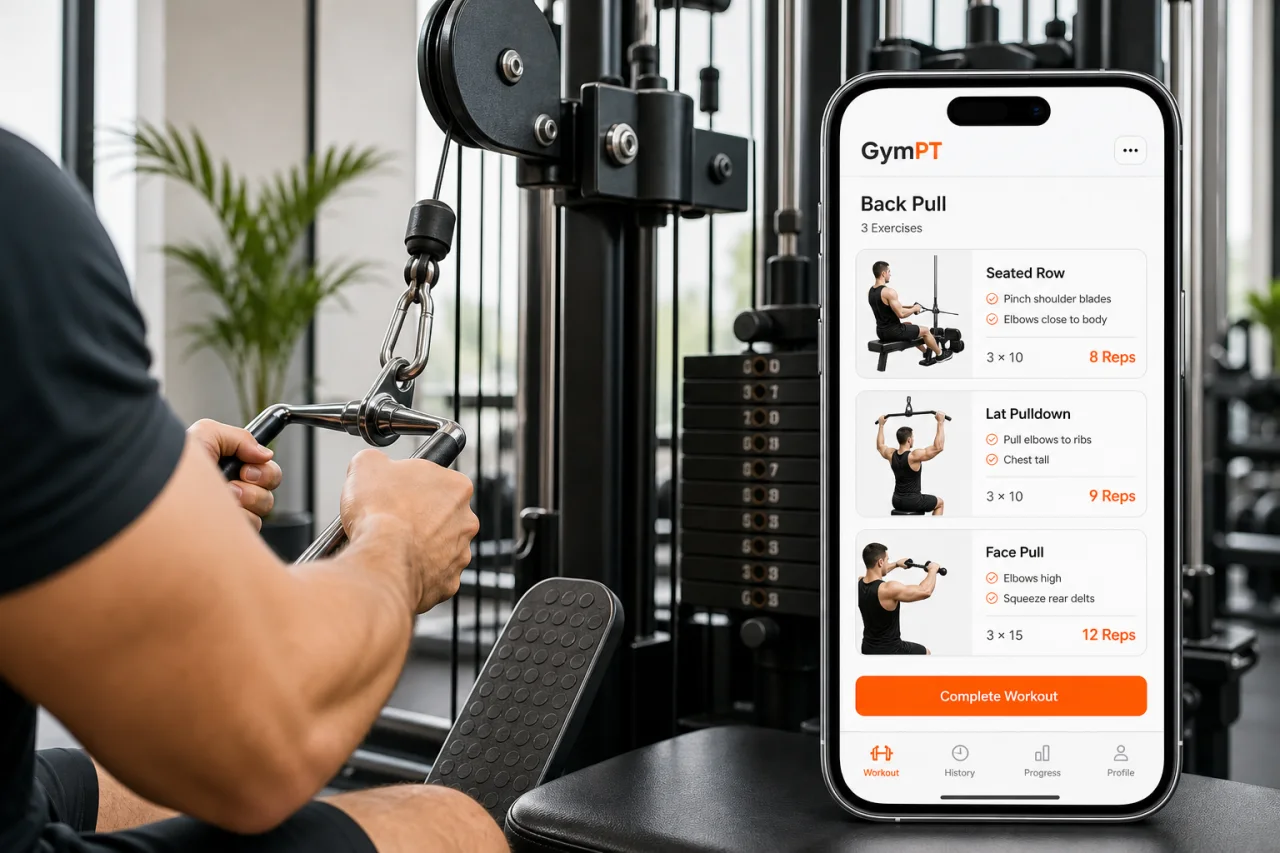
One of the hardest parts of back training is knowing whether you are actually improving. GymPT helps by turning your workouts into a plan you can follow, track, and adjust. You can build a cable-based back routine, log your sets and reps, and use progress insights to see when it is time to add load, reps, or a new variation.
If you are unsure which cable back exercises fit your equipment, GymPT can also help you choose movements based on what your gym has available and how experienced you are.
Key Takeaways
- Cable back exercises are excellent for controlled tension and repeatable technique.
- Rows, pulldowns, face pulls, and straight-arm pulldowns cover the back well.
- Use clean form, moderate loads, and steady progression.
- Beginners should prioritize control over weight.
- Tracking sets, reps, and effort makes progress easier to manage.
If you want a stronger back, cable training gives you a simple path: pull well, recover well, and progress gradually.