5 day workout split
5 Day Workout Split: The Best Weekly Structure for Recovery, Progress, and Flexibility
A 5 day workout split can be a powerful way to train with enough volume, enough recovery, and enough flexibility to stay consistent. Here’s how to structure it well.
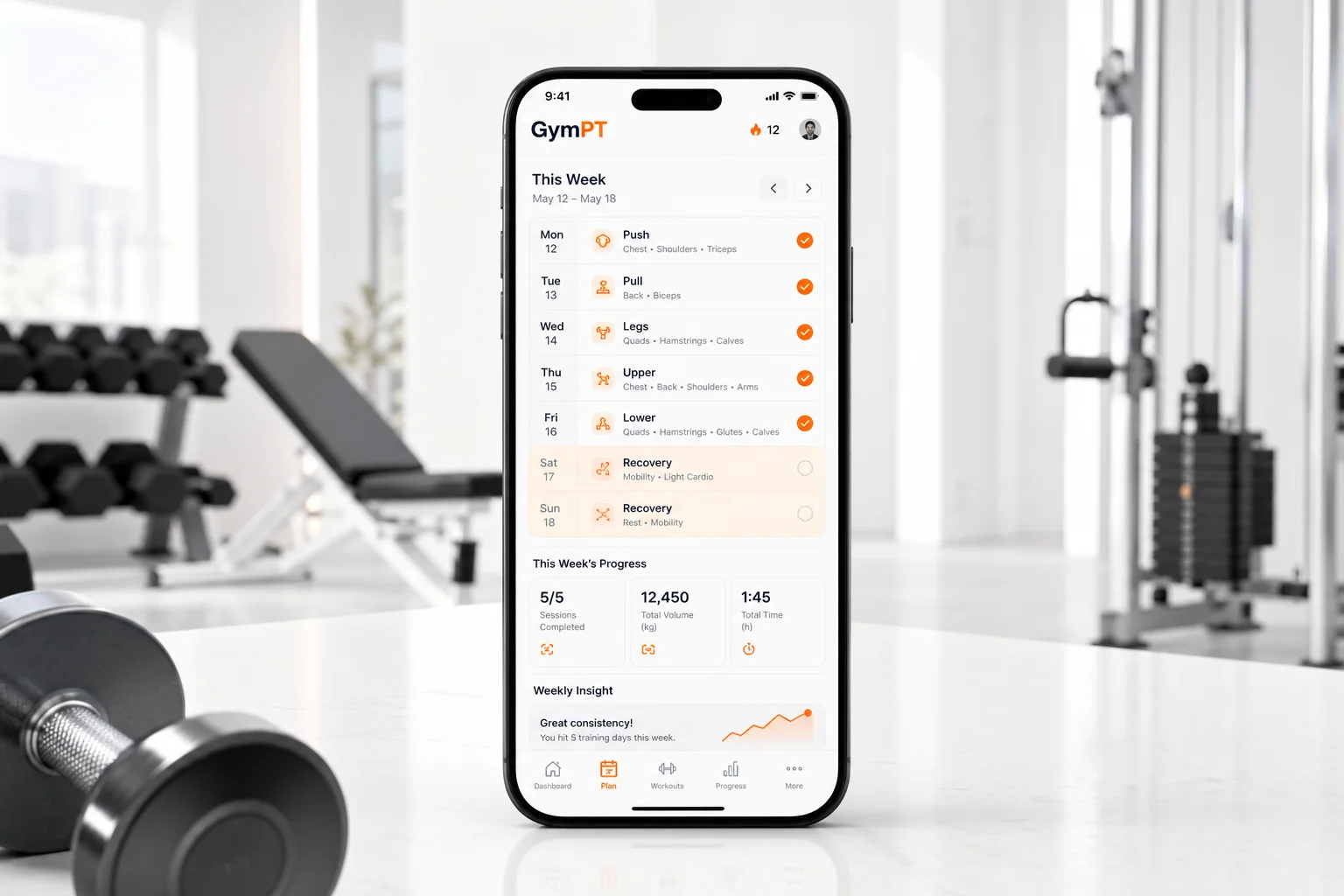
5 day workout split: what it is and why it works
A 5 day workout split is a weekly training structure where you lift or train on five separate days and use the remaining two days for rest, active recovery, or light cardio. For many people, it is the sweet spot between training enough to make progress and leaving enough room to recover.
That balance matters. Public health guidance recommends that adults include muscle-strengthening activity on at least two days per week, and general activity targets also emphasize regular movement across the week. A 5 day split goes beyond the minimum and gives you room to organize training by muscle group, movement pattern, or goal. The key is not just training more often, but training with a structure you can recover from and repeat.
GymPT can help you build that structure around your schedule, equipment, and current fitness level instead of forcing you into a generic template.
Who should use a 5 day workout split?
A 5 day workout split is usually a strong fit if you:
- Want more weekly training volume without cramming everything into 3 long sessions
- Can realistically train five days most weeks
- Recover well from moderate training frequency
- Have a clear goal such as muscle gain, strength, fat loss support, or general fitness
- Prefer shorter, more focused sessions
It is often less ideal if you are brand new to lifting, have a very unpredictable schedule, or struggle to recover between sessions. In those cases, a 3 day or 4 day structure may be easier to sustain.
How to choose the right weekly structure
The best 5 day workout split is the one that matches your goal, your recovery, and your available equipment. Here are the most useful ways to organize it.
1. Body-part split
This approach assigns one main muscle group or region to each day, such as chest, back, legs, shoulders, and arms. It can work well for people who like focused sessions and want to spend more time on each area.
Best for: intermediate lifters, hypertrophy-focused training, and gym users who like variety.
2. Upper/lower plus accessory days
This structure alternates upper and lower body training, then uses the fifth day for accessories, conditioning, or a weak-point session. It is often easier to recover from than a pure body-part split because major muscle groups are trained more than once per week.
Best for: balanced strength and muscle gain, especially if you want more frequent practice on the main lifts.
3. Push/pull/legs plus two extras
A push/pull/legs base can be expanded into five days by adding a second upper-body day, a lower-body emphasis day, or a conditioning and core day. This is a flexible option if you already know the basics of your training split.
Best for: lifters who want a familiar framework with room to customize.
4. Goal-based split
Some people do better when the week is built around a goal instead of a body part. For example: strength day, hypertrophy day, lower-body day, upper-body day, and conditioning day. This is especially useful when your schedule changes often.
Best for: people who want a personalized workout plan that adapts to real life.
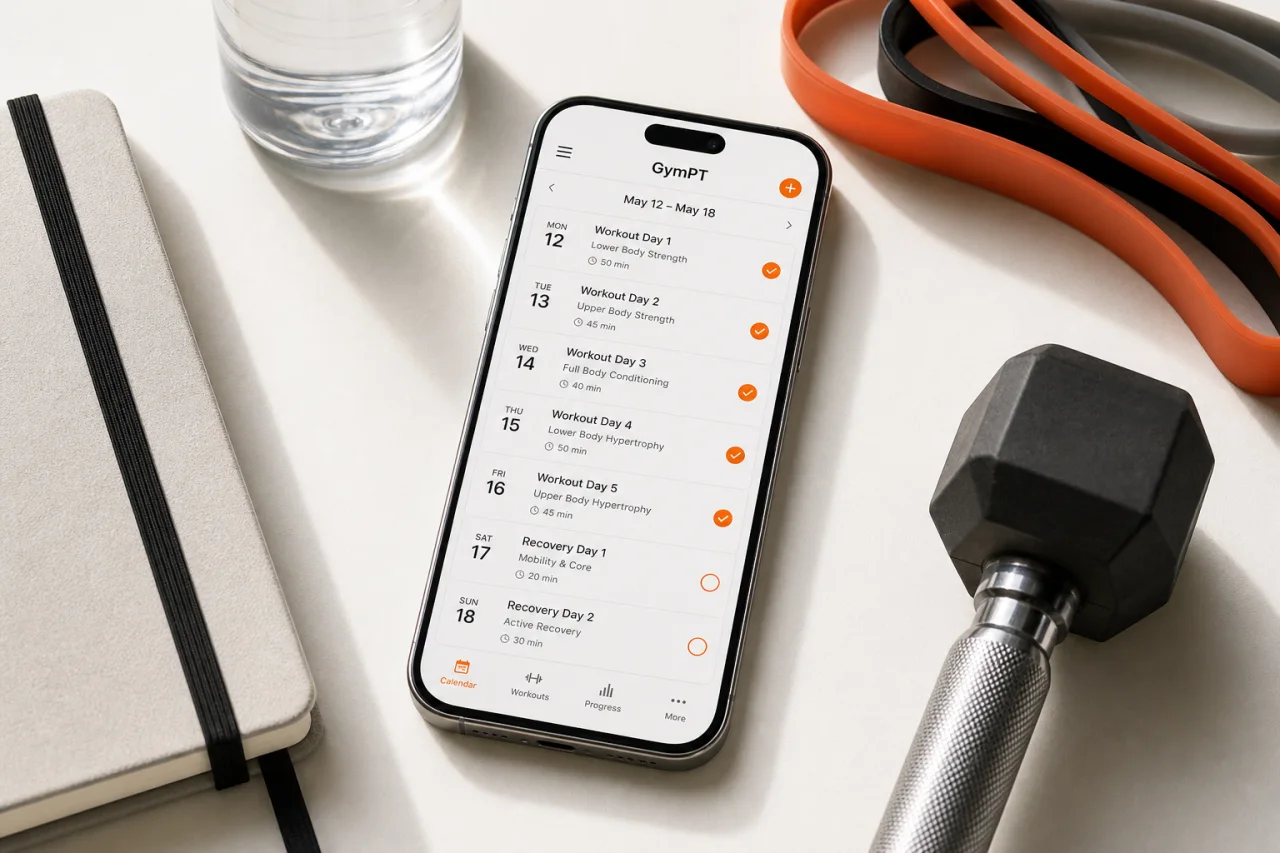
A simple 5 day workout split example
Here is a practical weekly structure you can use as a starting point:
- Monday: Upper body strength
- Tuesday: Lower body strength
- Wednesday: Rest or light cardio and mobility
- Thursday: Push hypertrophy
- Friday: Pull hypertrophy
- Saturday: Legs and core
- Sunday: Rest
This layout gives you two recovery days, spreads lower-body stress across the week, and keeps each session focused. If you prefer a different rhythm, the exact days do not matter as much as the pattern of stress and recovery.
For example, if you know your weekends are busy, you could move the fifth session to Wednesday and keep the rest days where they fit best.
How to make a 5 day split actually productive
A good weekly structure only works if the training inside it is sensible. Use these rules to keep your plan effective.
Keep the weekly volume realistic
More days do not automatically mean better results. If every session is too long or too exhausting, your performance will drop and recovery will suffer. A better approach is to spread your work across the week so each workout has a clear purpose.
Train the big movements consistently
Most people should anchor the week with compound patterns such as squats, hinges, presses, rows, and pulldowns or pull-ups. Then add accessory work to support your goal. That gives you a strong base without turning every workout into random exercise selection.
Leave room for recovery
Recovery is not wasted time. It is what lets you repeat quality sessions week after week. Adults generally need enough sleep to support training and daily function, and the NIH notes that adults who sleep less than 7 hours a night may have more health issues than those who sleep 7 or more hours. If your sleep, stress, or soreness is poor, your split may need to be adjusted.
Use progression, not just variety
If you change exercises every week, it becomes hard to know whether you are improving. Keep the main lifts stable long enough to add reps, load, or better control over time. Then rotate accessories when needed.
Match the split to your equipment
A 5 day workout split should work with the tools you actually have. A home gym user, a commercial gym member, and someone training with dumbbells only will need different exercise choices. GymPT can build around the equipment you have instead of assuming a full gym floor.
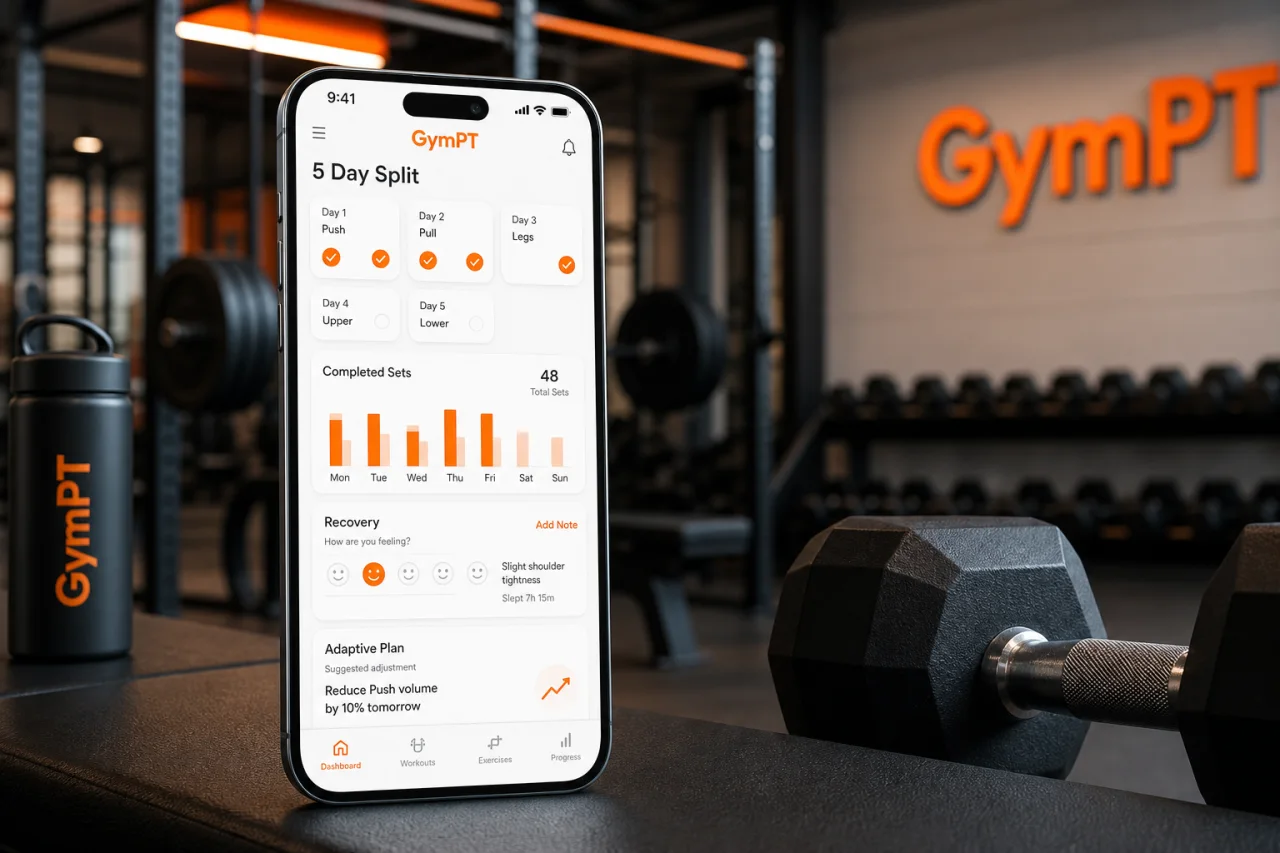
How to know if your 5 day workout split is too much
Watch for these signs that your plan may need to be reduced or reorganized:
- Your performance is dropping for more than one week
- You feel unusually sore before most sessions
- You are dreading workouts instead of recovering between them
- Your sleep or appetite is getting worse
- You cannot complete the plan consistently
If that happens, the answer is usually not to push harder. It is to simplify the week, reduce volume, or move to a 4 day gym workout plan that you can sustain better.
How GymPT helps you personalize a 5 day workout split
The best split is not the one that looks impressive on paper. It is the one that fits your life and still drives progress. GymPT helps you turn a 5 day structure into a plan that adapts to your goals, available equipment, and recovery.
- AI coach chat: ask how to adjust your week when energy, soreness, or schedule changes
- Personalized workout plans: get a split built around your goal and training level
- Equipment-based training: train with the tools you actually have
- Workout tracking: log sets, reps, and loads so progression is visible
- Progress insights: spot patterns in consistency and recovery before they become problems
- Body analysis: connect training decisions to broader progress signals
That combination is especially useful if you want a weekly workout split that can evolve instead of staying frozen for months.
Bottom line
A 5 day workout split can be an excellent choice if you want enough training frequency to progress while still protecting recovery. The best version is simple, repeatable, and matched to your goal, your equipment, and your schedule. If you can recover from it and stick to it, it is probably a good split. If not, it needs to be adjusted.
GymPT makes that adjustment easier by helping you build a plan that responds to real training data, not guesswork.
Frequently asked questions
Is a 5 day workout split good for beginners?
Sometimes, but not always. Beginners often do better with fewer training days because they need time to learn movement patterns and recover. A 3 day or 4 day plan is often easier to sustain at first.
Can I build muscle with a 5 day workout split?
Yes. A 5 day split can support muscle gain well if your weekly volume, exercise selection, effort, and recovery are all appropriate.
Should I do cardio on a 5 day split?
You can. Light to moderate cardio on rest days or after lifting can support general fitness, as long as it does not interfere with recovery or performance.
What is the best 5 day workout split for fat loss?
The best split is the one you can follow consistently while maintaining enough training quality and overall activity. Strength training plus regular movement is usually more sustainable than an overly aggressive plan.