4 day gym workout plan
4 Day Gym Workout Plan: A Smarter Weekly Split for Real Progress
A 4 day gym workout plan can be one of the most effective ways to train if you want enough weekly volume, enough recovery, and a schedule you can stick to. This guide shows how to structure the week, choose the right split, and adapt the plan to your goal, equipment, and recovery.

Why a 4 day gym workout plan works so well
A 4 day gym workout plan gives you a useful middle ground: more training opportunities than a 3-day routine, but more recovery than a 5- or 6-day split. For many people, that balance makes it easier to train hard, recover well, and stay consistent long enough to see progress.
That matters because effective training is not only about doing more work. It is about doing enough weekly work to stimulate adaptation, while leaving enough time for muscles, joints, and your nervous system to recover. Public health guidance also supports regular muscle-strengthening activity on at least 2 days per week, alongside weekly aerobic activity, which fits naturally into a 4-day structure.
If your schedule is busy, a 4-day plan is often the sweet spot: structured enough to be progressive, flexible enough to survive real life.
Who should use a 4 day split?
This format works especially well if you want one of these outcomes:
- Muscle gain with enough weekly volume to train each major muscle group more than once.
- Strength progress with room to practice the main lifts without rushing sessions.
- Fat loss support through consistent lifting, plus optional cardio on non-lifting days.
- A sustainable routine that fits around work, family, or school.
It is also a strong option if you have outgrown a beginner full-body plan but do not want to live in the gym. A 4-day schedule gives you more room to separate lower-body and upper-body work, or to split training by movement pattern, while still keeping the week manageable.
The best weekly structure for most people
There is no single perfect split, but the best 4-day gym workout plan usually follows one of these patterns:
Option 1: Upper / Lower / Upper / Lower
This is the most practical choice for many lifters because it is simple, balanced, and easy to progress. You train each half of the body twice per week, which helps distribute volume without making any one session too long.
- Monday: Upper body
- Tuesday: Lower body
- Thursday: Upper body
- Friday: Lower body
This setup works well for strength and hypertrophy because it gives each muscle group repeated practice and enough recovery between similar sessions.
Option 2: Push / Pull / Legs / Full body
If you like variety, this split can be a good fit. It spreads the workload across movement patterns and lets you add a full-body day for extra volume or weak-point work.
- Monday: Push
- Tuesday: Pull
- Thursday: Legs
- Saturday: Full body
This version is useful if you want a little more flexibility in exercise selection, especially when equipment availability changes from week to week.
Option 3: Strength focus with one accessory day
If your main goal is to get stronger on the big lifts, you can organize the week around two lower-intensity skill days and two heavier strength days. That keeps the main lifts fresh while still building enough total work.
For example:
- Day 1: Heavy lower
- Day 2: Heavy upper
- Day 3: Volume lower
- Day 4: Volume upper and accessories
The right split is the one you can repeat consistently. The best plan on paper is not better than the plan you can actually finish.
How to build each workout inside the week
A good 4-day plan does not need endless exercises. It needs the right exercise order, enough effort, and a clear purpose for each session.
Start with the main lift
Begin each workout with the movement that matters most for your goal. That might be a squat, bench press, deadlift variation, overhead press, row, or pull-up. Put your highest-skill, highest-energy exercise first so you can perform it with better technique and more load.
Use compound lifts before isolation work
Compound exercises give you the most training value early in the session because they involve more muscle mass and usually allow more total work. After that, add accessory movements to target specific muscles, improve balance, or bring up weak points.
Keep the session length realistic
Most people do better with sessions that are focused rather than endless. A 4-day plan should feel challenging, but not so long that it becomes hard to recover from or hard to repeat.
A simple rule: if your workout is so long that your last exercises are always rushed, cut the fluff and keep the work that moves the needle.
A sample 4 day gym workout plan
Here is a practical example using an upper/lower split. It is not the only way to train, but it is a strong starting point for many gym-goers.
Day 1: Upper body strength
- Bench press or machine chest press
- Row variation
- Overhead press
- Lat pulldown or pull-up
- Triceps pressdown
- Biceps curl
Day 2: Lower body strength
- Squat or leg press
- Romanian deadlift
- Split squat or lunge
- Leg curl
- Calf raise
- Core exercise
Day 3: Upper body volume
- Incline press or dumbbell press
- Seated cable row
- Lateral raise
- Chest-supported rear delt movement
- Lat-focused pull
- Arms finisher
Day 4: Lower body volume
- Front squat, hack squat, or leg press
- Hip hinge variation
- Walking lunge or step-up
- Leg extension
- Leg curl
- Core or carry work
For most lifters, this structure is enough to build a complete week without overcomplicating the plan.
How much volume should you do?
Weekly volume matters, but more is not always better. A useful approach is to start with a moderate amount of work and increase only when recovery and performance stay solid.
For hypertrophy, many people do well when each major muscle group gets trained more than once per week with enough hard sets to create a stimulus. For strength, the focus shifts more toward practicing the main lifts with quality reps and manageable fatigue.
Instead of chasing a fixed number for every exercise, ask three questions:
- Am I recovering before the next session?
- Am I adding reps, load, or control over time?
- Can I keep this pace for the next 8 to 12 weeks?
If the answer is yes, your volume is probably in the right range.
Recovery is part of the plan, not an afterthought
A 4-day gym workout plan works because it creates space between hard sessions. Use that space well.
- Sleep: Prioritize enough sleep so your performance does not slide week after week.
- Rest days: Keep at least one or two days free from hard lifting.
- Light activity: Walking, mobility work, or easy cardio can help you stay active without adding much fatigue.
- Exercise selection: If a movement beats you up every week, swap it for a similar pattern that is easier to recover from.
Recovery is not laziness. It is the part of training that lets the next workout be productive.
How to adapt the plan to your goal
The same 4-day structure can support different goals if you adjust the emphasis.
If your goal is muscle gain
Use a moderate rep range, keep most sets challenging, and make sure each muscle group appears at least twice per week. Add accessories for shoulders, arms, glutes, or calves if those areas matter to you.
If your goal is strength
Keep the main lifts at the center of the week. Use lower rep ranges on the primary lifts, then add a small amount of accessory work to support technique and joint balance.
If your goal is fat loss
Keep lifting as the foundation, then add walking, conditioning, or short cardio sessions on non-lifting days. The goal is to preserve muscle and maintain training quality while supporting a calorie deficit.
If your goal is general fitness
Mix strength, mobility, and conditioning in a way you enjoy. A balanced 4-day plan can improve consistency because it is easier to repeat than a more extreme routine.
How GymPT helps you keep the plan useful
The biggest problem with many workout plans is not the first week. It is week four, when life changes, energy drops, or the gym is crowded. That is where an adaptive tool helps.
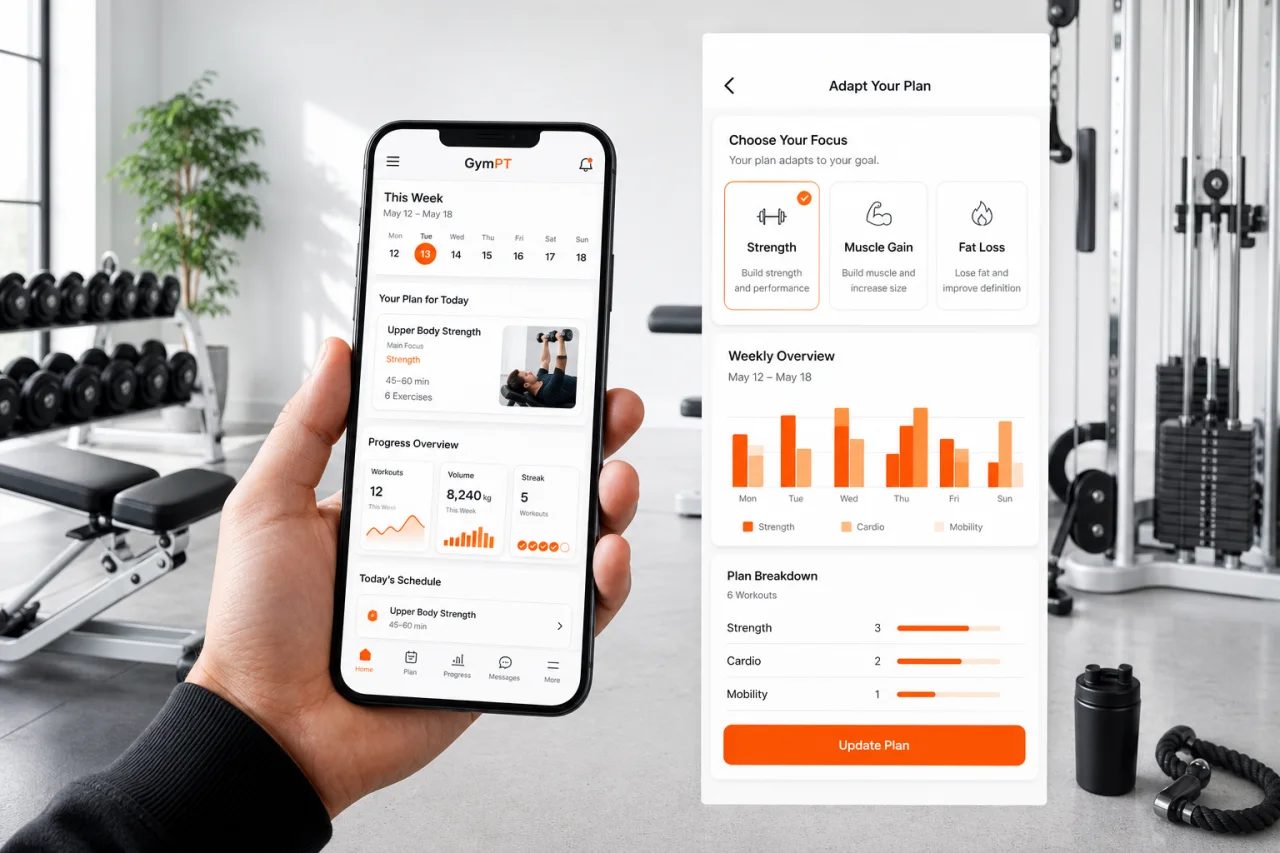
With GymPT, you can build a plan around your equipment, training goal, and schedule, then adjust it as your week changes. If you miss a session, need a different exercise, or want to shift volume based on recovery, the plan can adapt instead of forcing you to restart.
GymPT also helps you track workouts, review progress, and use body analysis and coach chat to make better training decisions over time. That means your 4 day gym workout plan can stay practical instead of becoming a rigid template you stop following.
Common mistakes to avoid
- Doing too much too soon: Starting with a plan that is too hard to recover from.
- Changing exercises every week: Making progress harder to measure.
- Skipping the main lift: Letting accessories take over the session.
- Ignoring recovery: Training hard without enough sleep, food, or rest.
- Copying someone else’s split: Using a plan that does not fit your schedule or equipment.
If your plan is not sustainable, it is not the right plan yet.
Final takeaway
A 4-day split is one of the most effective ways to train because it balances structure, recovery, and flexibility. It gives you enough weekly work to make progress while still leaving room for real life.
The best version is the one that matches your goal, your equipment, and your recovery. Build around those three things, then adjust as you go. That is how a workout plan becomes a system you can actually keep using.
If you want a plan that adapts with you, GymPT can help you build, track, and refine it week by week.