3 day full body workout plan
3 Day Full Body Workout Plan: How to Train Smarter, Recover Better, and Progress Week by Week
A practical guide to building a 3 day full body workout plan with the right exercise mix, recovery, and progression for real-world results.
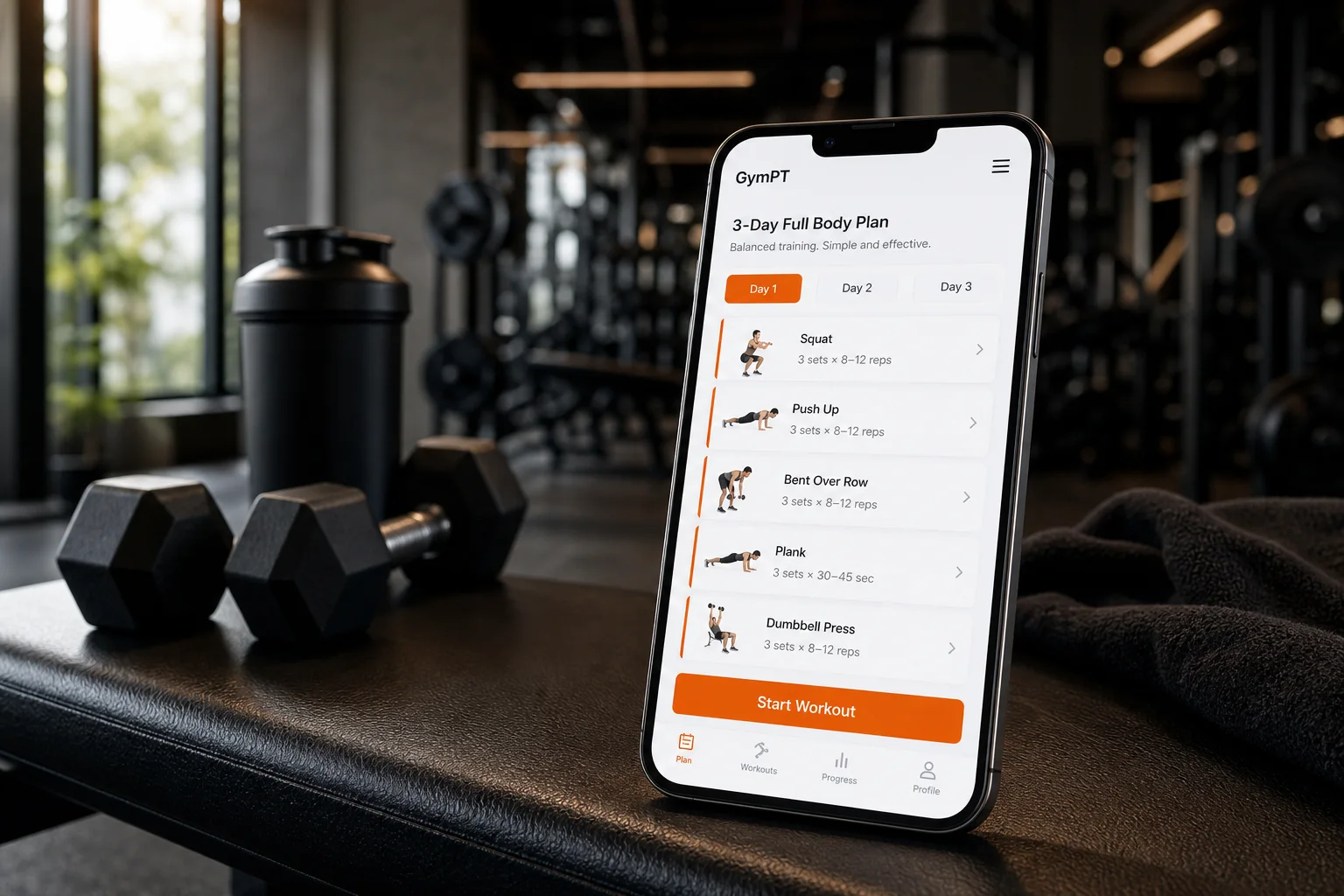
3 Day Full Body Workout Plan: the simplest split that still works hard
A well-built 3 day full body workout plan is one of the most practical ways to train if you want steady progress without living in the gym. It gives you enough weekly frequency to practice the main movement patterns, while still leaving room to recover, walk, sleep, and live your life. Public health guidance recommends muscle-strengthening work on at least two days per week, and resistance-training research suggests that training muscle groups more than once per week can be a smart way to support growth and strength.
This article shows you how to structure a 3-day plan by training level, how to manage recovery, and how to progress without guessing. If you want the app to do the planning for you, GymPT can help turn these principles into a personalized schedule.
Why a 3-day full body split is so effective
Three full-body sessions per week work well because they spread training stress across the week instead of concentrating it into one brutal day per muscle group. That usually makes it easier to keep technique sharp, maintain training quality, and recover between sessions. It also fits the general recommendation to train all major muscle groups on two or more days each week.
For many people, the biggest advantage is consistency. A 3-day schedule is easier to repeat than a complicated split, especially if your week is unpredictable. You can still train chest, back, legs, shoulders, arms, and core often enough to improve, but with less weekly friction.
Who this split is best for
- Beginners who need repetition of the basics.
- Busy lifters who can only commit three days per week.
- Intermediate trainees who want a balanced plan with manageable fatigue.
- Home or gym users who want a flexible structure based on available equipment.
How to build the plan: the 5 pieces that matter
A good full-body plan is not just “do everything three times.” It needs a structure. Use these five pieces to make the plan work.
1. Start with one lower-body pattern, one push, and one pull
Each workout should include:
- One squat or leg pattern such as a squat, leg press, split squat, or goblet squat.
- One push such as a bench press, machine press, push-up, or shoulder press.
- One pull such as a row, lat pulldown, pull-up, or cable row.
This keeps the plan balanced and helps you cover the major muscle groups efficiently.
2. Add one accessory for the weak link
After the main lifts, add one or two accessory movements for the area you want to improve most. That might be glutes, hamstrings, upper back, delts, biceps, triceps, or core. Accessory work is where you can personalize the plan without making it chaotic.
3. Keep weekly volume realistic
For most people, the best plan is the one you can repeat. Start with a moderate number of hard sets, then build up only if recovery and performance stay solid. The CDC notes that resistance work should be progressive over time, and that increasing weight, sets, reps, or training days can all drive adaptation.
4. Leave room for recovery
Recovery is not a bonus; it is part of the program. A simple Monday-Wednesday-Friday rhythm works well because it spaces sessions out and reduces the chance that fatigue from one workout ruins the next. If you prefer other days, keep at least one rest day between full-body sessions when possible.
5. Progress in one direction at a time
Do not try to add weight, reps, sets, and exercise complexity all at once. Pick one main progression method for 4 to 6 weeks. That makes it easier to see whether the plan is actually working.
A practical 3 day full body workout plan template
Below is a simple template you can use in a gym or adapt with machines, dumbbells, cables, or bodyweight. The exact exercise choice can change, but the structure should stay stable.
Day 1: Strength-focused full body
- Squat pattern: 3 sets of 5 to 8 reps
- Horizontal push: 3 sets of 5 to 8 reps
- Horizontal pull: 3 sets of 6 to 10 reps
- Accessory lower body: 2 sets of 8 to 12 reps
- Core: 2 sets of 8 to 12 controlled reps or timed holds
Day 2: Hypertrophy-focused full body
- Hinge or leg pattern: 3 sets of 8 to 12 reps
- Vertical push: 3 sets of 8 to 12 reps
- Vertical pull: 3 sets of 8 to 12 reps
- Accessory upper body: 2 to 3 sets of 10 to 15 reps
- Core or carry: 2 sets
Day 3: Balanced full body
- Single-leg or squat pattern: 3 sets of 8 to 10 reps
- Push variation: 3 sets of 8 to 12 reps
- Pull variation: 3 sets of 8 to 12 reps
- Posterior chain or glute accessory: 2 to 3 sets of 10 to 15 reps
- Arms or shoulders: 2 sets of 10 to 15 reps
This structure gives you one heavier day, one moderate volume day, and one balanced day. That variety helps you train hard without making every session feel identical.
How to choose exercises based on your level
Beginner version
If you are new to lifting, choose stable movements that are easy to learn and easy to repeat. Machines, dumbbells, and bodyweight variations are often the best starting point.
- Leg press or goblet squat
- Machine chest press or push-up
- Seated cable row or machine row
- Romanian deadlift with dumbbells
- Plank or dead bug
Keep the exercise list short. Beginners usually progress faster when they practice the same movements for several weeks instead of changing exercises every session.
Intermediate version
If you already know the basics, you can use more variation while keeping the same movement patterns. For example, rotate between barbell, dumbbell, cable, and machine options across the week. That can help you manage joints, keep training interesting, and target different angles.
Advanced version
Advanced lifters usually do best when the plan is more specific. You may need slightly higher weekly volume, more precise exercise selection, and clearer fatigue management. At that point, the goal is not just to “work out,” but to distribute effort so performance stays high across all three sessions.
How hard should each workout feel?
A 3-day plan works best when you leave a little in the tank on most sets. You do not need to max out every session to make progress. In practice, that means stopping most sets when you still have one to three good reps left. This helps preserve form and makes it easier to recover for the next workout.
For compound lifts, a moderate effort level is usually enough. For accessories, you can push a bit closer to fatigue because the overall cost is lower. The key is consistency: repeatable effort beats random all-out sessions.
Recovery rules that make the plan sustainable
Recovery is where many good plans fail. If you want your full body training split to work, protect the basics.
- Sleep enough to support performance and recovery.
- Keep at least one rest day between sessions when possible.
- Do not add extra hard cardio so aggressively that leg training suffers.
- Eat enough protein and total calories to match your goal.
- Track soreness and performance so you can spot when fatigue is building.
If your lifts are dropping, your joints feel beat up, or your motivation is crashing, the plan may be too aggressive. Reduce volume before you reduce consistency.
How to progress week by week
Progressive overload does not have to be complicated. Use one of these methods:
- Add reps first. Stay in a rep range until you hit the top end on all sets.
- Add load next. Increase weight slightly and return to the lower end of the rep range.
- Add a set only when needed. Use this if progress stalls and recovery is still good.
- Improve execution. Better range of motion, control, and consistency count too.
A simple example: if you do 3 sets of 6 to 8 reps on a squat pattern, try to move from 6, 6, 6 to 8, 8, 8 over time. Once you own the top end, add a small amount of weight and repeat.
That approach is easier to sustain than chasing random personal records every week.
Common mistakes to avoid
- Doing too many exercises. A full-body plan should be efficient, not endless.
- Training every set to failure. That often creates more fatigue than progress.
- Skipping pull work. Balanced training matters for posture, shoulder health, and overall development.
- Changing the plan too often. Give the program enough time to work.
- Ignoring recovery. Three good sessions beat three exhausted ones.
Sample weekly schedule
If you want a simple calendar, use this:
- Monday: Full body Day 1
- Tuesday: Rest or light walking
- Wednesday: Full body Day 2
- Thursday: Rest or mobility work
- Friday: Full body Day 3
- Weekend: Rest, easy cardio, or optional activity
This schedule is easy to remember and gives you a clean rhythm for recovery and progression.
How GymPT can help you follow the plan
The hardest part of training is often not the workout itself. It is deciding what to do, when to progress, and how to adjust when life gets busy. GymPT helps by turning your goals, equipment, and schedule into a personalized plan you can actually follow. You can use AI coach chat for quick guidance, track workouts, monitor progress, and adjust the plan as your strength and recovery change.
If you want a 3 day full body workout plan that feels tailored instead of generic, that is exactly the kind of structure GymPT is built to support.
Final take
A 3-day full-body split is simple, flexible, and effective when it is built around the basics: balanced movement patterns, realistic volume, enough recovery, and steady progression. You do not need a complicated program to make progress. You need a plan you can repeat long enough to improve.
Start with the template, keep the effort controlled, and progress one step at a time. That is how a good plan becomes a great one.
Related GymPT reads: AI Fitness Plan Generator: How to Use AI Coaching Without Guessing Your Way Through Training, AI Gym Workout Generator: How to Use AI Coaching for Smarter, Safer Training, Warm Up Before Workout: A Practical Guide for Better Training Sessions, Muscle Load Tracking: How to Measure Progress Without Guessing