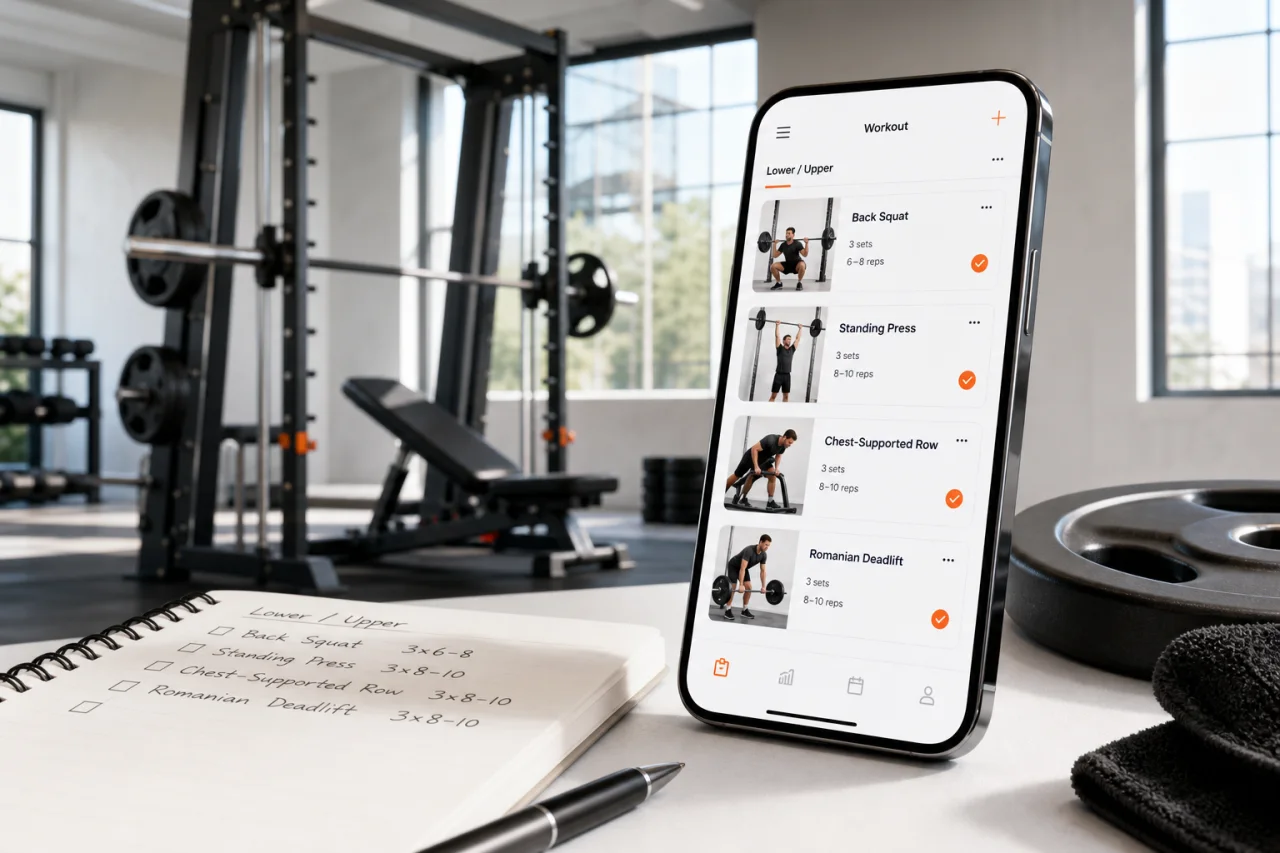
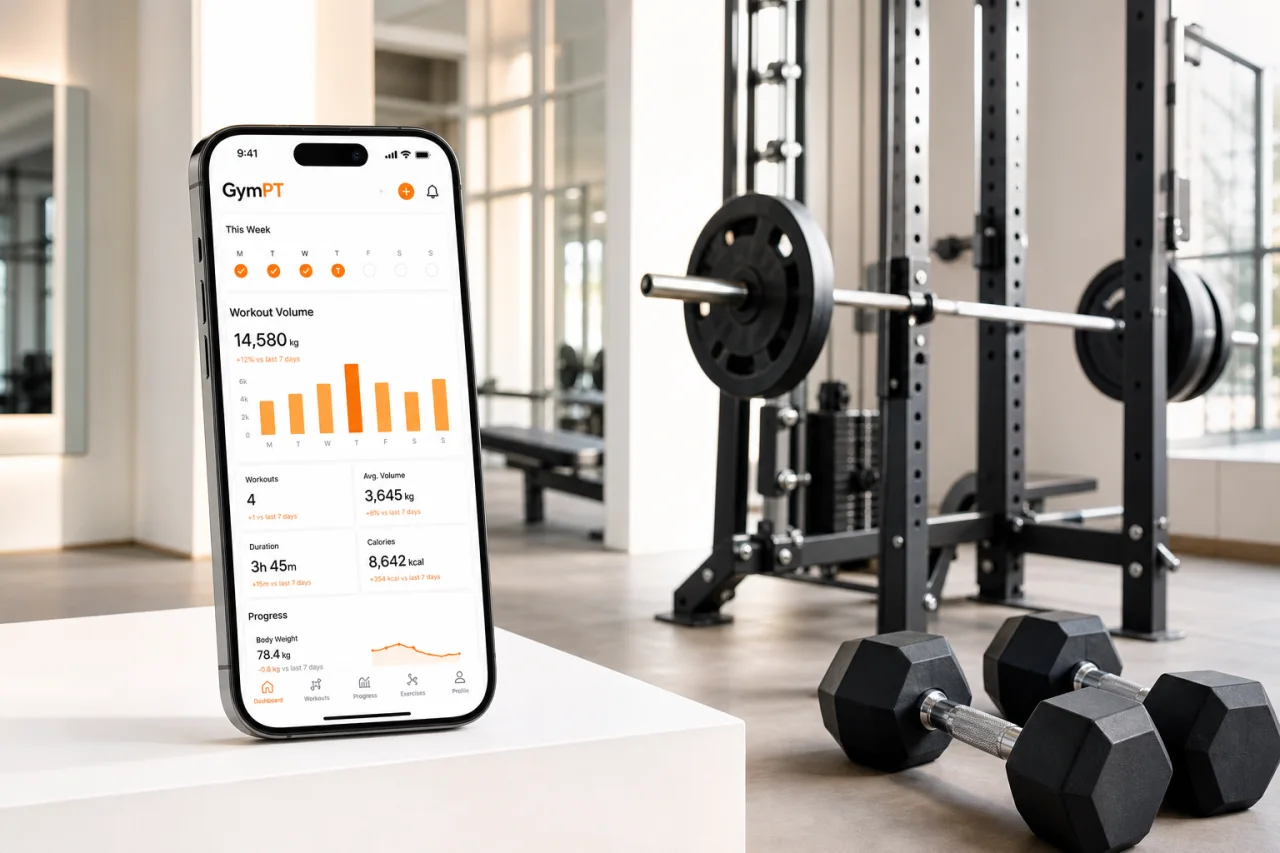
full body workout with smith machine
Full Body Workout With Smith Machine: Build a Smarter Plan Around One Tool
A Smith machine can anchor a complete full body workout when you choose the right movement patterns. Learn how to build a balanced plan, adjust for your gym setup, and progress with GymPT.
Full body workout with smith machine: how to build a balanced plan
A full body workout with smith machine can be one of the simplest ways to train when you want structure, stability, and easy exercise selection. The Smith machine is especially useful for beginners, busy gym-goers, and anyone who wants a predictable setup for squats, presses, lunges, and rows. The key is not to copy a random list of exercises. The key is to cover the major movement patterns your body needs, then adjust the plan to the equipment you actually have.
That approach matches current public health guidance: strength training should work the major muscle groups, and doing it at least twice per week is a practical target for most adults. A good full body session can do that efficiently without turning your workout into a marathon.
Why the Smith machine works well for full body training
The Smith machine gives you a fixed bar path, which can make it easier to learn movement patterns and stay consistent from set to set. That does not make it “better” than free weights for every goal, but it does make it a strong tool for building a repeatable plan. It is especially helpful when you want to train hard with less balance demand and fewer setup decisions.
For a full body session, that matters because you can move quickly from one pattern to the next: squat, hinge, push, pull, and single-leg work. If your gym has only a Smith machine plus a bench and a few dumbbells, you can still cover the whole body with a smart exercise selection.
The movement patterns your workout should cover
Instead of thinking in body parts first, think in patterns. A solid full body workout should include:
- Knee-dominant lower-body work for quads and glutes, such as squats or split squats.
- Hip-dominant lower-body work for glutes and hamstrings, such as Romanian deadlifts or hip thrusts.
- Horizontal pushing for chest, shoulders, and triceps, such as bench press or incline press.
- Horizontal pulling for upper back, such as rows.
- Optional vertical or accessory work for shoulders, calves, or core.
This pattern-based approach is useful because the Smith machine can support several of these movements safely and consistently. It also helps you avoid overloading one area while neglecting another.
A simple Smith machine full body workout
Use this as a practical template. If you are a beginner, start with fewer sets and leave a few reps in reserve. If you are more experienced, you can add load, sets, or a second weekly session.
Workout A
- Smith machine squat — 3 sets of 6 to 10 reps
- Smith machine bench press — 3 sets of 6 to 10 reps
- Smith machine bent-over row — 3 sets of 8 to 12 reps
- Smith machine Romanian deadlift — 2 to 3 sets of 8 to 12 reps
- Plank or dead bug — 2 to 3 sets
Workout B
- Smith machine split squat — 3 sets of 8 to 12 reps per leg
- Incline Smith machine press — 3 sets of 8 to 12 reps
- Smith machine hip thrust — 3 sets of 8 to 12 reps
- Inverted row on Smith machine or supported row variation — 3 sets of 8 to 12 reps
- Side plank or Pallof press — 2 to 3 sets
If you train only once per week, choose one version and make it a little longer. If you train twice per week, alternate A and B. That lines up well with guidance that recommends working major muscle groups on at least two days per week.
How to choose the right exercises around your equipment
Not every gym has the same attachments, bench options, or open floor space. That is where a good plan gets flexible. If your setup is limited, choose the closest movement pattern instead of forcing a perfect exercise.
- No bench? Use floor press, push-ups, or standing presses.
- No row station? Use Smith machine rows, inverted rows, or dumbbell rows if available.
- Limited lower-body space? Use squats, split squats, and hip thrusts instead of long walking lunges.
- Need a lower-skill hinge? Use Romanian deadlifts with a controlled range of motion.
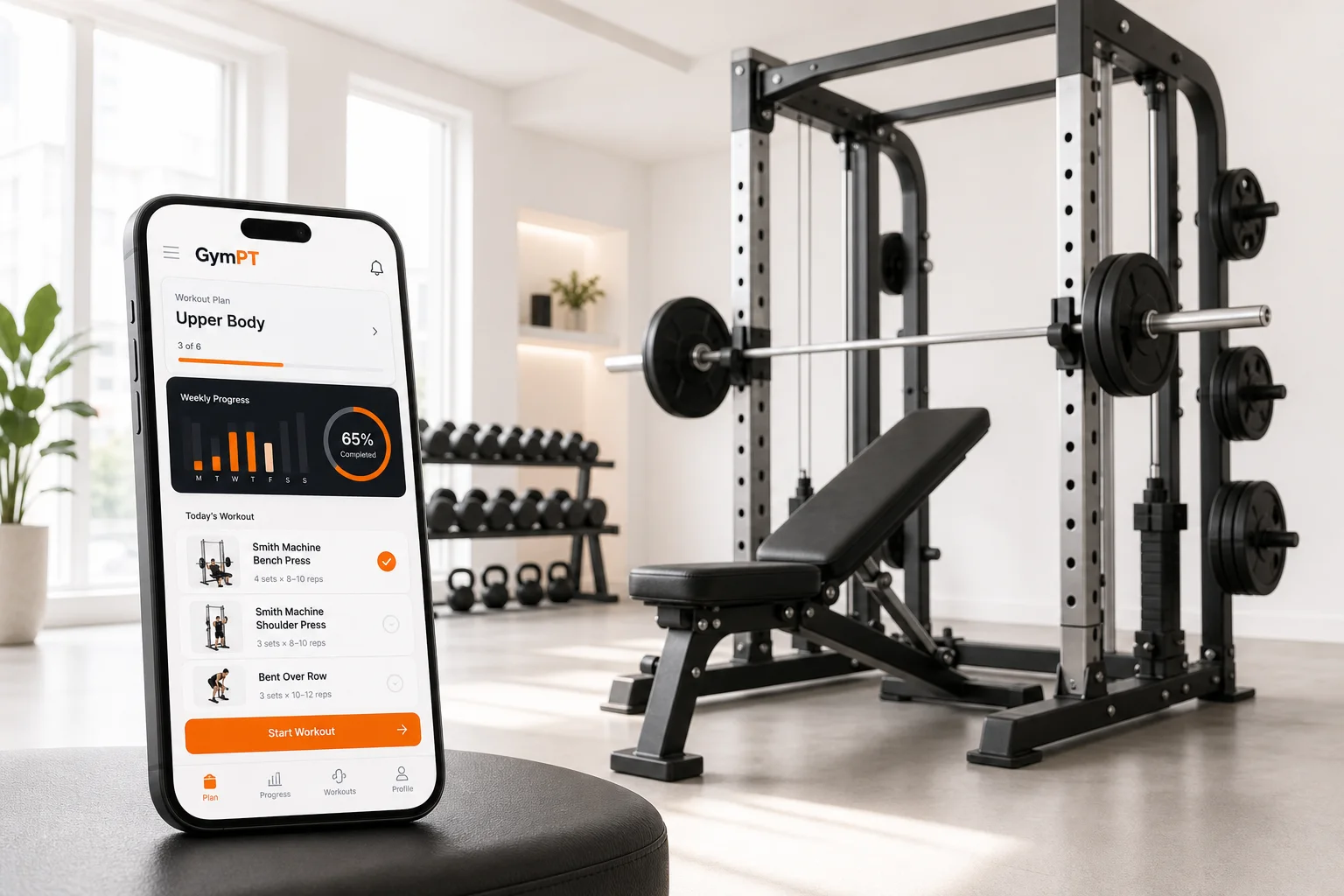
This is exactly where GymPT helps. You can tell the app what equipment you have, and it can build a plan around that setup instead of giving you a generic routine that does not fit your gym.
How hard should you train?
For most people, a useful target is 1 to 3 sets per exercise, with moderate loads that make the last few reps challenging but still controlled. Public health and exercise guidance commonly points to 8 to 12 repetitions as a practical range for many strength sessions, especially when you are building a balanced routine.
A simple rule: if you could easily do five more reps, the set was probably too light for your main work. If your form breaks down early, the load is probably too heavy. The Smith machine can help here because the fixed path makes it easier to repeat the same technique and compare sessions over time.
How to progress without overcomplicating the plan
Progress does not have to mean adding weight every workout. You can improve your plan in several ways:
- Add 1 rep per set until you reach the top of your rep range.
- Add a small amount of weight while keeping form clean.
- Add one extra set to a key lift.
- Improve control on the lowering phase.
- Reduce rest slightly while keeping performance stable.
GymPT can track these changes for you, which matters because progress is easier to manage when your workouts, loads, and reps are all in one place. If you are not sure whether to add weight or reps, the app can help you make the next step based on your recent performance.
Common Smith machine mistakes to avoid
- Using only one lower-body pattern. Squats are great, but you still need a hinge and some single-leg work.
- Skipping pulling movements. A full body workout should not be all pressing and squatting.
- Going too heavy too soon. The fixed bar path can feel stable, but control still matters.
- Ignoring range of motion. Use a depth and setup you can repeat with good form.
- Training without a plan. Random exercise order makes progress harder to measure.
If you want a stronger result, keep the workout simple enough to repeat and structured enough to improve.
How GymPT turns this into a better plan
A Smith machine workout works best when it is adapted to your goal, schedule, and available equipment. GymPT can help you do that by building a personalized plan, adjusting exercise choices, tracking your workouts, and showing progress insights over time. If your gym changes, your plan can change with it.
That is the real advantage of equipment-based training: you are not locked into one perfect routine. You are building a system that works with the tools you actually have.
Bottom line
A full body workout with smith machine is a practical, effective way to train when you want a stable setup and a clear structure. Focus on the main movement patterns, train the major muscle groups, and progress gradually. With the right exercise choices, a Smith machine can support a complete routine that is simple to follow and easy to improve.
If you want a plan that matches your equipment and your current level, GymPT can build it for you.