barbell exercises for beginners
Barbell Exercises for Beginners: A Smart Starter Plan Around One Tool
A beginner-friendly guide to barbell training that shows you which lifts to start with, how to organize them, and how GymPT can adapt your plan to your gym setup.
Barbell exercises for beginners: the simplest way to start strong
If you are new to lifting, barbell exercises for beginners can feel intimidating at first. The good news is that you do not need a huge exercise list to make progress. You need a small set of reliable movements, a clear order, and a plan that matches the equipment you actually have.
For most beginners, the best barbell training plan is built around a few compound lifts that train multiple muscle groups at once. That approach fits well with public health guidance that adults should do muscle-strengthening activity at least two days per week and work all major muscle groups. It also keeps your routine simple enough to repeat and improve.
Why barbell training works so well for beginners
A barbell is useful because it lets you load the same movement pattern over time. That makes progress easier to track than constantly changing exercises. It also teaches the basics of squatting, hinging, pressing, and pulling, which are the foundation of most strength programs.
Beginners usually do best when they focus on consistency, good technique, and gradual increases in load. ACSM’s recent resistance-training guidance also supports using a manageable number of sets per exercise, which is one reason simple barbell sessions work so well for new lifters.
The best barbell exercises for beginners
You do not need every barbell lift on day one. Start with the patterns below and build from there.
1. Barbell squat
The squat trains your legs, glutes, and core. If you are new, start with a comfortable depth and a load you can control. A goblet squat or bodyweight squat can help you learn the pattern before moving to the barbell.
2. Barbell Romanian deadlift
This is one of the best beginner hinge exercises. It teaches you how to keep a neutral spine while loading the hamstrings and glutes. Keep the bar close to your legs and move slowly.
3. Barbell bench press
The bench press builds chest, shoulders, and triceps strength. Beginners should focus on stable shoulder position, a controlled descent, and a consistent bar path.
4. Barbell row
Rows balance pressing work by training the upper back and lats. They are especially useful if you sit a lot during the day or want better posture support in your program.
5. Barbell overhead press
The overhead press develops shoulder strength and core stability. Use a light load at first and avoid leaning back to “cheat” the weight up.
How to choose the right barbell exercises for your gym
The smartest beginner plan is not the one with the most exercises. It is the one that fits your equipment, your confidence level, and your schedule.
- If you have a full rack and bench: use squats, bench press, rows, Romanian deadlifts, and overhead press.
- If you only have a barbell and plates: prioritize deadlift variations, floor press, bent-over rows, and front-loaded squat patterns.
- If your gym is busy: choose exercises that need less setup and can be done in a simple circuit or alternating format.
- If technique is still new: start with lighter variations and fewer exercises, then add complexity later.
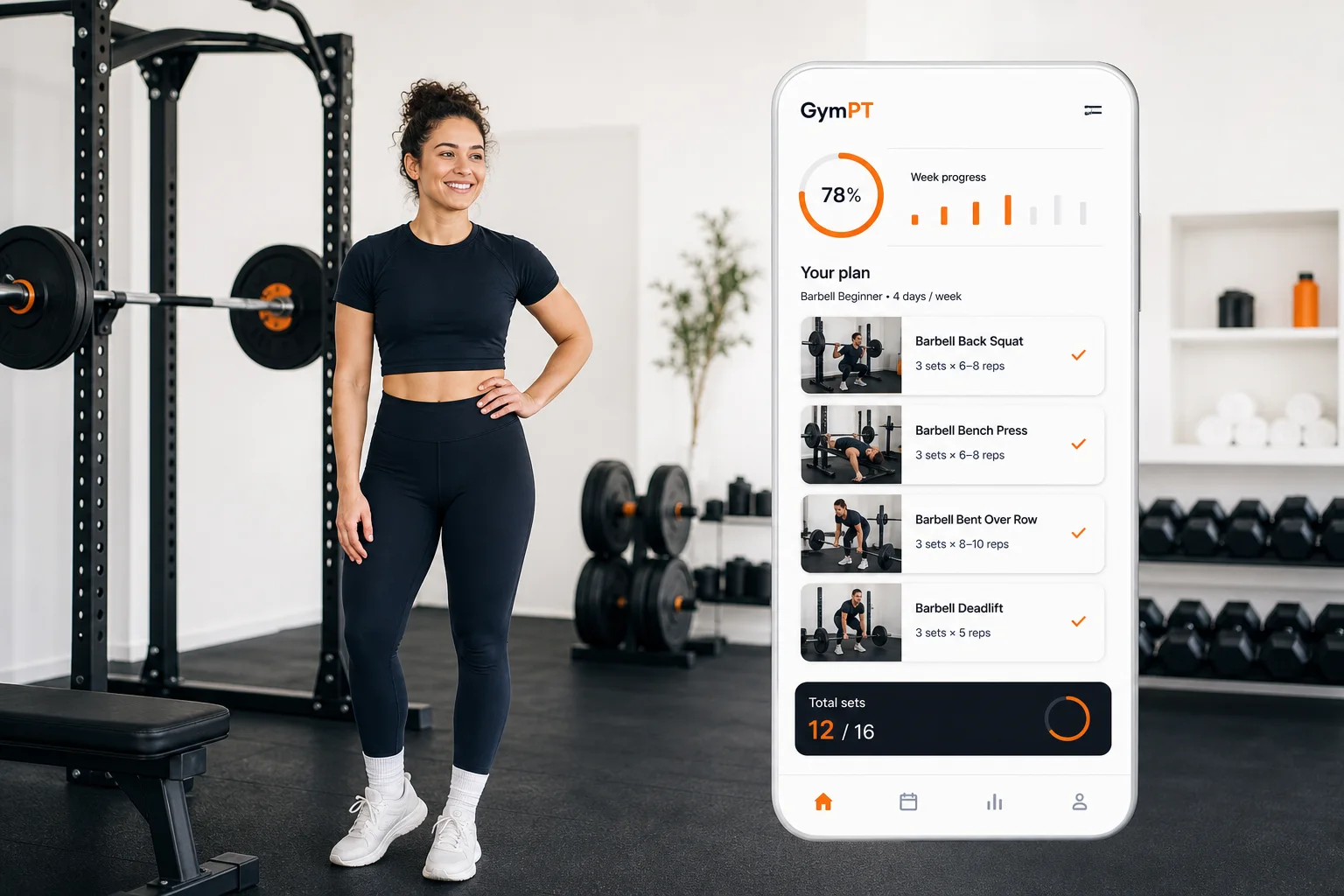
This is where GymPT helps. Instead of forcing a generic barbell routine, GymPT can build a workout around the equipment you have, then adjust exercise selection, volume, and progression as you improve.
A simple beginner barbell workout
Here is a practical full-body session you can repeat two to three times per week.
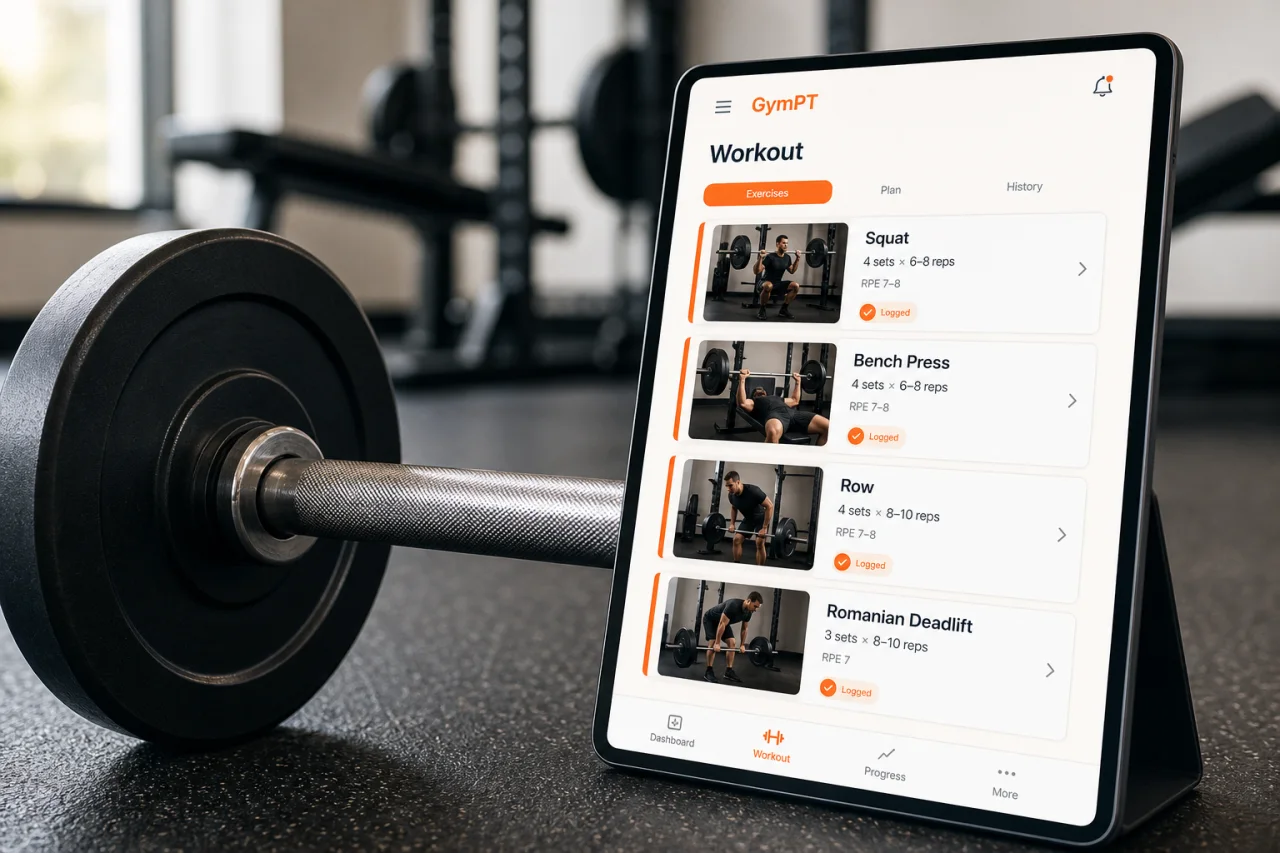
- Barbell squat — 3 sets of 5 to 8 reps
- Barbell bench press — 3 sets of 5 to 8 reps
- Barbell row — 3 sets of 8 to 10 reps
- Romanian deadlift — 2 to 3 sets of 8 to 10 reps
- Overhead press — 2 sets of 6 to 8 reps
Rest long enough to keep your form clean. For most beginners, that means taking enough time to recover between sets instead of rushing through the workout. If your technique breaks down, reduce the load before adding more weight.
How to progress without overcomplicating it
Progress should feel boring in the best way. Add a little weight, add a rep, or improve your form before trying to do everything at once. That is usually safer and more sustainable than chasing big jumps too early.
CDC guidance emphasizes regular muscle-strengthening work for adults, and that is exactly why a repeatable barbell plan matters. You are not trying to max out every session. You are building a habit that covers all major muscle groups week after week.
Common beginner mistakes to avoid
- Doing too many lifts: five good exercises beat ten random ones.
- Loading the bar too fast: technique should stay stable as weight increases.
- Skipping the hinge pattern: squats alone are not enough for balanced lower-body training.
- Ignoring upper-back work: rows help balance pressing and support better overall development.
- Changing the plan every week: beginners improve faster when they repeat the same core lifts.
How GymPT makes barbell training easier
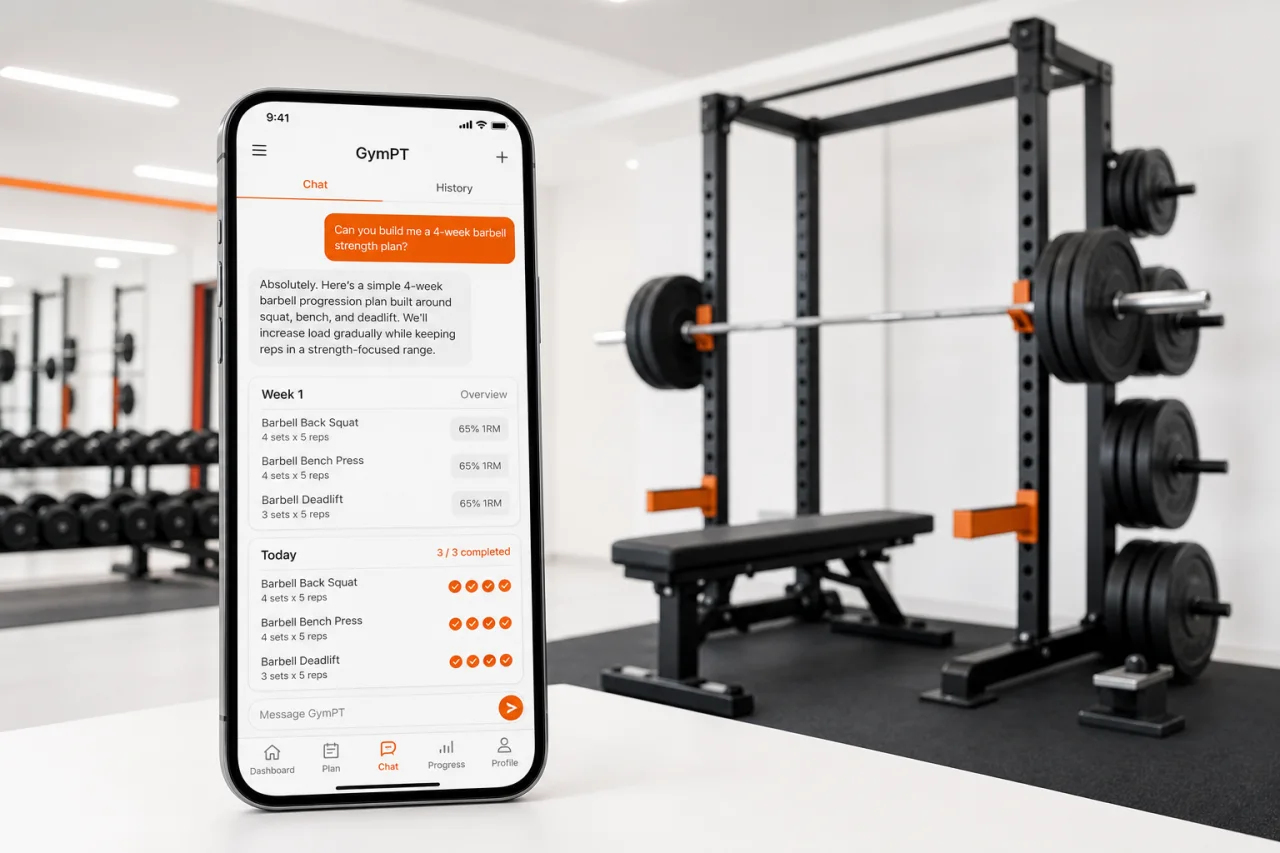
GymPT is built for exactly this kind of decision-making. If you tell it what equipment you have, how many days you can train, and what feels comfortable right now, it can create a personalized barbell workout plan that fits your reality instead of a generic template.
You can also use GymPT to track workouts, review progress insights, and chat with the AI coach when you are unsure whether to increase weight, swap an exercise, or simplify the session. That makes it easier to stay consistent and keep improving.
Final takeaway
The best barbell exercises for beginners are the ones you can perform safely, repeat consistently, and progress over time. Start with a few core lifts, keep the plan simple, and let your equipment guide the exercise selection. If you want a plan that adapts to your gym setup automatically, GymPT can do that for you.