abs workout for beginners
Abs Workout for Beginners: A Simple Core Plan That Builds Real Strength
A beginner abs workout should do more than burn. Learn how to train your core with smart exercise choices, clean form cues, and simple progressions you can actually stick to.
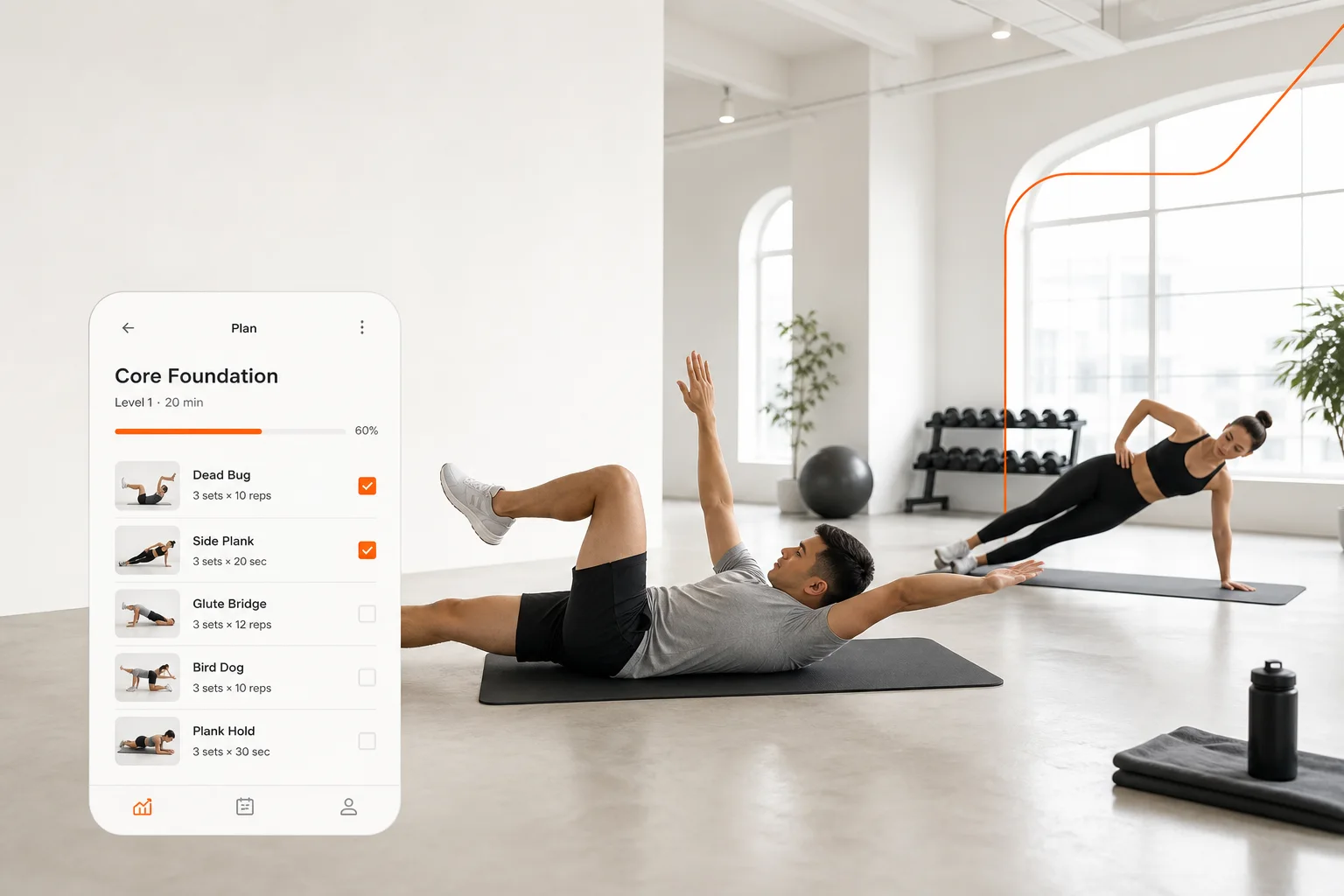
Abs Workout for Beginners: Start With Core Control, Not Burn
If you want an abs workout for beginners that actually helps you get stronger, start by thinking beyond crunches. Your abs are part of your core, which also includes the muscles around your lower back, pelvis, and hips. A good beginner plan trains those muscles to brace, resist movement, and support better posture and stability.
The goal is not to do the most reps possible. The goal is to learn control, keep your spine in a safe position, and build a base you can progress over time. That is why beginner core training works best when it includes a mix of crunching, bracing, and anti-rotation work.
What Makes a Good Beginner Abs Workout?
A smart beginner routine should be simple enough to repeat, but challenging enough to create progress. The best starting point is usually 4 to 5 exercises, done for moderate reps or short holds, with clean technique. Mayo Clinic recommends core work that keeps breathing steady and emphasizes control over speed.
- Train 2 to 3 times per week on non-consecutive days.
- Use 1 to 3 sets per exercise.
- Stop each set with 1 to 3 reps left in the tank so form stays sharp.
- Choose exercises you can repeat well before making them harder.
If you are brand new, a short routine done consistently beats a long routine you cannot recover from or maintain.
The Beginner Abs Workout
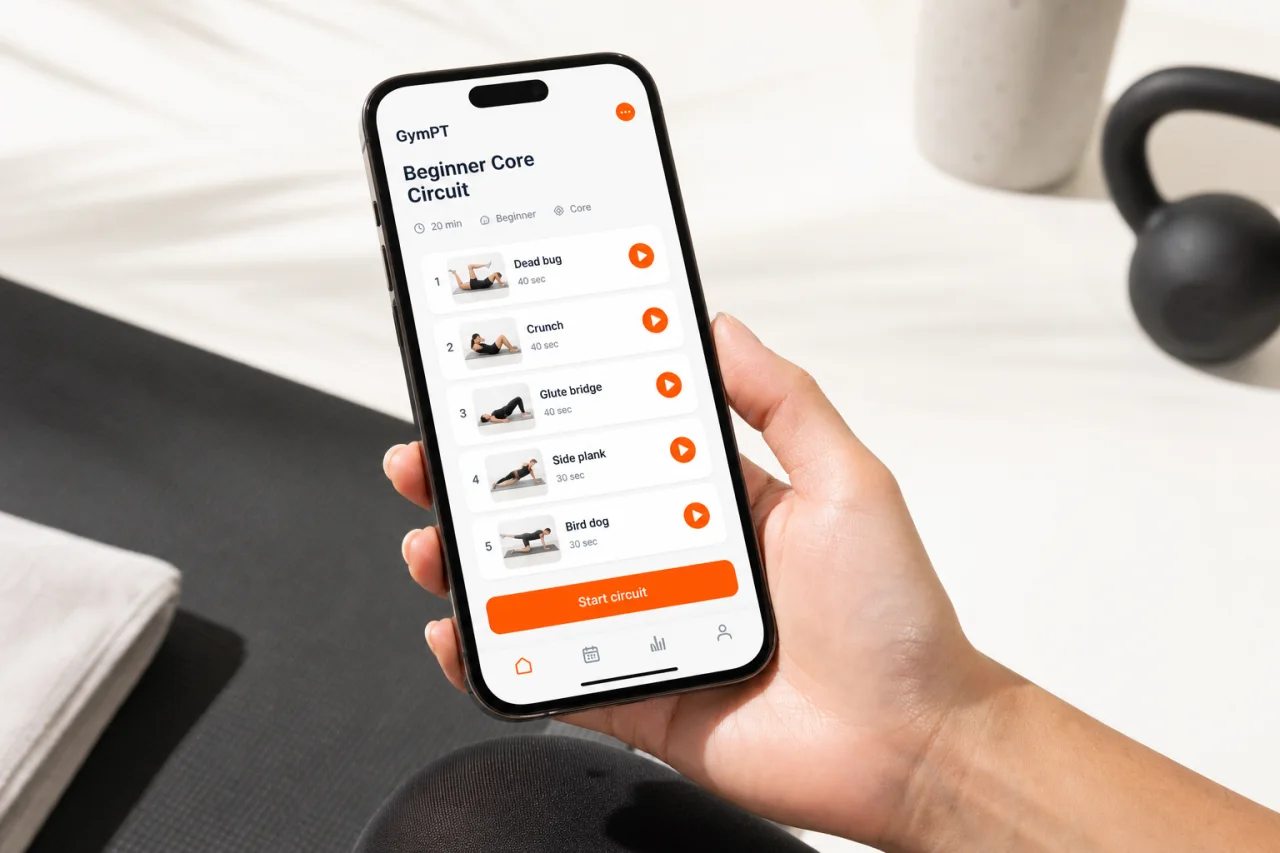
Do the following circuit after a warm-up or at the end of a full-body workout. Rest 30 to 60 seconds between exercises as needed.
1. Dead Bug
Why it helps: Teaches core bracing while your arms and legs move.
- Lie on your back with knees bent and arms pointed toward the ceiling.
- Press your lower back gently into the floor without flattening it aggressively.
- Slowly extend one leg and the opposite arm.
- Return to start and switch sides.
Beginner tip: Keep the range small if your back starts to arch.
Reps: 6 to 10 per side.
2. Crunch
Why it helps: A classic abs exercise that trains the front of the trunk.
- Lie on your back with knees bent and feet flat.
- Cross your arms over your chest or place fingertips lightly at your temples.
- Lift your shoulders a few inches off the floor.
- Lower slowly with control.
Form cue: Think “rib cage toward pelvis,” not “pull with the neck.”
Reps: 8 to 15.
3. Glute Bridge
Why it helps: Supports core stability by linking the abs, glutes, and pelvis.
- Lie on your back with knees bent and feet hip-width apart.
- Brace your abs, then lift your hips until shoulders, hips, and knees form a line.
- Pause briefly and lower under control.
Form cue: Keep your ribs down and avoid over-arching your lower back.
Reps: 10 to 15.
4. Side Plank From Knees
Why it helps: Trains the side abs and anti-side-bending strength.
- Lie on one side and prop yourself up on your forearm.
- Bend your knees and stack them.
- Lift your hips so your body forms a straight line from shoulders to knees.
- Hold while breathing steadily.
Beginner tip: Keep the top hand on your hip if balance feels shaky.
Hold: 15 to 30 seconds per side.
5. Bird Dog
Why it helps: Builds trunk stability without loading the spine heavily.
- Start on hands and knees.
- Reach one arm forward and the opposite leg back.
- Keep hips level and avoid twisting.
- Pause, return, and switch sides.
Form cue: Move slowly enough that your torso stays quiet.
Reps: 6 to 10 per side.
How to Make the Workout Easier or Harder
Beginner abs training should meet you where you are. If an exercise feels too hard, shorten the lever, reduce the range, or use a shorter hold. If it feels too easy, increase time under tension, add a set, or slow the lowering phase.
- Too hard: Use bent knees, smaller range of motion, or shorter holds.
- Too easy: Add 5 to 10 seconds to planks, slow down reps, or add one extra set.
- Not sure? If your lower back takes over, the exercise is probably too advanced for now.
Mayo Clinic notes that core exercises should be done with controlled breathing and good form, and that a bridge, crunch, side plank, and similar movements are all valid core builders.
Common Beginner Mistakes to Avoid
- Rushing reps: Fast reps usually reduce tension where you want it.
- Pulling on the neck: Keep the head relaxed during crunches.
- Holding your breath: Breathe through the effort so you can keep bracing.
- Chasing soreness: A good abs workout should feel challenging, not sloppy.
- Doing only flexion work: Include planks, bridges, and bird dogs for a more complete core plan.
Sample 10-Minute Beginner Abs Routine
- Dead Bug — 2 sets of 6 to 8 per side
- Crunch — 2 sets of 10 to 12
- Glute Bridge — 2 sets of 12
- Side Plank From Knees — 2 holds of 20 seconds per side
- Bird Dog — 2 sets of 6 per side
Move through the list with controlled rest. If you are short on time, do one round. If you recover well, do two rounds. That is enough volume for many beginners to build consistency without overdoing it.
How GymPT Can Help You Progress
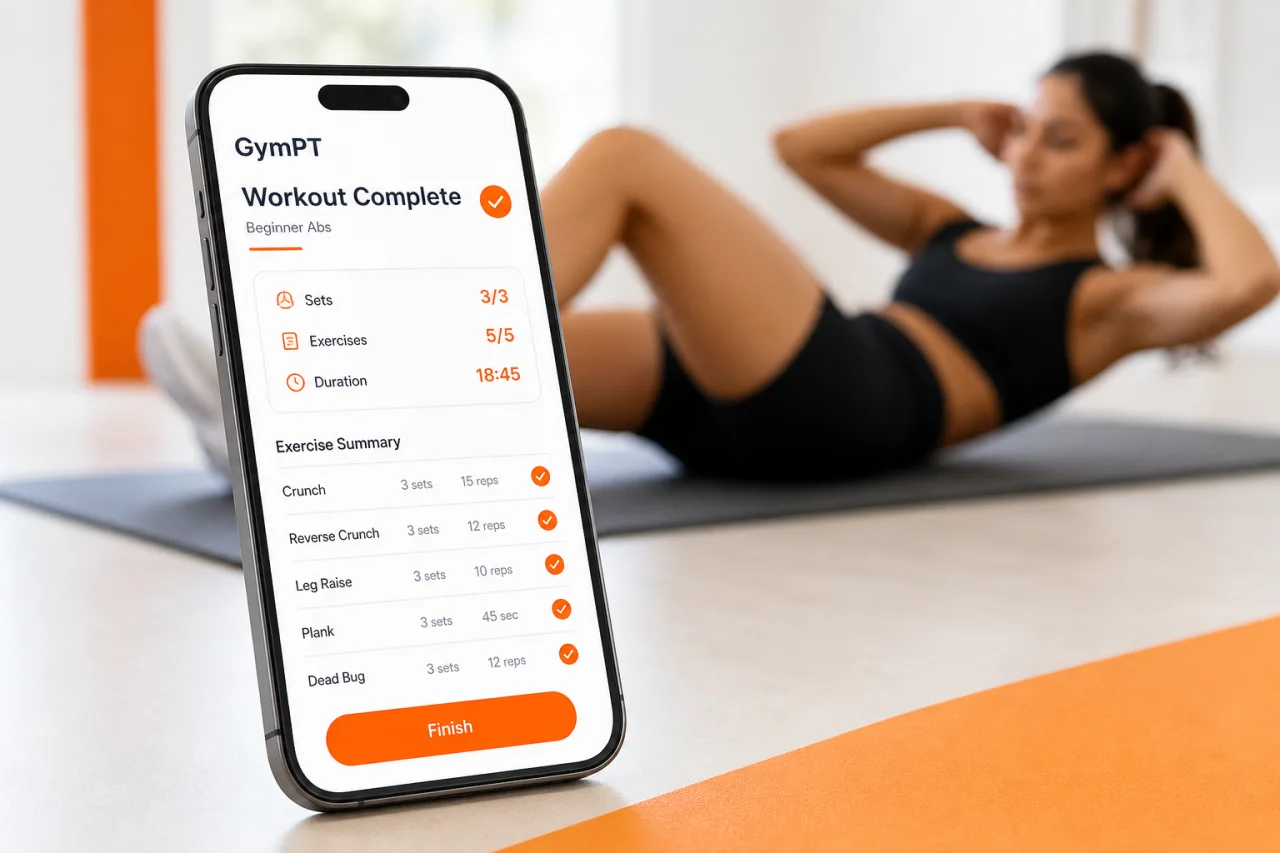
One of the hardest parts of core training is knowing when to progress. GymPT can turn a beginner abs workout into a plan that adapts to your equipment, schedule, and current level. You can use it to build a personalized routine, track completed sets, and review progress insights so you know when to add reps, time, or a harder variation.
If you are unsure whether to keep a movement, swap it, or make it harder, GymPT’s AI coach chat can help you choose the next step based on your actual training history.
When to Progress Your Abs Workout
You are ready to progress when you can finish every set with stable form, steady breathing, and no compensation from your neck or lower back. At that point, make one change at a time:
- Add 2 to 5 reps.
- Add 5 to 10 seconds to holds.
- Slow the lowering phase.
- Move from knee side planks to full side planks.
- Move from dead bugs to longer lever variations.
Progress should feel gradual. If form breaks, the exercise is too advanced for now.
Final Takeaway
The best abs workout for beginners is not the hardest one. It is the one you can repeat, recover from, and improve over time. Focus on control, breathing, and a balanced mix of crunches, bridges, planks, and anti-rotation drills. That is how you build real core strength, not just a temporary burn.
Start simple, track your reps, and make small upgrades when your form is solid. That is the kind of progress that lasts.