home workout with lat pulldown machine
Home Workout With Lat Pulldown Machine: Build a Smarter Back Plan Around One Station
A lat pulldown machine can anchor a complete home workout if you know how to pair it with the right push, leg, and core moves. Here’s how to build a balanced plan around one station and adapt it with GymPT.
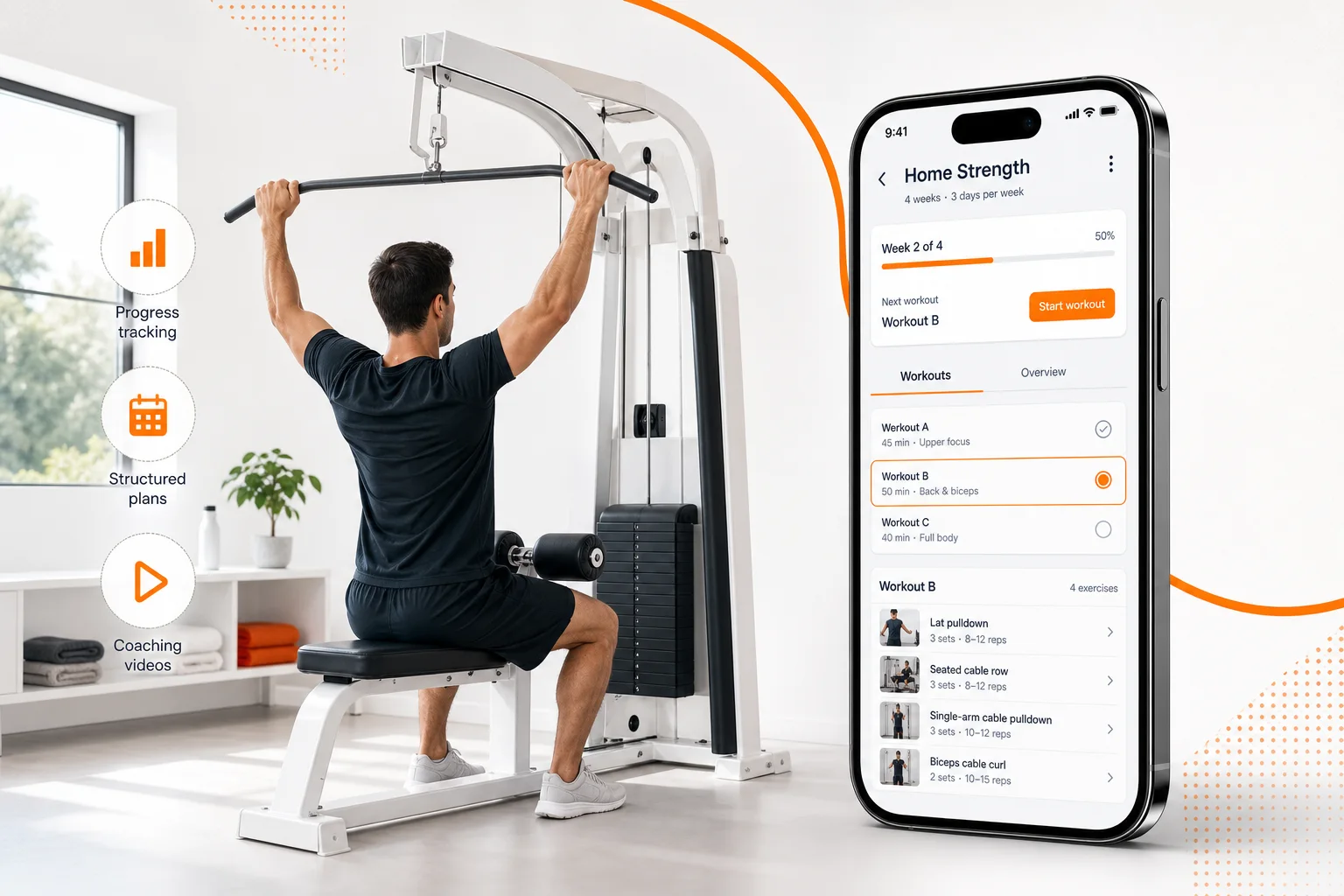
Home Workout With Lat Pulldown Machine: What It Can Do for Your Training
A home workout with lat pulldown machine works best when you treat the machine as the anchor for your pulling work, not the whole plan. The lat pulldown is excellent for training the back, biceps, and upper-body pulling pattern, but a balanced routine still needs pressing, leg work, and core training. Public health guidance recommends working all major muscle groups at least two days per week, and resistance training plans are usually more effective when they are built around a clear weekly structure instead of random exercises.
If you only have one machine at home, the smartest approach is simple: use the lat pulldown for your main back movement, then pair it with exercises that cover the rest of the body. That is exactly the kind of setup GymPT is designed to organize for you.
Why the Lat Pulldown Is a Strong Home-Gym Anchor
The lat pulldown gives you a controlled vertical pull, which makes it easier to train your back with consistent resistance and good form. It is especially useful if you want a machine-based option that is easier to load progressively than many bodyweight-only back exercises. ACSM’s recent resistance-training guidance emphasizes matching exercise selection, load, and weekly volume to your goal, whether that goal is strength, muscle growth, or general fitness.
For most home lifters, that means the lat pulldown should not be treated as a one-off back exercise. It should be part of a repeatable plan with:
- a main pull movement,
- a horizontal push movement,
- a lower-body exercise,
- and a core or carry-style finisher.
How to Build a Balanced Workout Around One Machine
Think in movement patterns, not just muscles. A good home session around a lat pulldown machine should cover the big training jobs your body needs each week: pull, push, squat or hinge, and brace. That structure lines up well with general strength guidance that recommends training the major muscle groups regularly rather than over-focusing on one area.
1. Start with the lat pulldown
Use the machine first while you are fresh. This is your main back exercise for the day. Keep your chest tall, pull the bar or handles down with control, and avoid turning the movement into a shrug or a lean-back swing. If you want a deeper form breakdown, GymPT can coach your setup, grip, and range of motion in real time.
2. Add a push exercise
Balance the pulling work with a press. At home, that might be push-ups, dumbbell floor press, or machine chest press if your setup includes one. This helps keep your upper-body training more complete and prevents your routine from becoming back-only.
3. Include a lower-body move
Choose one squat pattern or hinge pattern such as goblet squats, split squats, Romanian deadlifts, or leg presses if you have the equipment. Home training works better when the lower body is not an afterthought.
4. Finish with core work
Use planks, dead bugs, or cable-style anti-rotation work if your home setup allows it. Core training helps you keep better posture and transfer force more efficiently through the rest of your lifts.
A Simple Weekly Template for a Lat Pulldown Home Workout
If you want a practical starting point, use a two- or three-day full-body structure. That fits the common recommendation to train major muscle groups at least twice per week and makes it easier to progress without overcomplicating your schedule.
Option A: Two-day plan
- Day 1: Lat pulldown, push-up or press, squat pattern, plank
- Day 2: Lat pulldown variation, hinge pattern, row or rear-delt move, dead bug
Option B: Three-day plan
- Day 1: Back emphasis with lat pulldown
- Day 2: Lower-body emphasis
- Day 3: Upper-body balance with push and pull
For general muscular fitness, a practical starting range is often one to four sets of eight to 15 repetitions per exercise, with enough rest to keep form clean. ACSM’s newer guidance also highlights that training variables should match your goal, so heavier work, higher volume, or faster power work all make sense depending on what you want most.
Best Exercise Pairings for a Lat Pulldown Machine
Here are smart pairings that keep your home workout efficient and balanced:
- Lat pulldown + push-ups: simple upper-body balance.
- Lat pulldown + split squats: good for compact home spaces.
- Lat pulldown + Romanian deadlifts: strong pull-and-hinge pairing.
- Lat pulldown + plank variations: useful when you want a shorter session.
- Lat pulldown + dumbbell row: adds another back angle if you have dumbbells.
If you want a more advanced setup, GymPT can build supersets, track volume, and adjust your plan when your equipment changes.
How to Progress Without Guessing
Progressive overload does not have to mean adding weight every workout. You can progress by improving one variable at a time: reps, sets, load, tempo, rest time, or exercise quality. ACSM and ACE both emphasize that effective resistance training depends on consistent progression and appropriate weekly volume.
A simple progression rule for a home workout with lat pulldown machine:
- First, add reps while keeping form stable.
- Then add a small amount of weight.
- Then add a set if recovery is still good.
- Only then make the exercise harder with slower tempo or shorter rest.
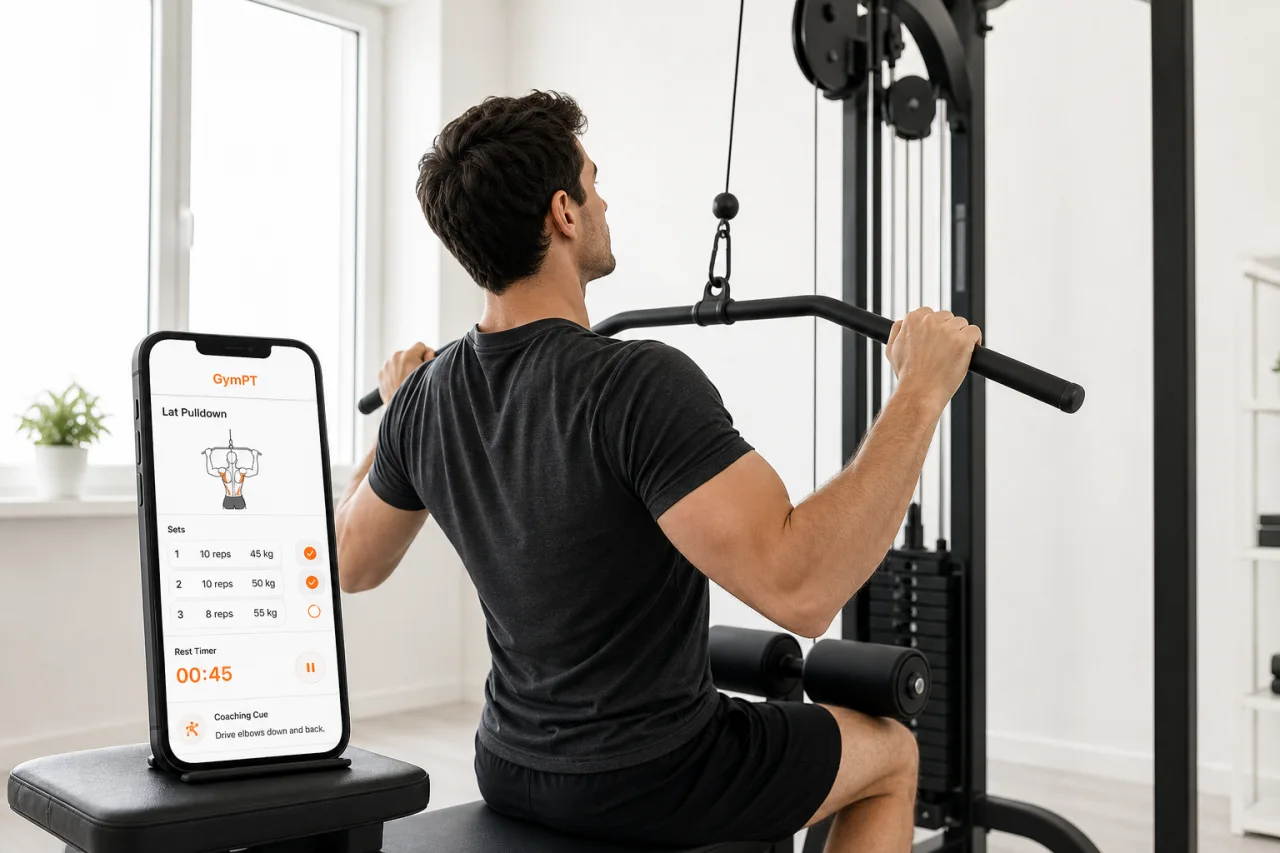
GymPT makes this easier by tracking your sessions and showing whether your back work is actually moving forward week to week.
Common Mistakes to Avoid
Most home lat pulldown plans fail for the same reasons: too much back work, not enough balance, and no progression. Avoid these mistakes:
- Training only the pulldown: your body needs push and leg work too.
- Using momentum: swinging the torso reduces control and makes progress harder to measure.
- Ignoring weekly volume: one hard set is not a plan.
- Changing exercises every session: consistency makes tracking and improvement easier.
- Skipping recovery: muscle-strengthening work is most useful when you can repeat it regularly.
How GymPT Helps You Turn One Machine Into a Real Program
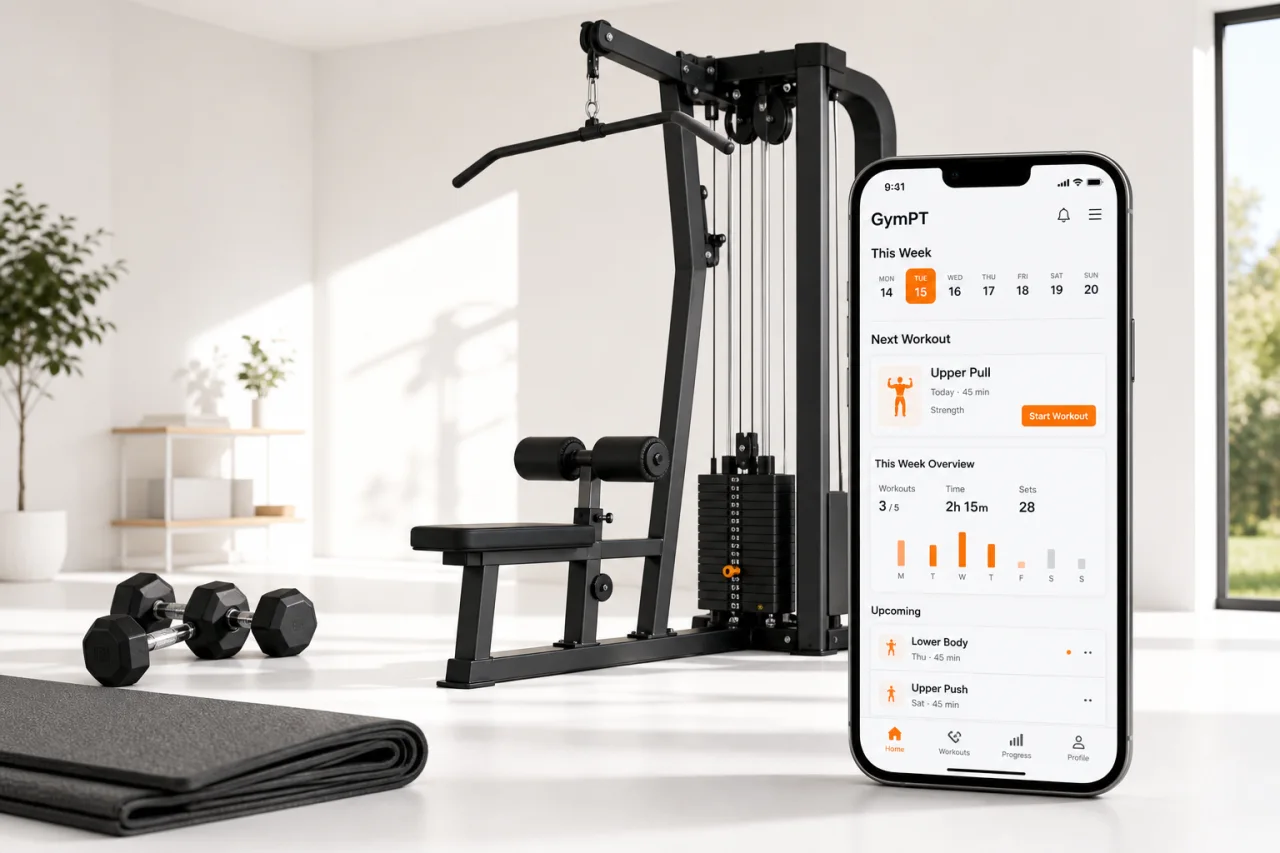
GymPT is useful when you have a specific piece of equipment and want the app to do the planning work for you. Instead of guessing which exercises to add, you can tell GymPT what you own, how many days you can train, and what your goal is. Then it can build a personalized plan, suggest substitutions, and keep your workouts aligned with your available equipment.
That matters because a good home program is not just a list of exercises. It is a system for choosing the right movements, repeating them long enough to improve, and adjusting the plan when your schedule or equipment changes.
Use GymPT to:
- build a lat pulldown-centered workout plan,
- balance pull, push, legs, and core,
- track sets, reps, and progress over time,
- and get coaching support when you are unsure what to do next.
Sample Home Workout With Lat Pulldown Machine
Here is a straightforward session you can use as a starting point:
- Lat pulldown: 3 sets of 8 to 12 reps
- Push-ups or press: 3 sets of 8 to 12 reps
- Split squats or goblet squats: 3 sets of 8 to 12 reps per side
- Romanian deadlift or hip hinge: 2 to 3 sets of 8 to 12 reps
- Plank: 2 to 3 sets of 20 to 45 seconds
If that feels too easy, add a set. If it feels too hard, reduce the load or reps and keep the movement clean. The best home workout is the one you can repeat consistently and progress over time.
Final Takeaway
A home workout with lat pulldown machine can be much more than a back day. When you build around movement patterns, train the major muscle groups regularly, and progress in a structured way, one machine can support a complete and effective home routine. GymPT helps you turn that idea into a plan you can actually follow.