AI workout planner for men
AI Workout Planner for Men: How to Build a Smarter Training Plan
An AI workout planner for men can turn broad goals into a practical, adaptable routine. Learn what to look for and how GymPT supports better training decisions.
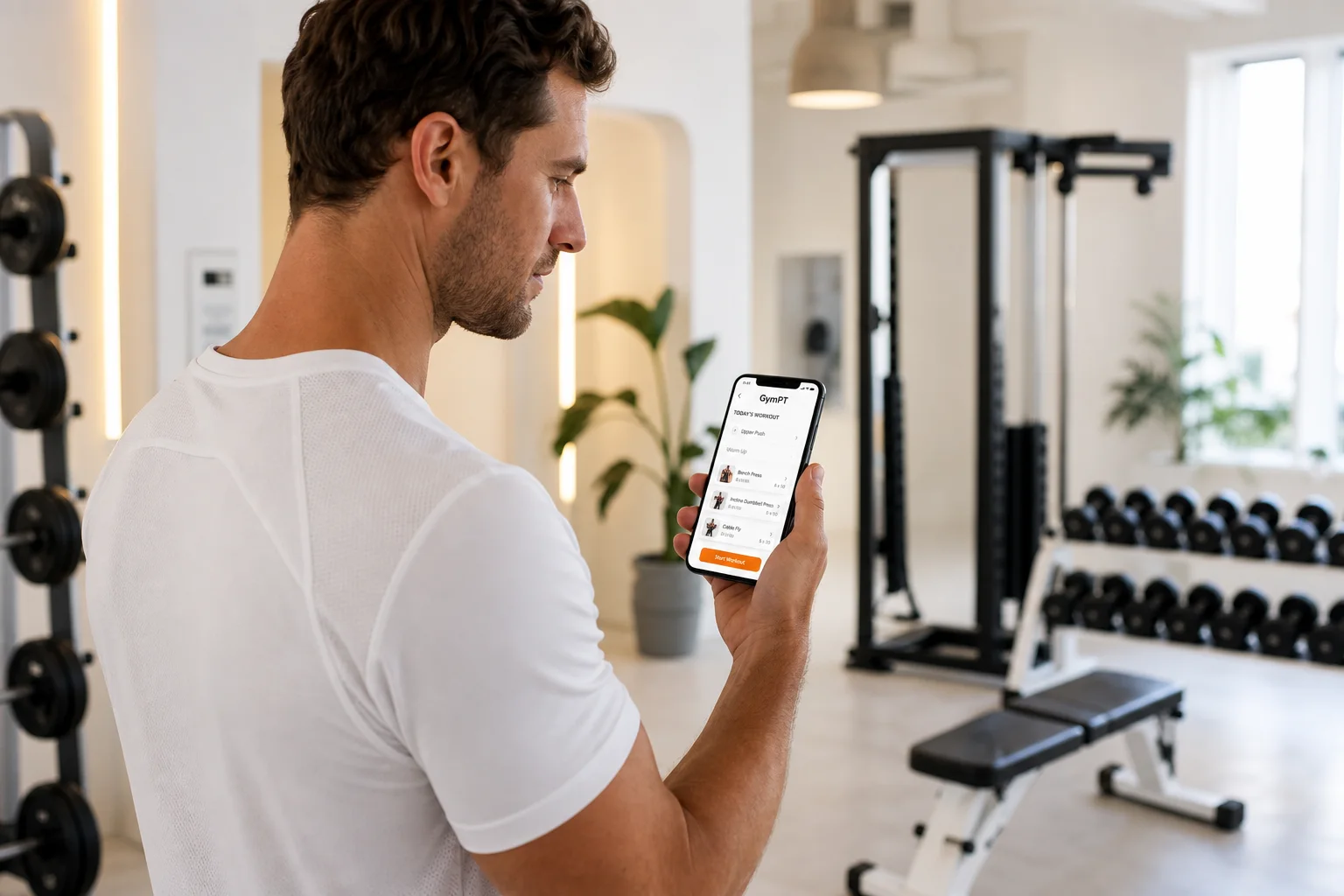
Choosing exercises is easy. Building a training plan you can follow, progress with, and adjust when life gets busy is much harder. That is where an AI workout planner for men can be useful.
The best tools do more than assemble random exercises. They consider your goal, training experience, schedule, available equipment, recovery, and performance history. Then they help you make practical decisions as your training changes.
GymPT is designed to support that process with personalized workout plans, AI coach chat, body analysis, equipment-based training, workout tracking, and progress insights. It is not a replacement for medical care or an in-person coach, but it can make everyday training more organized and responsive.
What should an AI workout planner for men actually do?
“For men” should not mean a generic routine built around heavy lifting or maximum intensity. Men have different goals, abilities, schedules, body proportions, preferences, and training histories. A useful planner should personalize the plan around the individual rather than rely on stereotypes.
At a minimum, an effective men's workout planner should help you:
- Define a clear primary goal, such as strength, muscle gain, general fitness, or fat loss support.
- Choose a realistic number of training days each week.
- Match exercises to the equipment you actually have.
- Organize warm-ups, working sets, repetitions, rest periods, and progression.
- Record completed sessions and performance changes.
- Adjust the plan when your schedule, energy, or equipment changes.
This matters because a theoretically perfect program is not useful if you cannot perform it consistently. Research on resistance training supports the value of structured training, but it also shows that several different prescriptions can produce positive results. The practical challenge is selecting a plan you can execute and continue improving.
Why personalization matters more than a “perfect” routine
Two people can have the same goal and still need different programs. One may train at a fully equipped gym four days per week. Another may have adjustable dumbbells at home and only three available sessions. A beginner may need fewer exercises and more practice, while an experienced lifter may benefit from a more specific progression model.
An AI fitness coach for men can help organize these variables before you start. Instead of searching for a routine that almost fits, you can begin with information such as:
- Your main training objective.
- Your experience level and preferred exercises.
- How many days and minutes you can train.
- Your available equipment and training location.
- Movements you want to avoid or replace.
- Your recent workout history and current performance.
Personalization also makes adherence easier. If a plan repeatedly asks you to use equipment you do not own, or schedules sessions on days you cannot train, the problem is not your motivation. The plan is poorly matched to your circumstances.
GymPT can use your inputs and workout history to create a more practical starting point, while AI coach chat gives you a way to ask follow-up questions about exercises, substitutions, training structure, and adjustments.
How AI can support smarter strength and muscle training
For many men, the main reason to use an AI workout planner is to build strength or muscle. A useful plan should account for more than exercise selection. It should also manage training volume, frequency, intensity, recovery, and progression.
1. Start with an appropriate weekly structure
A three-day full-body plan, four-day upper-lower split, or another schedule can all work. The best option depends on your availability, experience, and ability to recover. When weekly training volume is similar, frequency can often be chosen based on preference and practicality rather than a single “best” number.
An AI planner can distribute exercises across the week so that major movement patterns are trained consistently without turning every session into an exhausting marathon. If you miss a day, the plan can also help you understand what to move, combine, or skip instead of guessing.
2. Use progressive overload without forcing progress
Progressive overload means gradually increasing the challenge over time. That may involve adding weight, repetitions, sets, range of motion, or better control. It does not mean adding weight every session regardless of technique or recovery.
A practical plan might allow a repetition range. For example, you could perform three sets of an exercise within a target range and increase the load only after reaching the upper end with good form. This approach gives you a clear next step while avoiding the pressure to force a personal record when you are not ready.
3. Balance volume with recoverability
More work is not automatically better. Training volume can contribute to muscle growth, but the useful amount depends on your experience, exercise selection, sleep, nutrition, stress, and recovery capacity. A plan should be challenging enough to create a stimulus while still allowing you to complete future sessions well.
GymPT can help you review completed workouts and performance patterns. If your repetitions, loads, or consistency trend downward for several sessions, that may be a reason to reassess exercise order, weekly volume, rest, or recovery rather than simply adding more work.
What makes an AI gym routine app safer and more realistic?
AI can organize information quickly, but it should not pretend to know everything about your health or movement. A responsible app should support better decisions, not encourage reckless training.
Look for features and habits such as:
- Clear boundaries: The app should provide fitness guidance rather than diagnose pain, injuries, or medical conditions.
- Exercise alternatives: You should be able to replace a movement when equipment, comfort, or technique is a problem.
- Adjustable difficulty: The plan should not assume that every session deserves maximum effort.
- Progress tracking: You should be able to review what you actually completed instead of relying on memory.
- Context-aware coaching: Recommendations should consider your schedule, equipment, and recent training rather than only your original questionnaire.
- Human judgment: You remain responsible for stopping an exercise that causes unusual pain and seeking qualified professional advice when appropriate.
Before beginning a new program, especially if you have a known health condition, injury, or concerning symptoms, consider speaking with an appropriate healthcare professional. Fitness software cannot assess every individual situation.
How to use GymPT to build your personalized workout plan
You do not need to overcomplicate your first plan. Start with enough information for the app to make a sensible recommendation, then improve the plan through feedback.
- Choose one primary goal. Decide whether your immediate priority is strength, muscle gain, general fitness, or supporting fat loss. You can have secondary goals, but one main focus makes programming clearer.
- Set your real schedule. Select the number of days and approximate session length you can maintain during a normal week, not an ideal week.
- Add your equipment. Include barbells, dumbbells, cables, machines, bands, or bodyweight options that you can reliably access.
- Complete the sessions as written at first. Use the opening workouts to learn the structure, assess difficulty, and establish a performance baseline.
- Track every session. Record sets, repetitions, load, and completion. Small details become useful when you review progress over several weeks.
- Ask targeted coaching questions. Use AI coach chat to clarify technique cues, exercise substitutions, rest periods, or how to handle a missed workout.
- Review trends instead of single workouts. One difficult session does not prove that a plan is failing. Look for patterns in performance, consistency, recovery, and how manageable the schedule feels.
If you are new to structured training, you may also benefit from reading our guide to a workout generator for beginners. If you already train with weights, our article on a strength training program explains how to think about progression and tracking.
Common mistakes to avoid with AI-generated training
Chasing novelty instead of progression
A new exercise can feel productive, but constantly changing movements makes it harder to compare performance. Keep key exercises stable long enough to learn them and measure improvement. Use variety where it serves your goal, not simply because the app can generate endless options.
Training harder than your plan requires
Many people add extra sets, finishers, or high-intensity work because the session feels too easy. Sometimes that is appropriate, but frequent additions can undermine recovery. Complete the prescribed work, evaluate the trend, and make changes deliberately.
Ignoring equipment and time constraints
A plan that requires a cable station, squat rack, or long session every day may not survive a busy week. Be honest about your resources. For home training, our AI workout planner with dumbbells guide offers a useful way to think about equipment-based programming.
Expecting body analysis to replace measurement
Body analysis can provide useful context, but no single estimate tells the complete story. Combine it with workout performance, consistency, measurements you can repeat reliably, and how you feel during training. Progress is usually better understood as a trend than as one number.
Is an AI workout planner worth using?
An AI workout planner for men can be worthwhile if it helps you do three things consistently: follow a realistic plan, make sensible adjustments, and learn from your training data.
It should not promise instant results or remove the need for judgment. Instead, it can reduce the friction involved in planning sessions, selecting substitutions, organizing progression, and remembering what you did last time.
GymPT brings those functions together in one training workflow. You can create a plan around your goals and equipment, use AI coach chat when questions arise, track workouts as you complete them, and review progress insights over time.
For more help comparing features, read our guide to choosing an AI gym routine app. If you want a broader look at exercise selection and tracking, our article on a fitness app with an exercise library can help you evaluate what matters.
Final takeaway
The value of an AI workout planner is not that it produces the most complicated routine. Its value is helping you create a plan that fits your life, reflects your goal, uses the equipment available, and adapts as you collect better information.
Use AI for structure and feedback, use your training log for evidence, and use good judgment to keep the process sustainable. That combination gives you a more practical path toward stronger, more consistent training.