3 day dumbbell workout plan
3 Day Dumbbell Workout Plan: A Practical Full-Body Routine
This 3 day dumbbell workout plan builds full-body strength with limited equipment. Learn how to choose exercises, progress safely, and adapt each session to your goals.
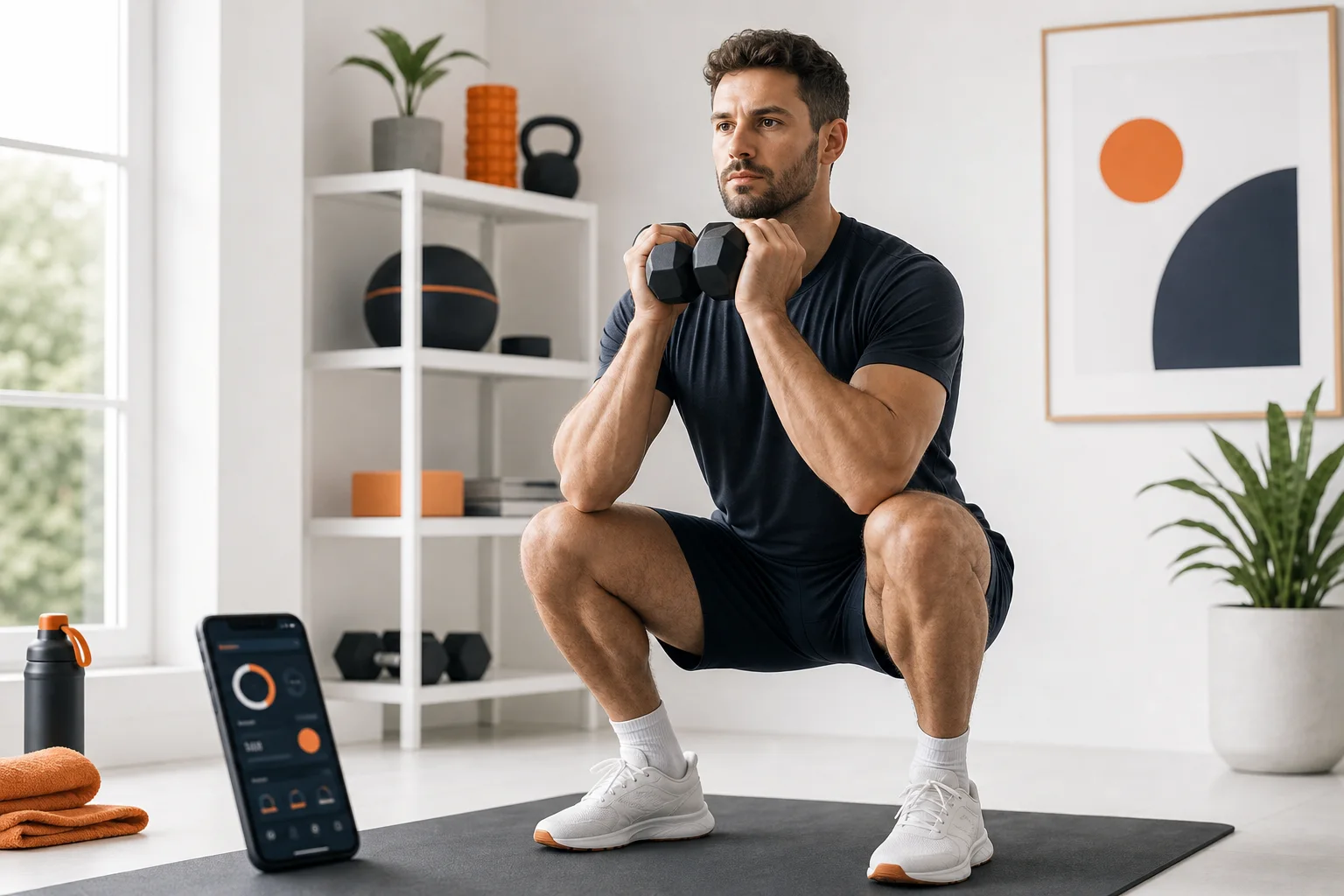
A good 3 day dumbbell workout plan does not need dozens of exercises or a fully equipped gym. With one or two pairs of dumbbells, you can train your legs, chest, back, shoulders, and arms through a balanced weekly routine.
The key is to organize your sessions around movement patterns, use exercises that match your available equipment, and track enough detail to make progress over time. This plan uses three full-body workouts, making it practical for home training, busy schedules, and anyone who prefers strength training without a complicated split.
How to structure a 3 day dumbbell workout plan
Train on non-consecutive days, such as Monday, Wednesday, and Friday. The rest days give you time to recover while allowing each major muscle group to be trained multiple times per week.
Each workout includes:
- A lower-body push: squat, split squat, or lunge pattern.
- A hip hinge: Romanian deadlift or another exercise focused on the glutes and hamstrings.
- An upper-body push: press variation for the chest, shoulders, or triceps.
- An upper-body pull: row variation for the back and biceps.
- Optional focused work: core, calves, arms, or conditioning based on your goal.
This approach is efficient because it covers the major movement patterns without requiring a separate body-part day for every muscle. It also makes it easier to stay consistent if you have only three training windows each week.
The 3 day dumbbell workout plan
Begin each session with five to eight minutes of general movement and lighter warm-up sets. For your first work set, choose a load that allows controlled technique and leaves approximately two good repetitions in reserve.
Day 1: Squat and horizontal push
- Goblet squat: 3 sets of 8–12 reps
- Dumbbell bench press: 3 sets of 8–12 reps
- One-arm dumbbell row: 3 sets of 8–12 reps per side
- Dumbbell Romanian deadlift: 3 sets of 8–12 reps
- Dumbbell lateral raise: 2 sets of 12––20 reps
- Front plank: 2–3 sets of 30–60 seconds
Use a stable bench for the dumbbell press if you have one. If not, perform a dumbbell floor press. The floor limits the range of motion slightly but still provides a useful horizontal pressing pattern.
Day 2: Hinge and vertical push
- Dumbbell Romanian deadlift: 3 sets of 8–12 reps
- Reverse lunge: 3 sets of 8–10 reps per leg
- Standing dumbbell overhead press: 3 sets of 6–10 reps
- Chest-supported dumbbell row: 3 sets of 8–12 reps
- Dumbbell curl: 2 sets of 10–15 reps
- Dead bug: 2–3 sets of 8–12 reps per side
The reverse lunge is often easier to control than a forward lunge because stepping backward can reduce the tendency to overreach. If balance is challenging, hold one dumbbell in a suitcase position or use a nearby support for stability.
Day 3: Unilateral strength and full-body volume
- Bulgarian split squat or supported split squat: 3 sets of 8–10 reps per leg
- Dumbbell floor press: 3 sets of 8–12 reps
- Supported one-arm dumbbell row: 3 sets of 10–12 reps per side
- Dumbbell hip thrust or glute bridge: 3 sets of 10–15 reps
- Dumbbell hammer curl: 2 sets of 10–15 reps
- Overhead dumbbell triceps extension: 2 sets of 10–15 reps
Single-leg exercises increase the challenge without requiring very heavy dumbbells. Start with a supported variation if you are still learning the movement or training in a small space.
How to choose the right dumbbell exercises
The best exercise is not always the most advanced option. Choose the version that lets you use a comfortable range of motion, maintain control, and progress gradually.
If you have light dumbbells
Use unilateral exercises, slower lowering phases, pauses, and higher repetitions. For example, a split squat can be demanding even with moderate dumbbells because each leg handles more of the workload. You can also add a one-second pause near the most difficult point of an exercise.
If you have heavy dumbbells
Prioritize exercises that allow a stable setup, such as goblet squats, Romanian deadlifts, dumbbell presses, and supported rows. You do not need to use the heaviest possible load on every movement. A weight that keeps your technique consistent is usually more useful than a load that forces you to compensate.
If you have only one dumbbell
Perform the routine unilaterally. Use one-arm rows, single-arm presses, suitcase squats, split squats, and single-arm Romanian deadlifts. Training one side at a time can also make it easier to identify differences in control or strength between sides.
If you have no bench
Replace the dumbbell bench press with a floor press, push-up, or squeeze press. Replace chest-supported rows with one-arm rows using your thigh or a sturdy household surface for support. GymPT can help you adapt a plan around the equipment you actually have instead of assuming access to a full gym.
Sets, reps, and rest periods
For most exercises in this plan, 8–12 repetitions is a useful starting range. It is wide enough to work with different dumbbell sizes while keeping the focus on controlled strength training. Isolation exercises such as lateral raises, curls, and triceps extensions can usually use 10–20 repetitions.
- Compound exercises: rest about 90–150 seconds between sets.
- Smaller isolation exercises: rest about 45–90 seconds.
- Core exercises: rest long enough to maintain good bracing and breathing.
You do not need to take every set to complete muscular failure. Stop when your form is likely to break down or when another repetition would require momentum. This makes the plan easier to recover from and gives you a clearer way to track performance.
Adults are generally advised to include muscle-strengthening activity on at least two days each week, so a three-day dumbbell routine can fit well within a balanced weekly activity schedule. If you are new to resistance training, begin with fewer sets and build gradually.
How to progress each week
Progressive overload does not always mean making a large jump in weight. Use a simple double-progression method:
- Start with a weight you can lift for the lower end of the listed range.
- Keep the same load until you can complete the upper end of the range for every set with controlled technique.
- Increase the dumbbell weight by the smallest practical amount.
- Return to the lower end of the range and build again.
For example, if your dumbbell press is programmed for 3 sets of 8–12 reps, you might begin with 10, 9, and 8 repetitions. Over several sessions, aim for 12, 12, and 12. Then increase the load and begin again around 8–10 repetitions.
Track the exercise, weight, repetitions, and how difficult the final set felt. This information is more useful than judging progress by soreness alone. GymPT can help organize your sessions, record completed workouts, and surface progress trends as your training develops.
How to adapt the plan to your goal
For general strength
Use the lower end of the repetition ranges on compound lifts, rest longer, and prioritize steady increases in load. Keep one or two repetitions in reserve on most sets so your technique remains consistent.
For muscle growth
Use the full repetition ranges and aim to accumulate enough challenging weekly work without letting recovery suffer. Add a set only when your current workload is manageable and your performance is stable across several sessions.
For fat loss
Keep resistance training as the foundation and add walking or other sustainable aerobic activity if appropriate. Avoid turning every dumbbell session into a breathless circuit. Strength and muscle retention still benefit from controlled repetitions and adequate rest.
For beginners
Perform two sets instead of three for the first two weeks, learn the movement patterns, and focus on repeating the routine consistently. A simple plan completed regularly is more valuable than an advanced program that is difficult to follow.
If you want to compare this routine with other training structures, explore GymPT's dumbbell workout plan built around available equipment or learn how a 3 day home workout plan can fit limited space. Beginners may also benefit from a workout generator for building a first training plan, while people focused on measurable overload can review this guide to a strength training program and progress tracking.
Common mistakes to avoid
- Changing exercises every workout: keep the main movements long enough to learn and improve them.
- Using momentum: control the lowering phase and avoid swinging weights through the hardest part.
- Ignoring unilateral work: single-arm and single-leg exercises are useful when dumbbells are limited.
- Adding volume too quickly: increase sets, reps, or weight gradually rather than changing everything at once.
- Skipping recovery: sleep, rest days, and reasonable training effort all influence how well you perform.
Make the plan fit your real training week
A three-day schedule works best when it is flexible enough to survive busy weeks. If you miss one session, continue with the next workout rather than trying to cram all three into consecutive days. You can also shorten a session by completing the first four exercises and leaving optional isolation work for later.
GymPT can personalize exercise selection based on your goal, available dumbbells, training experience, schedule, and preferred workout length. Use the plan above as a practical starting point, then adjust the exercise variations and progression targets as your equipment and performance change.
Consistency is the main advantage of a 3 day dumbbell workout plan. Train the major movement patterns, record your work, and make small improvements over time. That combination is enough to build a sustainable foundation for strength and fitness at home or in the gym.