bodyweight workout plan
Bodyweight Workout Plan: How to Build a Smarter Routine With the Equipment You Have
A bodyweight workout plan works best when it matches your space, skill level, and weekly schedule. Learn how to build one that progresses.
Bodyweight workout plan: the smart way to train with no equipment
A good bodyweight workout plan is not just a list of push-ups and squats. It is a training system built around what you can do today, what space you have, and how you will progress next week. That matters because muscle-strengthening work should be part of a weekly routine, and adults should include it on at least two days per week. The best plan is the one you can repeat, recover from, and gradually make harder.
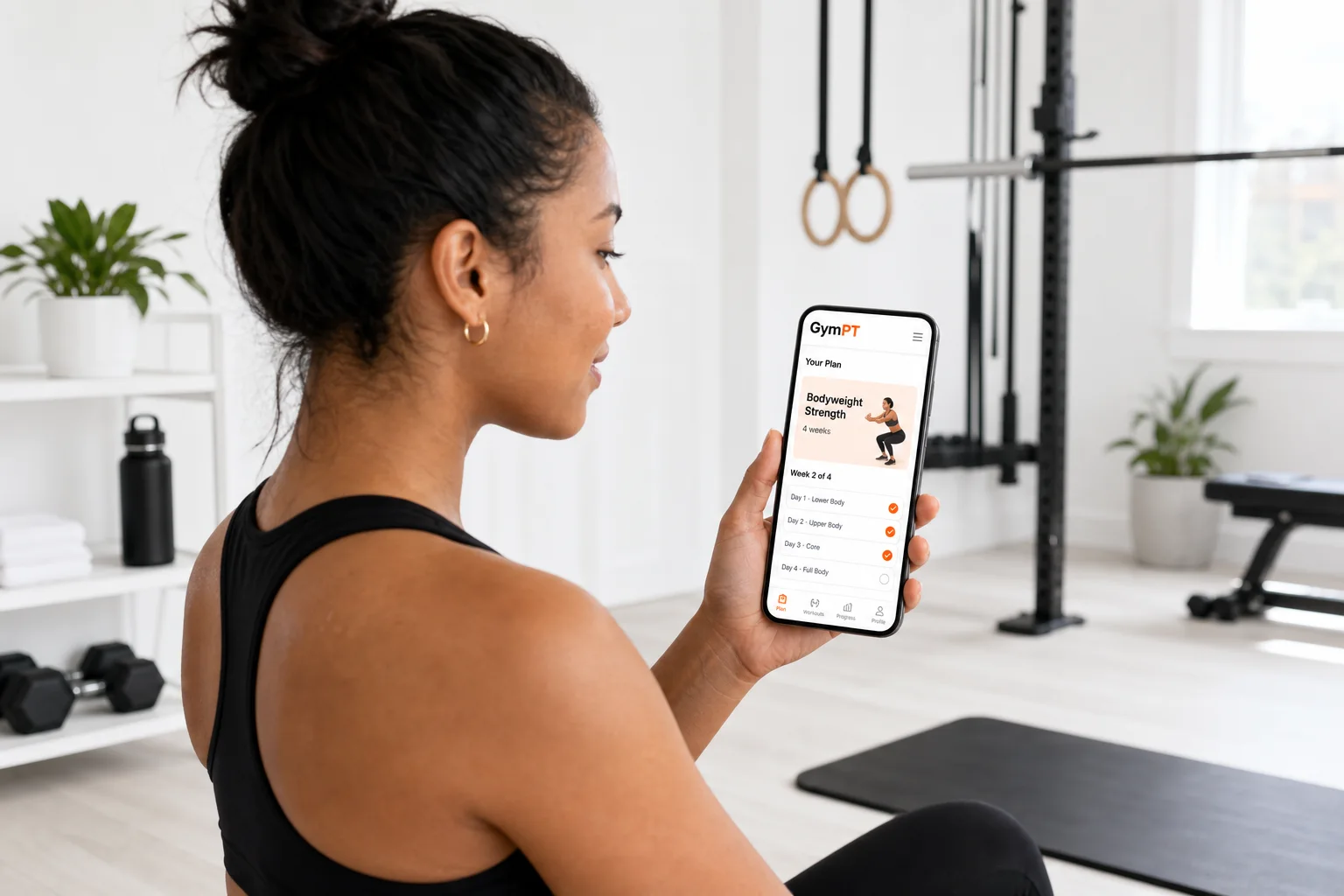
GymPT helps you do exactly that. Instead of guessing which exercises to choose, you can build a plan around your available equipment, training level, and schedule, then adjust it as your strength improves.
Start with the equipment you actually have
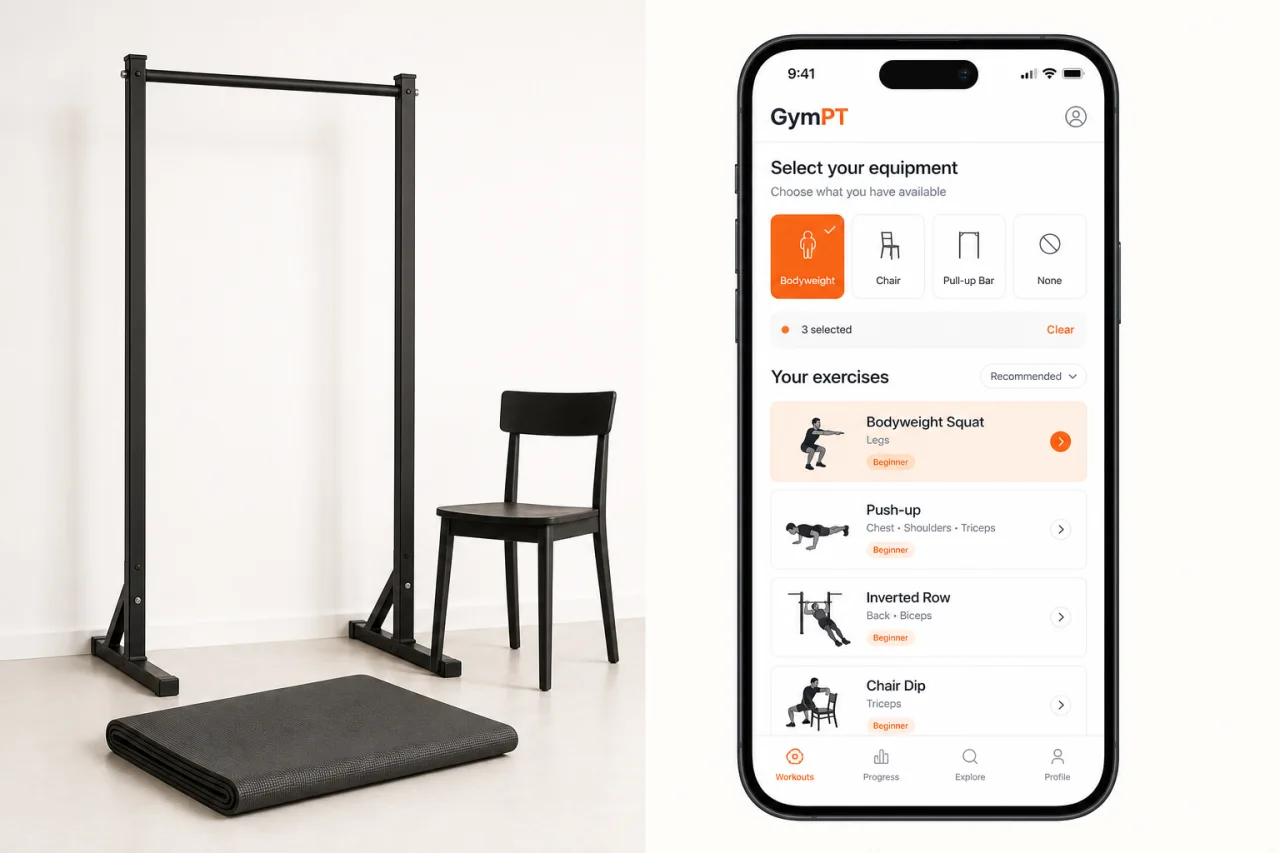
Bodyweight training is flexible, but “no equipment” does not mean “no options.” The right plan depends on what is available in your space.
- No equipment: squats, lunges, push-ups, planks, glute bridges, mountain climbers, dead bugs.
- One chair or bench: step-ups, incline push-ups, split squats, triceps dips, elevated glute bridges.
- A pull-up bar: hangs, assisted pull-ups, negatives, knee raises.
- Resistance band: band rows, band-assisted squats, banded glute bridges, Pallof presses.
The goal is not to collect exercises. The goal is to cover the main movement patterns: squat, hinge, push, pull, core, and carry or stability work. If you cannot do a true pull movement at home, use a band row or a table row variation if it is safe and stable.
Choose exercises by movement pattern, not by trend
Many people build a bodyweight workout plan around random “best exercises.” That usually leads to gaps. A better approach is to make sure every major pattern is trained.
1. Squat pattern
Use air squats, tempo squats, split squats, or step-ups. These train the legs and help build lower-body strength without needing heavy loads.
2. Hinge pattern
Use glute bridges, single-leg glute bridges, hip hinges, or sliding hamstring curls. This pattern is important for the glutes and hamstrings, which many bodyweight plans undertrain.
3. Push pattern
Use wall push-ups, incline push-ups, standard push-ups, or decline push-ups. Push variations let you scale difficulty without changing equipment.
4. Pull pattern
Use band rows, towel rows, or pull-up progressions if you have a bar. If you train at home with no pulling option, add a band as soon as possible so your plan stays balanced.
5. Core and anti-rotation
Use planks, side planks, dead bugs, hollow holds, and Pallof presses. A strong core is not just about crunches; it is about controlling movement.
How to make a bodyweight plan progressive
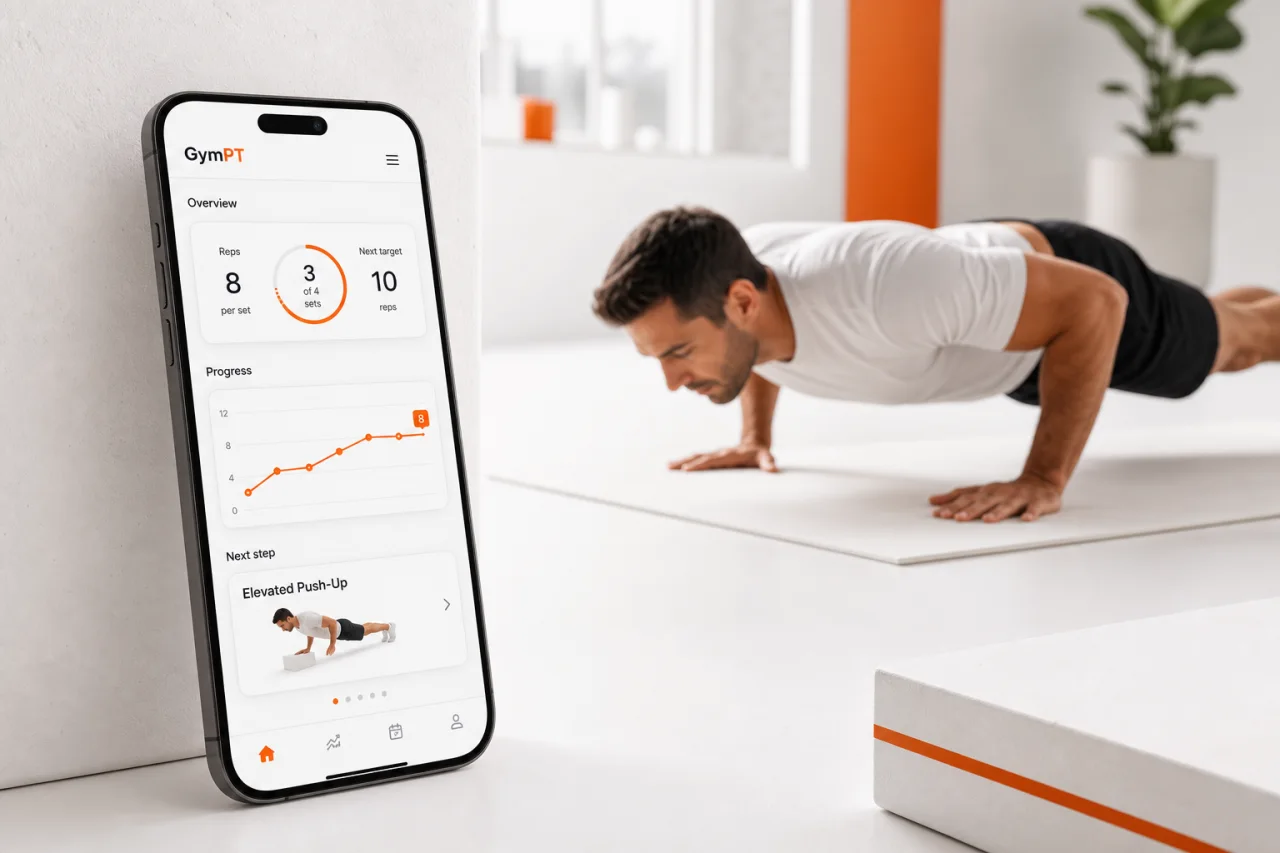
Progressive overload still matters in bodyweight training. The difference is that you progress by changing leverage, range of motion, tempo, rest, volume, or exercise variation instead of adding plates.
- Add reps: move from 8 to 12 clean reps before changing the exercise.
- Add sets: go from 2 to 3 or 4 sets when recovery is good.
- Slow the tempo: use a 3-second lowering phase.
- Increase range of motion: elevate the feet or deepen the squat if form stays solid.
- Reduce rest: shorten rest slightly for conditioning-focused sessions.
- Upgrade the variation: incline push-up to floor push-up, then decline push-up.
This is where many people stall. They repeat the same easy version for months and stop getting stronger. GymPT can track your workouts and suggest the next progression based on what you completed, not what you hoped to do.
A simple weekly bodyweight workout plan
If you want a practical starting point, use a three-day full-body structure. It is simple, recoverable, and easy to adapt.
Day 1
- Squat variation: 3 sets of 8–12
- Push-up variation: 3 sets of 6–12
- Glute bridge variation: 3 sets of 10–15
- Plank: 3 sets of 20–45 seconds
Day 2
- Split squat or step-up: 3 sets of 8–10 per side
- Band row or pull-up progression: 3 sets of 6–12
- Hip hinge variation: 3 sets of 10–15
- Side plank: 3 sets of 20–40 seconds per side
Day 3
- Squat variation with slower tempo: 3 sets of 8–10
- Push-up variation: 3 sets of 6–12
- Core drill: 3 sets of 8–12 per side
- Optional finisher: 5–10 minutes of brisk bodyweight intervals
That structure gives you enough weekly volume to improve while keeping the plan realistic. For many people, consistency beats complexity.
How hard should each set feel?
A useful rule is to finish most sets with about 1–3 reps left in the tank. That is challenging enough to stimulate progress without turning every workout into a grind. If every set feels easy, the exercise is too simple. If your form breaks down early, the exercise is too hard.
For beginners, the best bodyweight workout plan is often the one that feels almost too easy in week one and appropriately challenging by week three. That is a sign the progression is working.
Common mistakes to avoid
- Only training legs and push-ups: you still need pulling and core work.
- Chasing fatigue instead of quality: sloppy reps are not better reps.
- Using the same variation forever: bodyweight training still needs progression.
- Ignoring recovery: muscle-strengthening work should fit into the rest of your week.
- Building around exercises you cannot repeat: the best plan is sustainable.
How GymPT makes bodyweight training easier to stick with
GymPT is useful when you want a plan that adapts instead of staying static. You can tell the app what equipment you have, how many days you can train, and what level you are starting from. Then GymPT can generate a bodyweight workout plan, adjust exercise difficulty, and help you track progress over time.
That means less guessing and more training. If you miss a workout, have limited space, or want to swap an exercise, the plan can still stay on track.
Build your plan around what you can do consistently
The best bodyweight workout plan is not the hardest one. It is the one that covers all major movement patterns, progresses over time, and fits your real life. Start with the equipment you have, choose exercises by pattern, and make small upgrades when the current version gets too easy.
If you want a plan that adapts with you, GymPT can help you build it, track it, and improve it week by week.