small equipment workout plan
Small Equipment Workout Plan: How to Build a Smarter Routine Around the Gear You Have
A small equipment workout plan works best when every exercise earns its place. Learn how to choose moves, balance muscle groups, and adapt the plan with GymPT.
Small Equipment Workout Plan: Start With the Gear You Actually Have
A small equipment workout plan is not about doing less. It is about choosing the right exercises for the tools you already own, then organizing them into a plan you can repeat, progress, and track. That matters because adults are recommended to do regular physical activity and muscle-strengthening work on at least two days per week, and the best plan is the one you can follow consistently.
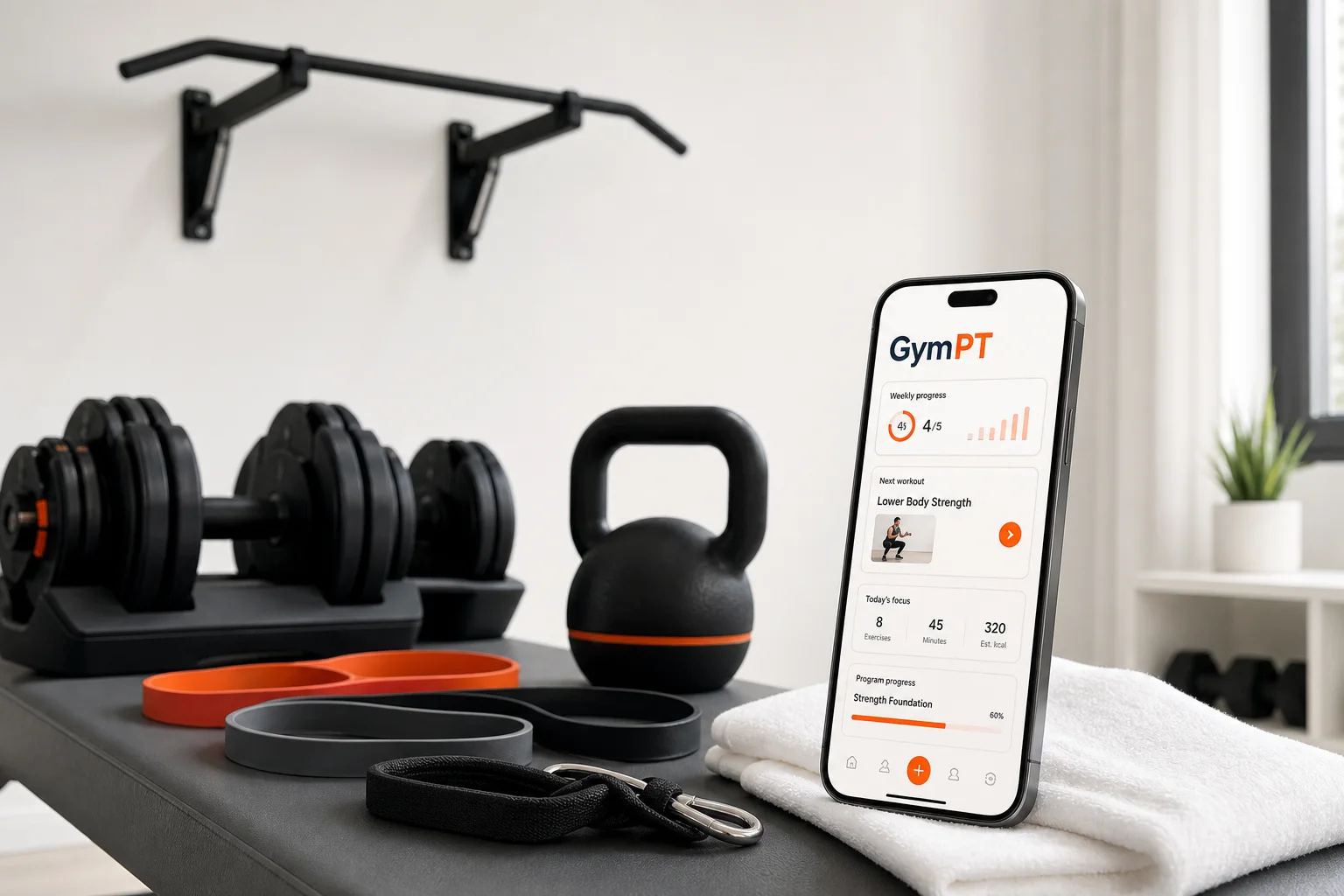
If your setup is limited to a pair of dumbbells, a resistance band, a bench, a pull-up bar, or a single cable station, you can still train your whole body well. The key is to match exercise selection to your equipment, your space, and your current training level. That is exactly where GymPT helps: it turns a short list of available tools into a personalized workout plan instead of a generic routine.
What Counts as Small Equipment?
“Small equipment” usually means compact tools that are easy to store and versatile enough to train multiple movement patterns. Common examples include:
- dumbbells or adjustable dumbbells
- resistance bands
- a bench or step
- a kettlebell
- a pull-up bar
- an ab wheel or sliders
- a cable station with one or two attachments
The advantage is flexibility. The limitation is that you cannot rely on one machine to do everything for you. So the plan has to cover the main movement patterns on purpose: squat, hinge, push, pull, lunge, carry, and core work.
How to Choose Exercises for a Small Equipment Workout Plan
The smartest exercise selection starts with movement patterns, not random favorites. If your equipment is limited, every exercise should do one of three jobs: build a major pattern, fill a gap, or make progression easier.
1. Pick one main lift for each pattern
For a balanced week, choose at least one exercise from each category:
- Squat: goblet squat, split squat, step-up
- Hinge: Romanian deadlift, kettlebell deadlift, banded good morning
- Push: dumbbell bench press, push-up, overhead press
- Pull: one-arm row, band row, pull-up or assisted pull-up
- Core: dead bug, plank, Pallof press, carry variations
This approach keeps the plan simple while still training the whole body. It also makes it easier to swap exercises when your equipment changes.
2. Use unilateral work when load is limited
If your dumbbells are too light, single-leg and single-arm exercises make the same equipment feel much harder. Split squats, one-arm rows, single-leg RDLs, and one-arm presses are especially useful in a small equipment workout plan because they increase challenge without needing heavier weights.
3. Choose exercises you can progress
A good exercise is not just effective today. It also gives you a clear way to improve next week. Progress can come from more reps, more sets, slower tempo, better range of motion, shorter rest, or a harder variation. GymPT can track those changes and suggest the next step automatically.
How to Structure the Week
Most people do well with two to four strength sessions per week. Frequency should match the number of exercises, the muscle groups trained per session, and your overall recovery. In practice, that means a small equipment workout plan can be full-body, upper/lower, or push-pull-legs depending on your schedule and recovery.
Option 1: Two-day full-body plan
This is the simplest setup if you are busy or just starting out.
- Day 1: squat, push, pull, core
- Day 2: hinge, lunge, push, pull, carry
Two full-body sessions work well when equipment is limited because each workout covers more ground. You do not need a large exercise menu to make progress.
Option 2: Three-day rotation
If you train three times per week, rotate emphasis while still touching the whole body:
- Day 1: lower-body emphasis
- Day 2: upper-body emphasis
- Day 3: full-body emphasis
This gives you more variety without making the plan complicated.
Option 3: Four-day upper/lower split
If you have more recovery capacity, an upper/lower split lets you add volume without turning each session into a marathon. That can be useful when your equipment is limited but you still want enough weekly work for strength and muscle growth.
A Simple Small Equipment Workout Plan Template
Use this as a starting point and adjust it to your gear.
Workout A
- Goblet squat — 3 sets of 8 to 12 reps
- Dumbbell bench press — 3 sets of 8 to 12 reps
- One-arm dumbbell row — 3 sets of 10 to 12 reps per side
- Romanian deadlift — 3 sets of 8 to 10 reps
- Plank — 3 sets of 30 to 45 seconds
Workout B
- Split squat — 3 sets of 8 to 10 reps per side
- Overhead press — 3 sets of 8 to 12 reps
- Band row or pull-up variation — 3 sets of 8 to 12 reps
- Hip hinge variation — 3 sets of 10 to 12 reps
- Pallof press — 3 sets of 10 to 12 reps per side
Keep rest periods long enough to maintain good form. For most compound lifts, 60 to 120 seconds is a practical starting point. If the set is hard and technique starts to slip, rest longer.
How to Progress When the Equipment Is Limited
Progression is where many small-equipment plans fail. People repeat the same weights and the same reps for weeks, then wonder why results stall. A better approach is to use a simple progression rule.
- Step 1: pick a rep range, such as 8 to 12
- Step 2: stay with the same exercise until you can hit the top of the range for all sets
- Step 3: increase load, slow the tempo, or move to a harder variation
If your weights are fixed, progression can still happen through tempo, pauses, range of motion, and unilateral work. That is one reason equipment-based training is so effective: it forces you to get more precise with execution.
How GymPT Makes the Plan Smarter
GymPT helps you turn a basic small equipment workout plan into something that adapts to real life. You can tell it what equipment you have, how many days you can train, and which movements you want to improve. Then it can build a plan around those constraints instead of forcing a one-size-fits-all routine.
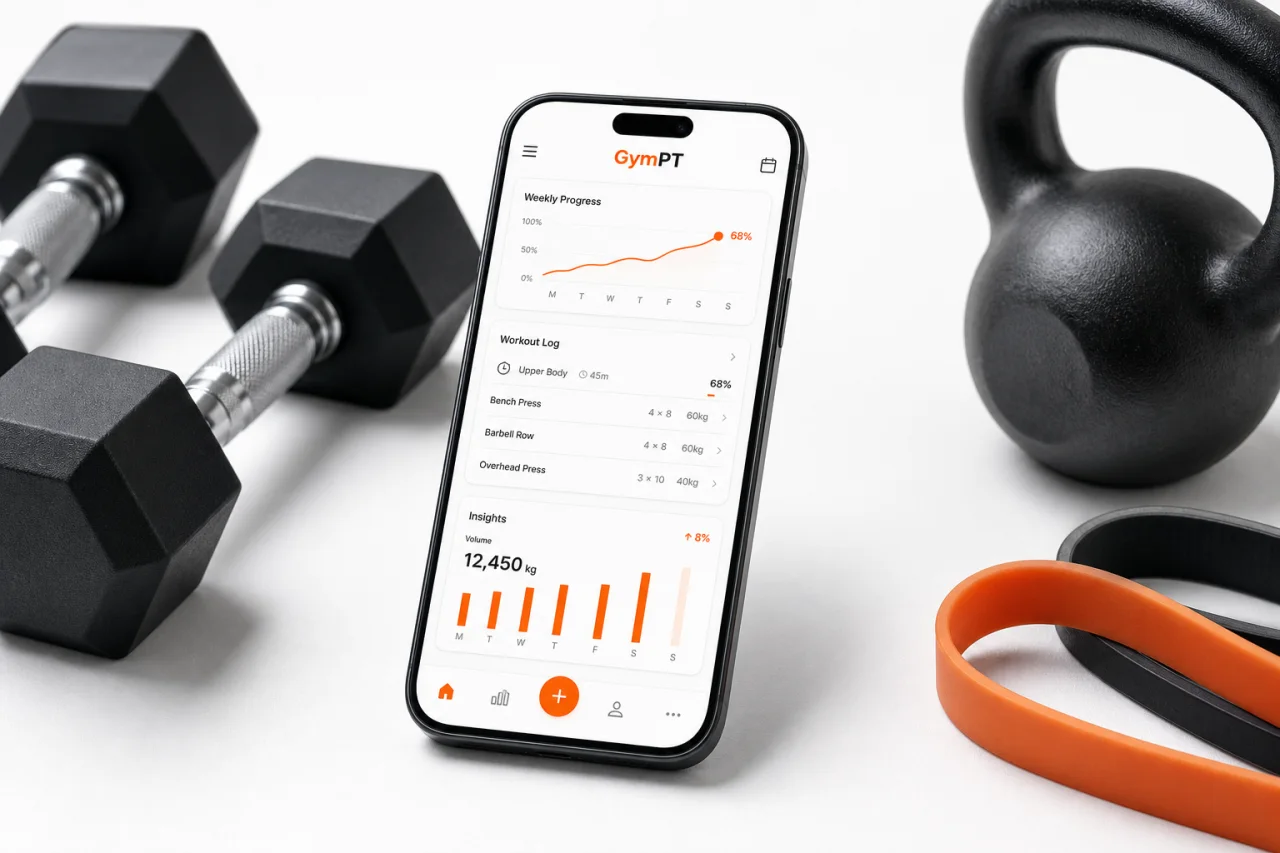
GymPT also supports workout tracking and progress insights, which matter because the best plan is the one you can review and improve. If one exercise is too easy, too hard, or awkward for your setup, you can update the plan instead of guessing.
Use GymPT when you need to:
- swap exercises based on available equipment
- balance upper and lower body work
- adjust volume when recovery is low
- track whether your reps, sets, or load are improving
- keep a plan consistent across home, hotel, or gym settings
Common Mistakes to Avoid
- Using too many exercises: a small setup works best when the plan is focused.
- Ignoring pulling work: rows and pull variations matter just as much as presses.
- Skipping progression: repeating the same workout forever leads to stagnation.
- Choosing exercises you cannot load or control: good form matters more than novelty.
- Making the plan too advanced too soon: start with movements you can repeat cleanly.
Bottom Line
A small equipment workout plan works when you build it around movement patterns, not random exercises. Start with the gear you have, choose movements you can progress, and keep the weekly structure simple enough to repeat. With GymPT, you can adapt the plan as your equipment, schedule, and strength change, which makes consistency much easier to maintain.
If you want a plan that fits your exact setup, GymPT can build one in minutes and keep adjusting it as you train.
Related GymPT Guides
For more equipment-based training ideas, explore bodyweight workout plan, home workout with dumbbell, full body workout with dumbbell, and full body workout with lat pulldown machine.