resistance band only workout
Resistance Band Only Workout: How to Build a Smarter Plan With One Tool
A resistance band only workout can build strength, muscle, and consistency if you choose the right movements, train close enough to effort, and progress with a plan. Here’s how to make one band work for your goals with GymPT.
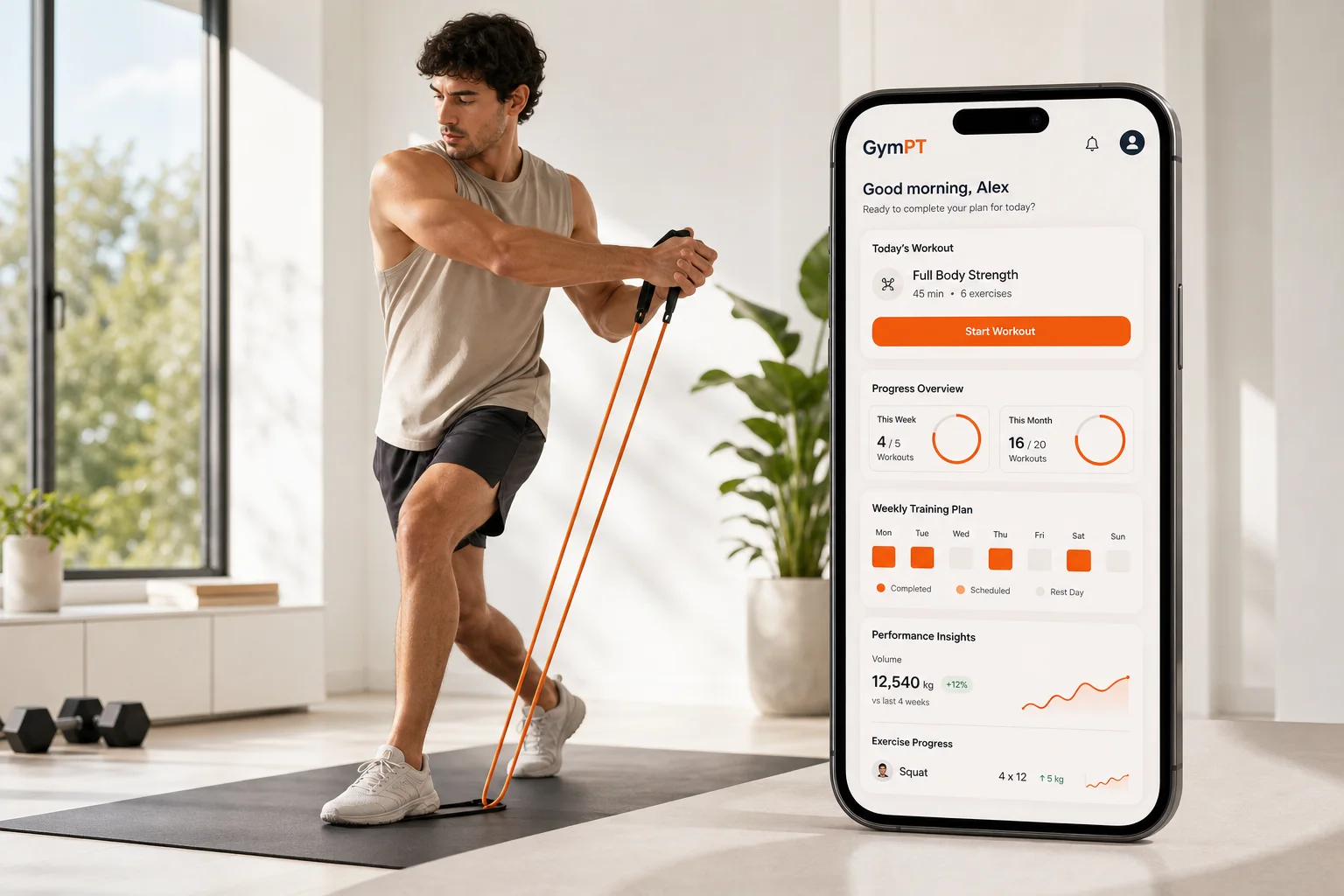
Resistance band only workout: what actually makes it effective
A resistance band only workout can be a complete training session, not a fallback. Bands are useful because they let you train the whole body, change angles quickly, and scale difficulty without needing a full gym. The key is not trying to copy a barbell session rep for rep. The key is choosing movements that match the equipment you have and then progressing them on purpose.
For most adults, the big picture is simple: regular muscle-strengthening work matters, and major muscle groups should be trained at least two days per week. That makes a band-only setup a practical option for home training, travel, or small spaces.
How to choose the right band exercises
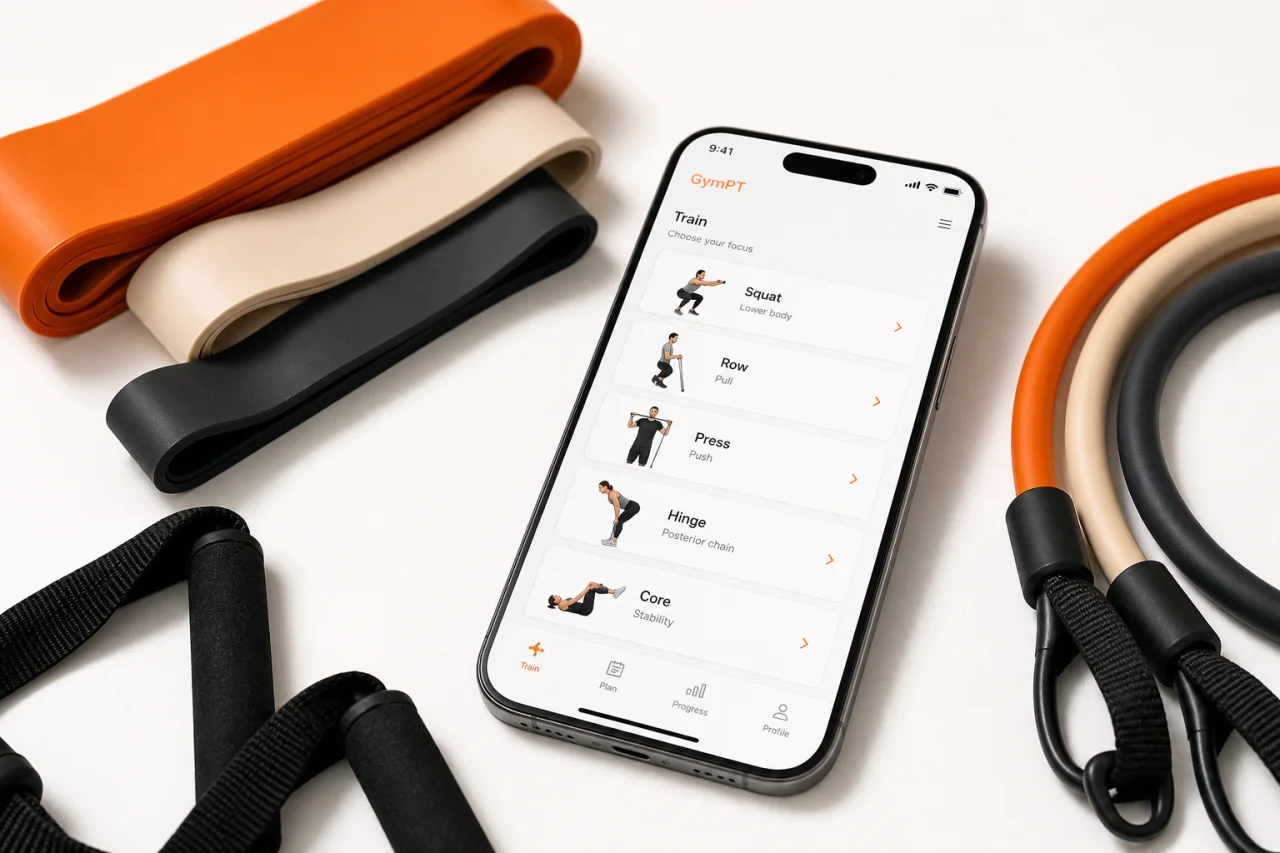
When you only have bands, build your workout around movement patterns instead of random exercises. That keeps the plan balanced and easier to progress.
- Squat pattern: banded squat, split squat, or squat to press.
- Hinge pattern: banded Romanian deadlift, good morning, or pull-through.
- Push pattern: band chest press, overhead press, or push-up with band resistance.
- Pull pattern: band row, lat pulldown variation, or face pull.
- Core pattern: Pallof press, dead bug with band tension, or anti-rotation hold.
This approach helps you cover the whole body even if your equipment is limited. It also makes it easier to swap exercises when your anchor point, band strength, or space changes.
What to prioritize if you only have one band
If you truly have one band, prioritize exercises that give you the most training value per rep. Rows, presses, squats, hinges, and split squats usually beat isolation work because they train more muscle at once. If your band is light, slow the tempo, add pauses, or use unilateral variations to make the set harder.
How hard should a band-only workout feel?
Band training works best when sets are challenging enough to create a real stimulus. You do not need to chase failure every set, but you should finish most working sets with only a few good reps left in the tank. That is especially important with bands because resistance increases as the band stretches, so the hardest part of the set often happens near the end.
A practical target is 2 to 4 sets per exercise, with 8 to 20 reps depending on the movement and band tension. Use slower reps, longer pauses, or shorter rest periods when the band is too easy. Use a stronger band or a longer stretch when the band is too light. Strength training variables such as exercise choice, volume, rest intervals, and frequency can all be adjusted to fit the goal.
A simple full-body resistance band only workout
Here is a straightforward template you can use as a starting point. It is designed for general strength, muscle tone, and consistency.
- Band squat — 3 sets of 10 to 15 reps
- Band row — 3 sets of 10 to 15 reps
- Band chest press — 3 sets of 8 to 15 reps
- Band Romanian deadlift — 3 sets of 10 to 15 reps
- Band overhead press — 2 to 3 sets of 8 to 12 reps
- Pallof press — 2 to 3 sets of 10 to 12 reps per side
Rest about 45 to 90 seconds between sets. If you want a more conditioning-focused session, keep the rest shorter. If you want more strength focus, rest a little longer and use a heavier band or harder variation.
How to make this plan harder over time
- Add reps until you reach the top of your target range.
- Use a stronger band or step farther from the anchor.
- Slow the lowering phase to 3 seconds.
- Add a 1-second pause at the hardest point.
- Move from bilateral to unilateral versions.
That is progression. You do not need a new workout every week; you need a better reason for the same workout to become harder.
Common mistakes in band-only training
Band workouts fail when people treat them like warm-ups instead of real training. The most common mistakes are easy to fix:
- Using only light tension: if every set feels easy, the workout is too easy.
- Skipping pulling work: rows and face pulls help balance pressing volume.
- Doing too many random exercises: stick to a few repeatable patterns.
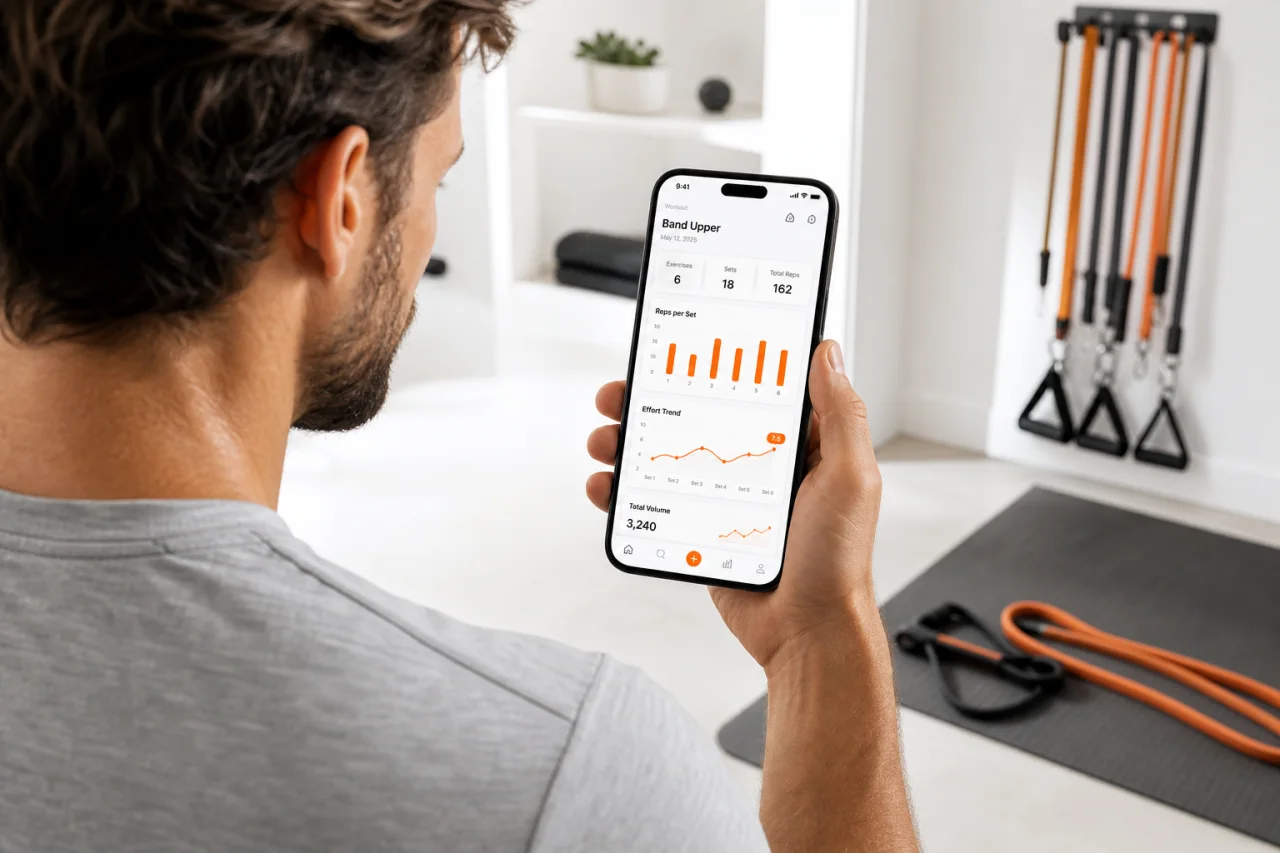
- Never tracking progress: if you do not log reps, band level, and effort, you cannot tell if you are improving.
- Ignoring setup: a secure anchor point matters for safety and consistency.
WHO guidance also supports doing muscle-strengthening work on at least two days per week, which makes a repeatable band plan a smart long-term habit rather than a temporary fix.
How GymPT helps you adapt a band-only plan
GymPT makes a resistance band only workout easier to stick with because it can build the plan around your actual equipment. If you only have loop bands, tube bands, or one anchor point, GymPT can adjust exercise selection, volume, and progression so your workout still makes sense.
Use GymPT when you want to:
- build a full-body plan from limited equipment,
- swap exercises when your setup changes,
- track workout volume and effort over time,
- see progress insights without guessing,
- get coach-style feedback through AI chat.
That matters because the best plan is not the fanciest one. It is the one you can repeat, progress, and recover from.
Quick checklist before your next band workout
- Do I have one squat, one hinge, one push, one pull, and one core move?
- Are my working sets challenging enough?
- Did I choose a rep range I can repeat next week?
- Did I log the band, reps, and effort?
- Can I make one small progression next session?
If the answer is yes, your band-only session is doing real work. If not, simplify the plan and make the next workout easier to repeat.
Bottom line: a resistance band only workout can absolutely build strength and muscle when the plan is balanced, progressive, and tracked. Start with the movements you can do well, then let GymPT help you turn that setup into a smarter routine.